Welcome to Taxo Tape
Why Surface Wetting Matters in Phase-Change Material Performance
Introduction
Phase-change materials (PCMs) are widely used in electronics cooling to reduce thermal resistance between heat-generating components and heat spreaders. When heated, a PCM softens or melts slightly, allowing it to flow and fill microscopic gaps that would otherwise trap air and impede heat transfer.
One factor that strongly influences how well a PCM performs—but is often unnoticed—is surface wetting. Wetting describes how effectively a PCM can make intimate contact with a surface once it begins to soften. Even a high-conductivity material will underperform if its wetting behavior is poor.
What Is Surface Wetting in TIM Applications?
In thermal interface material (TIM) applications, surface wetting refers to a PCM’s ability to spread across a surface and form close, uniform contact. Effective wetting depends on the relationship between the PCM’s surface energy, its viscosity when softened, and the roughness of the surfaces it must adhere to.
When wetting is good, the PCM flows into surface asperities, displaces trapped air, and forms a continuous conductive path. Poor wetting, on the other hand, leaves voids or unfilled regions that behave as thermal insulators. Put simply:
Good wetting → smooth coverage, minimal air pockets, stable interface
Poor wetting → patchy coverage, trapped air, increased thermal resistance
How Surface Wetting Affects Thermal Performance
Surface wetting directly influences the thermal contact resistance (TCR) of a PCM interface. If the PCM does not spread adequately, TCR increases because air gaps remain between the two surfaces. These micro-voids significantly reduce the heat flow, even if the material itself has high intrinsic thermal conductivity.
During a PCM’s phase-change cycle—when it transitions from solid to semi-fluid—the wetting behavior becomes especially important. The material must soften enough to flow, fill the gaps, and maintain intimate contact as the temperature fluctuates. If wetting is insufficient, the PCM will not establish a stable thermal bridge, leading to performance decay over time.
Materials and Formulation Factors Influencing Wetting
The wetting performance of a PCM is closely tied to its formulation and the characteristics of the surfaces it contacts. Key factors include:
Polymer matrix and filler selection: The base polymer and the type, size, and loading of fillers determine flow behavior and how easily the material conforms to surface irregularities.
Softening temperature and melt-flow behavior: A PCM that softens at an appropriate temperature will spread more effectively under operating conditions without excessive pump-out.
Surface-affinity additives: Certain additives can lower surface tension or increase adhesion, improving the PCM’s ability to wet metals or ceramics.
Surface characteristics of mating parts: Materials such as aluminum, copper, and ceramic have different surface energies and roughness levels, which influence how well a PCM can spread when heated.
Surface Wetting Behavior in Real Applications
In real hardware environments, wetting influences not only initial thermal performance but also how a PCM behaves throughout its service life. In LED modules, insufficient wetting prevents the PCM from filling the gaps between the substrate and the heat sink, leading to rising junction temperatures. In EV battery packs, poor wetting can leave voids that concentrate heat and accelerate cell aging. Inverter modules with large, uneven surfaces often experience hotspots when the PCM cannot reach all micro-cavities. Telecom and 5G equipment, which run under continuous high load, are especially sensitive to wetting quality because even small voids increase temperature rise during peak power events.
Engineers commonly encounter issues such as incomplete spread, trapped air pockets, material shrinkage after repeated thermal cycles, and degraded contact over time. If wetting is inadequate, these voids expand with cycling and undermine long-term reliability, resulting in higher TCR and unstable thermal performance.
How to Evaluate Wetting in PCM Selection
Assessing wetting begins with a few practical tests. Spreading tests show how well a PCM flows when heated under pressure. Contact-angle measurements help compare how readily different formulations interact with a surface. Rheology tests provide insight into viscosity changes during softening, which directly affects flow and coverage.
During evaluation, engineers can perform simple checks: verify uniform surface coverage after heating, look for signs of voids or unfilled areas, and test whether the material maintains good contact after several heating cycles. In engineering terms, “good wetting” means continuous coverage, minimal trapped air, stable material position, and consistent thermal resistance across repeated cycles.
How Manufacturers Improve Wetting Performance
Wetting behavior can be significantly improved through formulation engineering. Adjusting the polymer matrix and optimizing filler particle size helps the PCM flow more easily into surface irregularities. Controlling viscosity and melt-flow properties ensures the material softens predictably at the right temperature without excessive movement during operation.
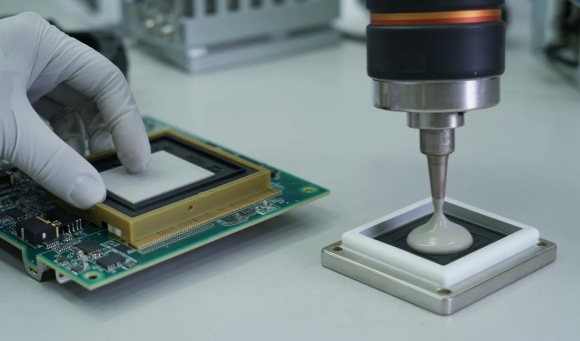
Many suppliers also offer pre-applied PCM formats—such as unsupported films or PCMs coated on thin carriers—to guarantee even coverage during assembly. These formats reduce the risk of poor wetting caused by uneven manual application.
Conclusion
Surface wetting plays a central role in how effectively a phase-change material transfers heat. Even materials with high thermal conductivity can underperform if they fail to create close, uniform contact with the mating surfaces. Evaluating wetting behavior early—during sample screening or prototype build—helps engineers avoid reliability issues and achieve stable long-term thermal performance.