Welcome to Taxo Tape
How to Choose Thermal Interface Materials for UPS Systems
Opening
Industrial UPS systems don't fail randomly. In many documented field cases, thermal stress—not electrical design—is what shortens the lifespan of power conversion components. Yet thermal interface material selection often gets treated as an afterthought, decided late in the design cycle when the heatsink geometry is already fixed and the BOM is nearly locked.
This guide is written for engineers and procurement managers who need to make defensible TIM decisions: not just "which pad has the highest thermal conductivity," but which material actually fits the assembly process, the operating environment, and the long-term reliability requirements of an industrial UPS.
The Thermal Challenge Inside a UPS
A modern industrial UPS—whether it's a 10 kVA online double-conversion unit or a 200 kVA three-phase system—is essentially a high-density power conversion platform running continuously, often in environments that are far less controlled than a data center.
Where the heat comes from
The dominant heat sources are well understood: IGBTs and MOSFETs in the inverter and rectifier stages, rectifier diodes, boost inductors under high ripple current, and DC link capacitors operating near their voltage rating. In a typical online UPS, the inverter stage alone can account for 60–70% of total thermal losses. IGBT modules in the 1200V/100A class, for example, may dissipate 150–300W per module under full load—concentrated in a package footprint of roughly 60 × 100mm.
Why UPS thermal environments are demanding
Three factors make UPS thermal management genuinely harder than many other power electronics applications:
Continuous duty cycle. Unlike a motor drive that runs intermittently, an online UPS is always processing power. There's no natural cool-down period. TIMs that perform acceptably in cyclic applications may degrade faster under constant thermal load.
Ambient variability. Industrial UPS units are deployed in telecom shelters, factory floors, outdoor enclosures, and basement equipment rooms. Ambient temperatures can range from –25°C in winter startups to 50°C+ in poorly ventilated enclosures. A TIM selected based on 25°C lab data may behave very differently at the actual operating point.
Vibration and mechanical stress. In UPS installations near rotating machinery—generators, compressors, or HVAC equipment—low-frequency vibration is a real concern. Over time, this can cause pad deformation, grease pump-out, or delamination at the TIM interface, any of which increases junction-to-heatsink thermal resistance and accelerates component aging.
The thermal resistance chain
The practical target for most UPS designers is to keep the IGBT junction temperature (Tj) below the manufacturer's derated limit—typically 125°C for silicon IGBTs, though 150°C is achievable with modern chipsets. The TIM sits in a resistance chain: Rth(j-c) is fixed by the component, Rth(c-h) is where TIM selection matters, and Rth(h-a) is determined by heatsink design and airflow. Improving Rth(c-h) by even 0.05°C/W can translate to a meaningful reduction in Tj at high ambient conditions.
TIM Categories and What They're Actually Good For
There's no universal best TIM for UPS applications. The right choice depends on the specific sub-assembly, the assembly process, and the reliability requirements. Here's an honest look at each major category.
Thermal Pads
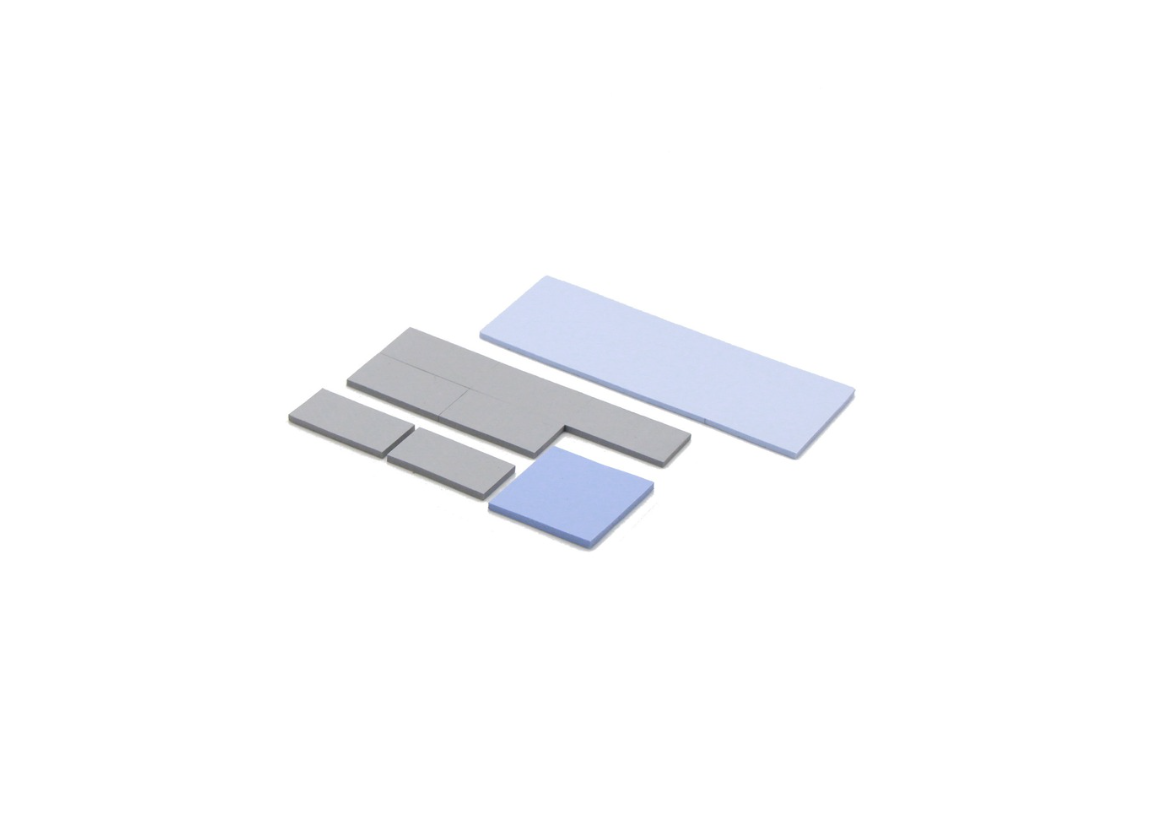
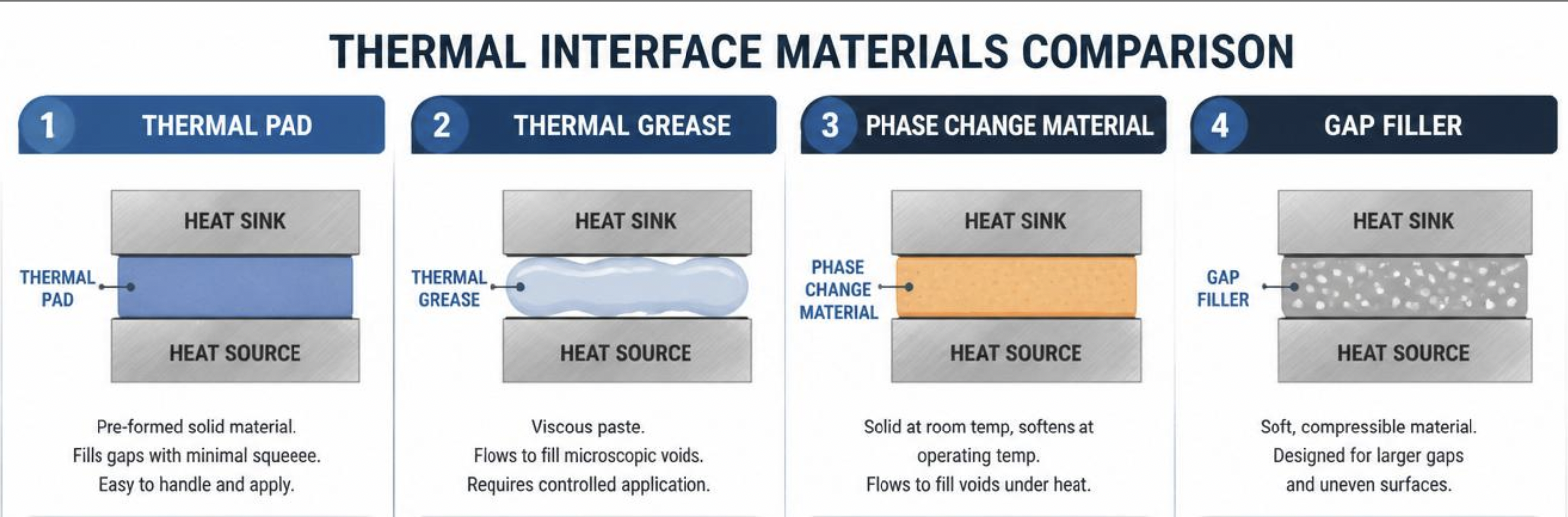
Thermal pads are the default choice for most board-level and module-level interfaces, and for good reason: they're clean, consistent, and reworkable. A technician can replace a pad during field service without special equipment or process controls.
Typical thermal conductivity ranges from 1.5 W/m·K for basic silicone-filled pads up to 12–15 W/m·K for high-performance boron nitride (BN) filled versions. The tradeoff is that pads maintain a measurable bond line thickness (BLT)—usually 0.2–1.0mm depending on compression—which adds thermal resistance compared to a well-applied grease at the same conductivity.
Pads are the right call when: assembly repeatability matters, the interface may need rework, or when component heights vary across a PCB and a conformable material is needed.
Thermal Grease / Paste
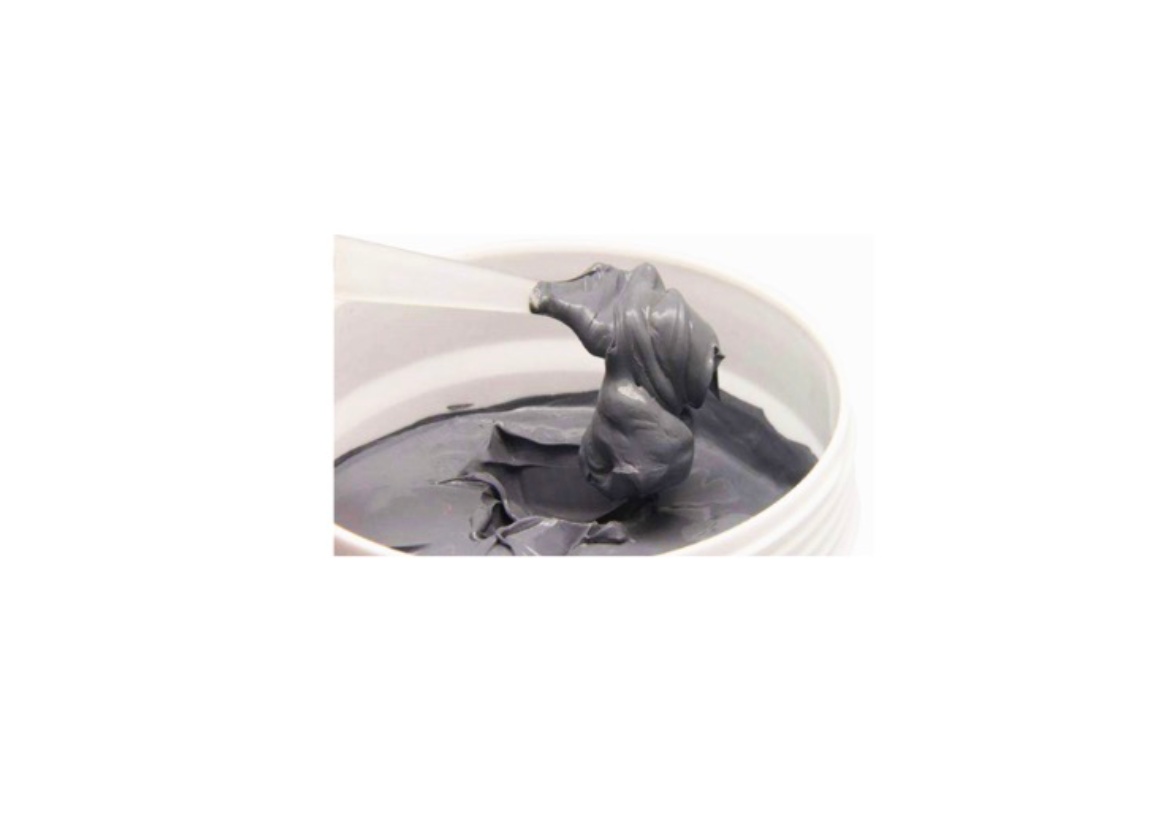
Thermal grease delivers the lowest contact resistance of any non-bonding TIM when applied correctly. With BLT values under 0.1mm achievable under adequate clamping pressure, and thermal conductivity typically in the 3–8 W/m·K range, grease is the preferred choice for high-flux interfaces like IGBT modules mounted directly to heatsinks.
The honest tradeoffs: grease is messy, application consistency is operator-dependent, and it doesn't handle rework gracefully. More critically for long-term UPS reliability, silicone-based greases are susceptible to pump-out under thermal cycling—the grease migrates away from the interface under repeated expansion and contraction, gradually increasing thermal resistance. This is a known failure mode in power electronics that should be factored into any maintenance schedule.
Phase Change Materials (PCM)
PCMs occupy a useful middle ground. At room temperature they handle like a solid pad, making assembly clean and repeatable. Once the system heats up and the material crosses its phase transition temperature—typically 45–55°C for most commercial PCMs—it softens and flows to conform to surface irregularities, approaching the contact quality of a grease.
Thermal conductivity of PCMs is generally moderate (3–7 W/m·K), but the self-conforming behavior under operating conditions often makes them more effective than their room-temperature specs suggest. They're particularly well-suited for IGBT module interfaces where clamping pressure may vary across the package footprint, or for applications where automated assembly needs to handle materials like solids but thermal performance needs to approach that of a grease.
Gap Fillers (1K / 2K)
Gap fillers are soft, highly conformable materials designed to bridge significant height variations—typically 0.5mm to 5mm—between components and a common heatsink or chassis wall. In a UPS context, they're most relevant for transformer hot spots, inductor surfaces, and groups of mixed-height components on a control board.
Thermal conductivity typically ranges from 1.5–6 W/m·K. Two-component (2K) gap fillers are dispensed in liquid form and cure in place, which offers advantages for complex geometries but introduces process control requirements. One-component (1K) versions are pre-formed sheets or dispensable materials that don't require curing.
One important note: gap fillers are generally softer and more compressible than standard thermal pads, which means they can conform well under low clamping pressure—but they're not designed for high-pressure, thin-BLT applications like direct IGBT module mounting.
A brief note on graphite sheets and potting compounds: graphite sheets have exceptional in-plane conductivity (700–1500 W/m·K) but poor through-plane conductivity (~5–10 W/m·K), making them useful for heat spreading within a PCB layer or enclosure wall, not as a primary TIM. Potting compounds are relevant for specific UPS sub-assemblies—particularly transformer and inductor encapsulation—where both thermal management and environmental protection are needed simultaneously.
Key Parameters to Compare—and What They Actually Mean
TIM datasheets can be misleading if you're reading the numbers without understanding what they represent in a real assembly.
Thermal conductivity (λ)
This is the number most prominently featured in product listings, measured in W/m·K. It describes the material's intrinsic ability to conduct heat. But here's what datasheets rarely tell you: thermal conductivity alone doesn't determine thermal performance in a real joint.
A 10 W/m·K pad applied at 1.0mm BLT may underperform a 5 W/m·K grease applied at 0.05mm BLT, because the resistance contribution of a thicker bond line can outweigh the conductivity advantage. Always evaluate λ in the context of the expected BLT for your application.
Thermal impedance / resistance
This is the more actionable number. Thermal impedance (expressed as °C·in²/W or °C·cm²/W) accounts for both conductivity and thickness, and thermal resistance (°C/W) accounts for actual contact area as well. When comparing TIMs for a specific interface, this is the figure that maps directly onto your system thermal budget.
For reference, a well-applied thermal grease at a typical IGBT module interface might achieve Rth(c-h) in the range of 0.03–0.08°C/W for a 60 × 100mm module. A mid-range thermal pad on the same interface might land at 0.08–0.15°C/W depending on BLT and conductivity.
Hardness and compression
Pad hardness (typically measured on the Shore 00 scale) determines how much the material conforms to surface roughness and how much clamping force is needed to reach the rated BLT. Softer pads (Shore 00 20–40) conform more readily under low clamping pressure, which matters for fragile components or PCB flex concerns. Harder pads (Shore 00 60–80) hold their shape better during handling but may leave air pockets at rough or uneven surfaces.
Dielectric strength
Often overlooked, but relevant in UPS designs where the TIM sits between a switching device and a grounded heatsink with a creepage/clearance requirement. Dielectric strength (typically expressed in kV/mm) and volume resistivity determine whether the TIM provides adequate electrical isolation. Most silicone pads offer 10–20 kV/mm dielectric strength, which is sufficient for most UPS applications, but this should be verified against the actual working voltage and any applicable safety standards (IEC 62040, UL 1778).
Operating temperature range
Standard silicone-based TIMs typically cover –40°C to 200°C, which is adequate for most UPS applications. However, some silicone-free alternatives (used when silicone contamination is a concern, such as in optical or coating applications) may have a narrower operating range. For outdoor or uncontrolled-environment UPS installations, confirming the low-temperature performance—particularly the material's flexibility at cold startup—is worth checking against the datasheet.
Application-Specific Guidance: Matching TIM to UPS Sub-Assembly
Knowing the categories is one thing. Knowing which material belongs at which interface inside a UPS is where the real engineering judgment comes in.
IGBT / MOSFET modules → heatsink
This is the highest-stakes interface in the system. Power dissipation is concentrated, the component is expensive, and junction temperature directly governs both performance and lifespan. The priority here is minimizing Rth(c-h), which means minimizing BLT.
Thermal grease remains the benchmark for this interface when applied under controlled conditions with adequate and uniform clamping pressure. PCMs are a strong alternative when assembly automation or process consistency is a concern—they handle like solids on the line but self-optimize once the system reaches operating temperature. High-conductivity thermal pads (≥6 W/m·K) are acceptable when reworkability is a hard requirement, but expect a thermal resistance penalty of 0.03–0.08°C/W compared to grease on the same interface.
Avoid soft gap fillers here. They're not designed for the thin BLT and high clamping pressures that this interface demands.
Control PCB components → heatsink or chassis
Control boards typically carry a mix of components—gate driver ICs, DSPs, DC-DC converters, current sense resistors—with varying heights and modest individual power dissipation. The priority shifts from raw thermal performance to conformability, electrical isolation, and reworkability.
A medium-hardness silicone thermal pad (3–6 W/m·K, Shore 00 40–60) handles most of these requirements well. If the board carries multiple component heights and a single pad needs to span them, a softer gap filler or a low-hardness pad that conforms under gentle compression is worth considering. Where isolated gate drivers sit close to switching nodes with significant voltage swing, verify the pad's dielectric strength and ensure it covers the required creepage distance.
Transformer and inductor surfaces
Magnetics in a UPS generate distributed heat across an irregular geometry—the wound bobbin, the ferrite core, and the winding layer all contribute differently. Standard flat pads don't conform well here.
Gap fillers (1K preformed sheets or 2K dispensed materials) are the practical choice. They can be cut or dispensed to fit the profile and compress into surface irregularities under chassis mounting pressure. For applications where long-term vibration resistance and moisture ingress protection are also needed—outdoor UPS cabinets, for example—thermally conductive potting compound is worth evaluating, accepting that it eliminates rework access entirely.
DC link capacitors
Capacitors in the DC link typically have low clamping loads and irregular contact surfaces. The thermal interface here is often underspecified because individual capacitor dissipation seems low—but in high-ripple designs, capacitor temperature directly affects capacitance stability and rated lifetime (capacitor life roughly halves for every 10°C rise above rated temperature, a well-established electrolytic capacitor aging rule).
A low-hardness thermal pad or thin gap filler under moderate compression is appropriate. The key requirement is conformability under low load—not high thermal conductivity.
Quick reference summary
| Sub-Assembly | Recommended TIM | Primary Reason |
|---|---|---|
| IGBT/MOSFET → heatsink | Thermal grease or PCM | Minimize Rth(c-h), high flux density |
| Control PCB components | Medium thermal pad | Reworkability, mixed height, isolation |
| Transformer / inductor | Gap filler or potting compound | Irregular geometry, vibration tolerance |
| DC link capacitors | Low-hardness pad or thin gap filler | Low clamping pressure, conformability |
Common Selection Mistakes
These are the errors that show up repeatedly in thermal design reviews—not exotic edge cases, but predictable missteps that can be avoided with a bit of upfront scrutiny.
Chasing thermal conductivity while ignoring BLT
A 12 W/m·K pad applied at 1.2mm BLT has a thermal impedance of roughly 1.0°C·in²/W. A 6 W/m·K pad applied at 0.4mm BLT comes in around 0.67°C·in²/W—meaningfully better, despite the lower conductivity number. This calculation is straightforward, but the habit of comparing products by λ alone is surprisingly persistent. Always run the impedance math at your expected BLT before shortlisting materials.
Ignoring long-term degradation
A TIM that performs well at initial assembly may degrade significantly over the product lifecycle. Silicone grease pump-out under thermal cycling is the most common example—the grease migrates to the edges of the interface, leaving a grease-depleted zone at the hottest part of the package. Pad compression set (permanent deformation over time) and silicone bleed onto adjacent surfaces are also real concerns in long-running systems.
When evaluating a TIM for a UPS that's expected to run 10+ years in the field with minimal maintenance, ask the supplier for thermal cycling reliability data, not just initial performance specs. A material that degrades from 0.10°C/W to 0.25°C/W over 1000 thermal cycles is a different product than one that reads 0.10°C/W in a datasheet snapshot.
Selecting at 25°C for an application that runs hot
Most TIM datasheets report thermal conductivity at 25°C. The actual operating interface temperature in a loaded UPS may be 80–120°C. Some materials—particularly phase change types—perform better as temperature rises (that's the point), while others, including certain acrylic-based pads, can stiffen or degrade at sustained high temperatures. If your application runs hot, ask for conductivity data across temperature, or request samples for characterization at your actual operating conditions.
Missing the compatibility check
Silicone-based TIMs—pads, greases, and gap fillers alike—can outgas low-molecular-weight siloxanes over time. In most UPS environments this is not a concern, but if the assembly is in close proximity to optical sensors, relay contacts, or surfaces that will receive conformal coating, silicone contamination is a known cause of adhesion failure and contact resistance increase. Silicone-free thermal pads (typically acrylic or urethane matrix) exist specifically for these applications and are worth specifying proactively rather than troubleshooting after the fact.
Qualification and Testing Checklist
Selecting a TIM on paper is step one. Before it goes into production, a structured qualification process protects against surprises.
What to request from a supplier
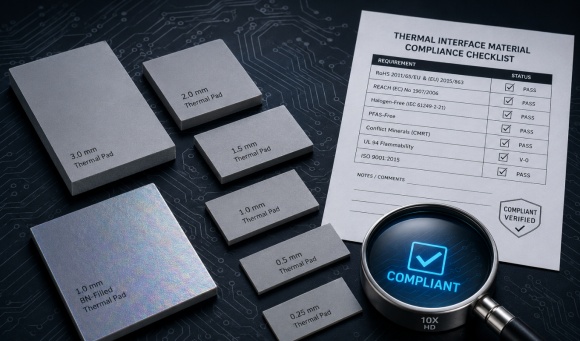
A complete technical data sheet should include: thermal conductivity (test method specified—ASTM D5470 or ISO 22007-2 are the relevant standards), thermal impedance at defined BLT and clamping pressure, dielectric strength and volume resistivity, hardness, operating temperature range, and flammability rating (UL 94 V-0 is the typical requirement for power electronics applications).
Beyond the datasheet, ask for: reliability test data covering thermal cycling (–40°C to 125°C, 500–1000 cycles is a reasonable baseline for industrial applications), long-term aging data if available, and RoHS compliance documentation. For regulated markets, confirm whether the material is listed in any relevant safety certification scope (UL, TÜV, or equivalent).
In-house validation
Before full production adoption, two practical checks are worth running:
Thermal imaging under load is the most direct verification. Compare component case temperatures (or heatsink temperatures near the interface) with the new TIM against your reference material under identical load conditions. A calibrated IR camera is sufficient for this—you don't need a thermal test vehicle. A Tj difference of more than a few degrees at the same load point is a signal worth investigating before committing to a production change.
Sample aging: if the platform runs continuously, consider running a small batch of test assemblies for 500–1000 hours at elevated temperature, then disassembling to inspect for pump-out, bleed, or dimensional change. This is particularly relevant for grease and PCM interfaces where long-term migration is the primary failure mode.
When to engage application engineering support
Standard datasheet selection is appropriate for well-characterized, flat interfaces with known clamping loads and standard geometries. When any of the following apply, direct application engineering input from the supplier is worth requesting: non-standard geometry, very high power density (>50 W/cm²), unusual operating environment (high humidity, chemical exposure, altitude), or tight junction temperature margin where every 0.01°C/W matters.
Putting It Together: A Decision Framework
Rather than a checklist, think of TIM selection for a UPS as a sequence of narrowing questions:
Power density at the interface — above ~20 W/cm², grease or PCM. Below that threshold, a good thermal pad is usually sufficient.
Geometry — flat and well-characterized favors grease or pad. Irregular or tall components require gap filler or potting.
Assembly process — if the line needs clean, consistent handling without dispensing equipment, pads or PCMs. If the process can support controlled dispensing, grease or 2K gap filler opens up.
Rework requirement — field-serviceable products need pads or PCMs. Potted or greased interfaces are difficult to rework cleanly.
Reliability horizon — for 10+ year continuous-duty applications, weight long-term stability data at least as heavily as initial thermal performance.
No single TIM wins across all these dimensions. The value of working through this sequence is that it surfaces the real constraints early—before the heatsink is machined and the BOM is locked.