Welcome to Taxo Tape
Thermal Pad Selection for Automotive ECU and MCU Systems
Introduction: Why Thermal Management Matters in Automotive ECUs
Modern automotive ECUs are no longer simple control units with limited processing tasks. With the integration of advanced driver assistance systems (ADAS), electrification, connectivity, and functional safety requirements, ECUs are becoming smaller, more powerful, and more densely populated with heat-generating components.
As ECU housings shrink and component density increases, thermal margins become significantly tighter. In many real-world designs, the limiting factor is not peak power capability, but the ability to continuously dissipate heat under long operating hours, elevated ambient temperatures, and restricted airflow.
Excessive junction temperatures directly affect ECU reliability and lifetime. Prolonged thermal stress accelerates silicon aging, solder joint fatigue, and degradation of polymer-based materials inside the assembly. In automotive applications, where ECUs are expected to operate reliably for years under vibration, thermal cycling, and wide temperature ranges, heat is a primary design constraint rather than a secondary concern.
Thermal interface materials (TIMs) play a critical role in bridging the thermal path between heat-generating components and the ECU housing or heat spreader. Among these materials, thermal pads are widely used to ensure stable and repeatable thermal performance throughout the vehicle’s service life.
Typical Heat Sources in ECU and MCU Systems
Thermal challenges in ECU assemblies typically originate from multiple components rather than a single hotspot.
Microcontrollers (MCUs) and processors are often the dominant heat sources. As clock speeds increase and multi-core architectures are adopted, localized heat flux under the MCU package can become significant, especially in safety-critical or real-time control applications.
Power management ICs and voltage regulators generate continuous heat due to conversion losses. These components often operate close to the MCU, contributing to local temperature rise and creating thermal interaction between devices.
MOSFETs, gate drivers, and other power components introduce additional thermal load, particularly in ECUs related to motor control, power steering, battery management, or body electronics.
In most ECU designs, heat follows a defined transfer path:
chip → package → thermal interface material → housing or heat sink.
Any weakness along this path—such as air gaps, uneven surfaces, or insufficient contact pressure—can significantly increase thermal resistance and compromise overall system performance.
Why Thermal Pads Are Commonly Used in Automotive ECUs
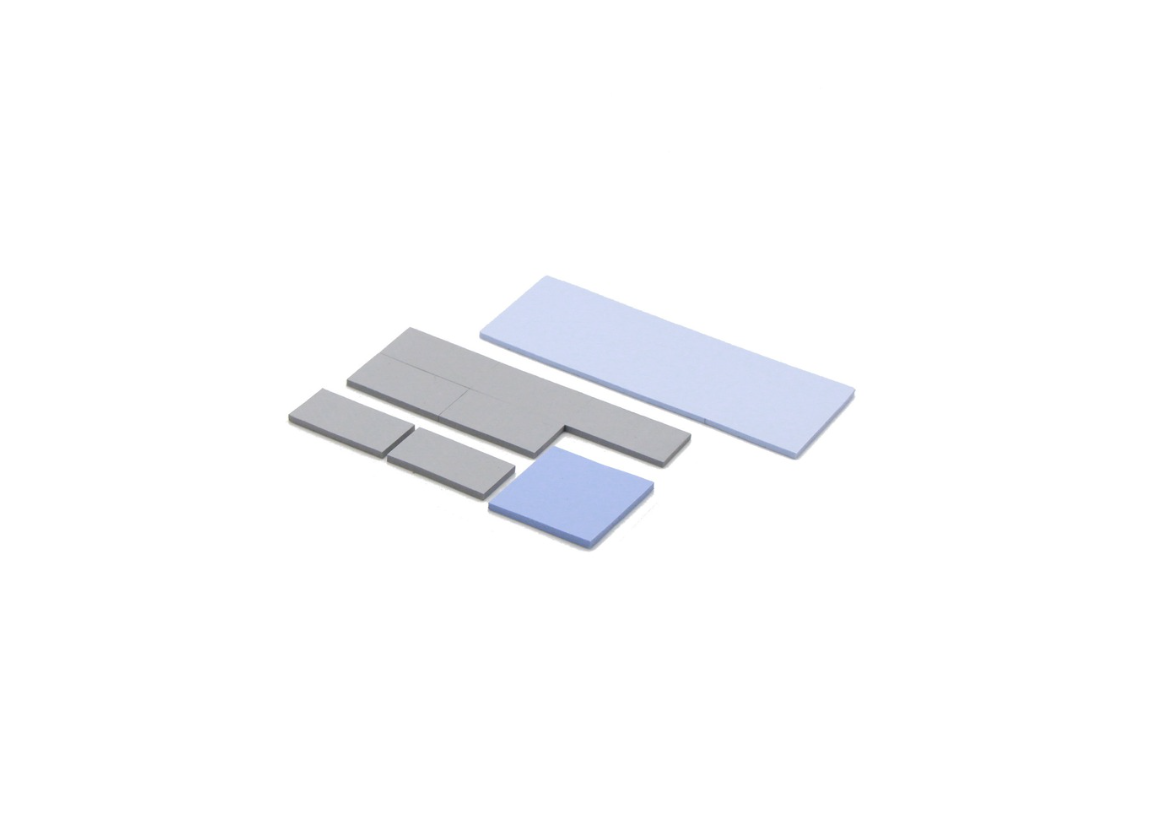
Thermal pads are widely adopted in automotive ECUs because they address several practical assembly challenges that rigid or liquid materials cannot easily solve.
First, tolerance compensation is a major advantage. ECU housings, PCBs, and component packages all have manufacturing tolerances. Thermal pads can conform to uneven surfaces and variable gaps, ensuring consistent contact without requiring extremely tight mechanical tolerances.
Second, electrical insulation is often required. Many ECU designs rely on aluminum or metal housings as heat spreaders, while components and PCB traces must remain electrically isolated. Silicone-based thermal pads provide both thermal conduction and dielectric protection in a single material.
Third, ease of automated assembly makes thermal pads suitable for high-volume automotive production. Pads can be pre-cut, placed by automation, and remain stable during assembly without contamination risks.
Compared with thermal grease, pads avoid pump-out, migration, and long-term reliability concerns. Compared with phase change materials, thermal pads offer stable performance across repeated thermal cycles without relying on specific activation temperatures.
Key Requirements for Automotive-Grade Thermal Pads
4.1 Thermal Performance
In ECU applications, thermal conductivity values alone do not tell the full story. While datasheets often highlight high W/m·K numbers, real interface thermal resistance depends heavily on surface contact quality, pad softness, and compression behavior.
A softer pad with moderate conductivity may outperform a rigid, high-conductivity pad if it achieves better surface contact. Additionally, pad thickness directly affects thermal resistance—thicker pads introduce longer heat paths and should only be used when necessary to bridge larger gaps.
4.2 Mechanical Properties
Thermal pads in automotive ECUs must perform reliably under both low and high clamping forces. Insufficient compression can lead to poor contact, while excessive force may stress sensitive components or PCB solder joints.
Long-term mechanical stability under vibration is equally important. Pads must maintain thickness, elasticity, and contact integrity over years of exposure to mechanical shock and continuous vibration typical of vehicle environments.
4.3 Electrical and Safety Requirements
Electrical insulation is often a non-negotiable requirement. Automotive-grade thermal pads must offer adequate dielectric strength and volume resistivity to protect sensitive electronics when mounted against conductive housings.
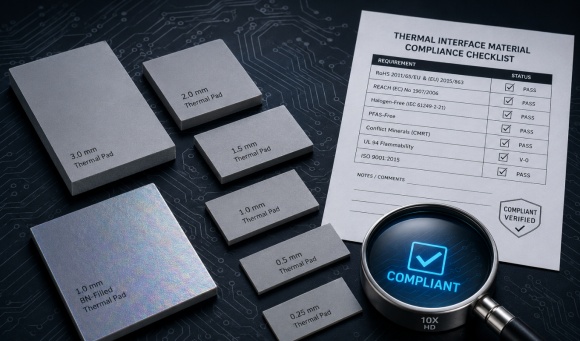
In addition, flame retardancy, such as compliance with UL94 V-0, is commonly required to meet automotive safety standards and OEM qualification processes.
4.4 Environmental Reliability
Automotive ECUs operate across wide temperature ranges, often from sub-zero cold starts to sustained high-temperature operation. Thermal pads must remain flexible and functional across this range without cracking, hardening, or oil bleeding.
Resistance to thermal cycling and long-term aging is critical. Materials that perform well initially but degrade after repeated temperature swings can lead to rising junction temperatures and unexpected reliability issues later in the vehicle’s life cycle.
Thermal Pad Selection Criteria for ECU and MCU Applications
Selecting a thermal pad for ECU and MCU systems is not about choosing the highest-performing material on paper, but about matching material behavior to real mechanical and thermal conditions inside the assembly.
5.1 Choosing the Right Thermal Conductivity
High thermal conductivity values are often viewed as the primary selection criterion. However, a higher W/m·K rating does not automatically result in better system-level thermal performance.
High-conductivity pads are typically stiffer and require higher compression force to achieve proper surface contact. In ECU designs with limited clamping force or uneven interfaces, such materials may actually increase interface resistance due to incomplete contact.
Higher W/m·K materials are usually justified when:
Heat flux density is very high
Contact pressure is well-controlled
Interface flatness is relatively good
In many MCU-centric ECUs, moderate conductivity materials with better conformability provide more stable and predictable thermal results. Avoiding over-specification helps reduce cost, mechanical stress, and long-term reliability risks.
5.2 Thickness Selection and Gap Analysis
Thermal pad thickness should be determined by real, measured gaps, not nominal CAD values alone. In practice, gap variation caused by PCB warpage, component height tolerance, and housing flatness is common.
Typical gap ranges in ECU housings often fall between 0.5 mm and 2.0 mm, depending on mechanical design and assembly method. Choosing a pad that is too thin may lead to poor contact, while excessive thickness increases thermal resistance and requires higher compression.
Gap measurement during prototype or pilot builds is strongly recommended. Simple methods such as feeler gauges, soft impression materials, or controlled compression tests can reveal actual interface conditions and prevent late-stage design corrections.
5.3 Softness and Compression Trade-Offs
Softness is a critical yet frequently misunderstood parameter. Softer pads conform better to surface irregularities and reduce contact resistance, but they also experience higher compression and potential long-term creep.
In ECU assemblies, the goal is to balance thermal contact quality with mechanical protection. Excessive compression force can stress MCU packages, solder joints, or thin PCBs, especially in vibration-prone environments.
A properly selected pad should:
Achieve full surface contact at realistic assembly pressure
Maintain elasticity under long-term vibration
Protect sensitive components from mechanical overload
Common Mistakes in Thermal Pad Selection for Automotive Electronics
Several recurring issues are observed in ECU thermal designs:
Focusing solely on datasheet conductivity numbers without considering interface conditions
Ignoring assembly pressure and housing flatness, leading to poor real-world contact
Selecting materials without automotive validation experience, resulting in aging or stability problems over time
These mistakes often surface late in the development cycle, when redesign costs and validation delays become significant.
Practical Selection Example: A Typical ECU MCU Cooling Scenario
Consider a typical ECU design where an MCU is mounted on a PCB and thermally coupled to an aluminum housing acting as a heat spreader.
The main thermal challenge is maintaining acceptable MCU junction temperature during continuous operation in elevated ambient conditions, while avoiding excessive mechanical stress on the PCB.
In this scenario:
The interface gap varies due to PCB tolerance and housing flatness
Available clamping force is limited
Electrical insulation is required between the PCB and housing
Rather than selecting the highest conductivity pad, a moderately conductive, compliant thermal pad is often the most effective solution. The reasoning focuses on achieving consistent surface contact, stable thermal resistance over time, and mechanical protection of the assembly—rather than maximizing a single material parameter.
Validation and Testing Considerations
Before mass production, sample evaluation under real assembly conditions is essential. Bench testing alone cannot fully represent vehicle operating environments.
Thermal cycling tests help assess material stability under repeated temperature changes, while vibration and aging tests reveal long-term mechanical behavior.
Close collaboration between the ECU designer and the thermal material supplier allows early identification of risks and optimization of material properties for the specific application.
Conclusion: Matching Material Properties to Real ECU Conditions
There is no universal “best” thermal pad for automotive ECUs. The optimal solution depends on thermal load, mechanical constraints, assembly conditions, and long-term reliability requirements.
An application-driven selection approach—supported by early testing and engineering collaboration—reduces redesign risks and improves overall system reliability throughout the ECU’s service life.