Welcome to Taxo Tape
Thermal Pad Compliance for Europe: RoHS, REACH, and Key Supplier Checks
Why Compliance Is Now a Technical Requirement, Not Just a Checkbox
There was a time when a supplier's verbal assurance of "RoHS compliance" was enough to move a component through procurement. That window has largely closed.
For thermal pads and other thermal interface materials entering European supply chains, compliance documentation has shifted from a shipping formality to a design-in prerequisite. European OEM customers — particularly in industrial power, EV infrastructure, and telecom — increasingly request material declarations and third-party test reports before a component reaches the approved vendor list, not after. When that documentation is missing or vague, the consequences show up early and expensively: rejected shipments at customs, component-level redesigns, and production delays that cascade across a program.
The underlying driver isn't bureaucratic caution. EU directives carry real enforcement mechanisms, and downstream OEMs who incorporate non-compliant materials bear liability exposure under both RoHS and REACH frameworks. That liability pressure travels up the supply chain.
For procurement engineers and technical managers sourcing thermal pads, this creates a practical problem: the compliance language suppliers use is often inconsistent, the documentation standards vary widely, and the line between genuine compliance and a well-formatted declaration is not always obvious. This article breaks down what RoHS 3 and REACH actually require for thermal interface materials, where the common gaps appear, and what a rigorous supplier qualification checklist looks like in practice.
RoHS 3 (EU 2015/863): What It Means for Thermal Pads
RoHS — the Restriction of Hazardous Substances Directive — restricts the use of specific substances in electrical and electronic equipment (EEE) placed on the EU market. The current version, RoHS 3 (EU Directive 2015/863), expanded the original list from six to ten restricted substances by adding four phthalates: DEHP, BBP, DBP, and DIBP.
Thermal pads are not standalone EEE products, but they are components incorporated into equipment that falls under RoHS scope. That means the restriction applies to the materials used in the pad itself — binders, adhesives, flame retardants, and any colorants or processing aids in the formulation.
The ten restricted substances and their thresholds:
| Substance | Max Concentration (by weight in homogeneous material) |
|---|---|
| Lead (Pb) | 0.1% |
| Mercury (Hg) | 0.1% |
| Cadmium (Cd) | 0.01% |
| Hexavalent chromium (Cr VI) | 0.1% |
| Polybrominated biphenyls (PBB) | 0.1% |
| Polybrominated diphenyl ethers (PBDE) | 0.1% |
| DEHP | 0.1% |
| BBP | 0.1% |
| DBP | 0.1% |
| DIBP | 0.1% |
The phthalates addition under RoHS 3 is particularly relevant for thermal pads because phthalates are widely used as plasticizers in polymer systems. Silicone-based pads are generally low-risk here — silicone does not typically require phthalate plasticizers — but pads using certain polymer binders, pressure-sensitive adhesive layers, or carrier films may carry measurable phthalate content that wasn't screened under earlier RoHS versions.
What valid documentation looks like. A credible RoHS compliance declaration should reference the specific directive (2011/65/EU as amended by 2015/863), identify the product by part number or material type, and be supported by third-party test reports from an accredited laboratory — SGS, Intertek, TÜV Rheinland, and Bureau Veritas are commonly recognized. Test reports should show substance-level results against the homogeneous material threshold, not just a pass/fail summary.
Self-declarations without underlying test data are technically permissible under EU law but offer limited assurance. When a supplier provides only a signed declaration with no lab report, the question worth asking is: what test data does that declaration rest on?
REACH SVHC: The Moving Target in Material Compliance
REACH (Registration, Evaluation, Authorisation and Restriction of Chemicals — EU Regulation No. 1907/2006) operates on a different logic than RoHS, and the distinction matters.
RoHS restricts specific substances in specific product categories. REACH is a broader chemical management regulation that governs substances throughout their lifecycle. For thermal pad sourcing, the most operationally relevant part of REACH is the SVHC (Substances of Very High Concern) candidate list and the Article 33 disclosure obligation that comes with it.
How the SVHC list works. ECHA (the European Chemicals Agency) maintains a candidate list of substances identified as carcinogenic, mutagenic, reprotoxic (CMR), persistent/bioaccumulative/toxic (PBT), or of equivalent concern. As of mid-2025, the candidate list contains over 240 substances. It is updated twice a year, which is why the "moving target" framing is accurate — a material that cleared SVHC screening in 2022 may not clear it against the current list.
Under Article 33, if a product contains an SVHC above 0.1% by weight (of the entire article), the supplier is obligated to disclose that information to the customer upon request, and to consumers within 45 days. This is not a ban — it is a disclosure requirement — but in practice, many OEM customers treat SVHC presence as a disqualifying factor regardless.
Where thermal pads carry SVHC risk. The filler chemistry and flame retardant package are the two areas most worth scrutinizing:
Certain brominated flame retardants have appeared on the SVHC candidate list, with relevance to pads that carry a V-0 flame rating through additive chemistry rather than inherently flame-resistant base materials.
Some older adhesive and coating formulations contain SVHC-listed plasticizers or processing chemicals that were not flagged under earlier versions of the list.
Specific boron compounds used as sintering aids in certain ceramic-filled pads have also been subject to SVHC evaluation — though this is more relevant to higher-performance ceramic substrates than standard BN-filled thermal pads.
Why "REACH compliant" on a datasheet is not sufficient. A compliant stamp printed on a product page tells you almost nothing without context. The meaningful questions are: which version of the SVHC candidate list was the product screened against, and when? Is there a full Safety Data Sheet (SDS) available that identifies all components above 1% concentration? Has the supplier committed to proactive notification if the formulation changes or if new substances are added to the candidate list?
The SDS is the single most informative compliance document for REACH purposes. If a supplier cannot or will not provide a current SDS for a thermal pad, that is a substantive red flag — not a procedural one.
Beyond the Basics: Other Compliance Layers European OEMs May Require
RoHS and REACH form the regulatory foundation, but they are rarely the complete picture for European industrial procurement. Depending on the application and the customer's internal standards, thermal pad suppliers may also need to address the following.
Halogen-free requirements. The IEC 61249-2-21 standard defines halogen-free as chlorine below 900 ppm, bromine below 900 ppm, and total halogens below 1500 ppm by weight. This requirement originated in printed circuit board materials but has migrated into broader component specifications — particularly in telecom infrastructure, server hardware, and industrial control equipment where fire safety and off-gassing during rework are concerns. Silicone-based thermal pads with non-brominated flame retardant packages can typically meet this threshold; pads relying on conventional brominated FR additives cannot. If your application target includes any telecom or data infrastructure OEM, halogen-free is worth confirming proactively rather than waiting for it to appear as a late-stage requirement.
UL 94 flame classification. UL 94 is a US standard, but it has been adopted as a de facto global benchmark for flammability rating of plastic and elastomeric materials. The two ratings most commonly specified are V-0 (self-extinguishing within 10 seconds, no drip that ignites) and HB (slower burn rate, less stringent). For thermal pads used in enclosed power electronics — UPS systems, inverters, EV charging modules — V-0 is the expected baseline. HB-rated materials may be acceptable in open or ventilated assemblies, but specifying engineers will usually ask. The V-0 rating needs to be supported by UL certification or equivalent third-party test data, not a self-assessed claim.
PFAS restrictions. Poly- and perfluoroalkyl substances (PFAS) are under active regulatory scrutiny in the EU, with a broad restriction proposal covering thousands of compounds under development through ECHA. This is relevant for thermal pads because fluoropolymer-based materials — certain phase change films and specialized high-temperature pads — contain PFAS by definition. The regulation is not finalized as of this writing, but several European OEMs have already begun implementing internal PFAS-free requirements ahead of any mandate. If a customer's specification sheet includes a PFAS declaration request, it is worth treating seriously rather than dismissing as premature.
Quick reference: compliance documentation by requirement
| Compliance Type | Applicable Standard | Documentation to Request |
|---|---|---|
| RoHS 3 | EU 2015/863 | Third-party test report (SGS / TÜV / Intertek) + compliance declaration |
| REACH SVHC | EU 1907/2006, Article 33 | SVHC declaration (with candidate list version + date) + full SDS |
| Halogen-free | IEC 61249-2-21 | Halogen content test report |
| Flame rating | UL 94 | UL certification or equivalent lab test report |
| PFAS | EU REACH (pending) | PFAS declaration or fluorine content test data |
Technical Parameters That Intersect With Compliance
Compliance and performance are not parallel tracks — the material chemistry that determines a thermal pad's compliance profile also shapes its thermal and mechanical behavior. Understanding this relationship helps engineers avoid a common sourcing mistake: selecting a pad based on performance data alone, then discovering compliance issues at the qualification stage.
Filler type drives both conductivity and compliance complexity. The dominant filler categories in commercial thermal pads each carry a different compliance footprint:
Boron nitride (BN)-filled pads offer a favorable compliance profile: BN is chemically inert, does not appear on the SVHC candidate list, and carries no RoHS restriction concerns. These pads also deliver low dielectric constant and low dielectric loss, making them well suited for high-frequency power electronics. Typical thermal conductivity: 3–8 W/m·K depending on BN loading and orientation.
Aluminum oxide (Al₂O₃)-filled pads are cost-effective and broadly compliant, though conductivity is more modest. Typical range: 1.0–3.0 W/m·K. The binder and adhesive system needs scrutiny, not the filler itself.
Aluminum nitride (AlN) and silicon carbide (SiC)-filled pads can reach 6–12 W/m·K but require closer review of the full formulation — processing aids and sintering agents may introduce substances worth screening.
Carbon-based fillers (graphite, carbon fiber) can achieve higher conductivity ranges but may introduce electrical conductivity where isolation is needed, and some processing chemistries carry more compliance complexity.
Performance parameters in context:
| Parameter | Typical Range | Notes |
|---|---|---|
| Thermal conductivity | 1.0–15 W/m·K | Varies by filler type and loading |
| Thermal resistance | <0.5°C·in²/W (high-performance) | Thickness and contact pressure dependent |
| Operating temperature | –40°C to 200°C | Silicone-based; fluorosilicone extends higher |
| Phase change activation | 45–55°C | PCM materials; improves contact under cycling |
| Dielectric strength | 5–20 kV/mm | BN-filled pads toward upper end |
The compliance-performance tradeoff. Higher thermal conductivity does not automatically mean higher compliance risk, but it often means more complex formulations — and more complex formulations require more thorough documentation. A pad rated at 12 W/m·K achieved through a hybrid filler system may perform well on paper, but the compliance documentation burden is proportionally higher. For applications where 3–6 W/m·K is sufficient, a simpler, well-documented BN or Al₂O₃ formulation will typically move through qualification faster and with fewer surprises.
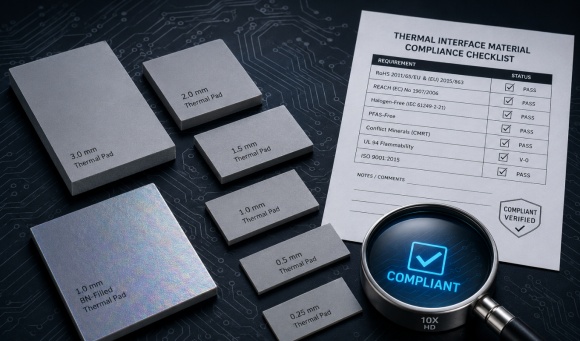
A Practical Supplier Qualification Checklist
The following documents and questions reflect what a rigorous qualification process looks like in practice. A supplier who cannot address most of these points is not necessarily non-compliant — but they may lack the documentation infrastructure to support an EU-facing supply chain reliably.
Documents to request before approving a thermal pad supplier:
① RoHS test report from an accredited third-party laboratoryThe report should identify the specific product or material type, reference EU Directive 2015/863, and show substance-level concentration data — not just a pass/fail summary. Acceptable labs include SGS, Intertek, TÜV Rheinland, Bureau Veritas, and equivalent CNAS/ILAC-accredited facilities.
② Full Safety Data Sheet (SDS), current versionThe SDS should list all components above 1% concentration (0.1% for SVHC substances), reference the current REACH candidate list version, and include Section 15 (Regulatory Information) with explicit SVHC disclosure or absence confirmation.
③ REACH SVHC declaration with candidate list version and dateA declaration that does not reference which version of the SVHC candidate list was used is functionally incomplete. Given that the list is updated twice annually, declarations more than 12 months old should be reconfirmed.
④ Halogen content test report (if specified by customer or application)Should reference IEC 61249-2-21 thresholds. Required for telecom, server, and certain industrial control applications.
⑤ UL 94 certification or equivalent flammability test dataFor enclosed power electronics, confirm the rating (V-0 vs. HB) and verify it applies to the specific thickness and formulation being sourced — not just the product family.
⑥ Lot-level traceabilityCan the supplier trace a delivered lot back to the raw material batch? This matters for failure investigation and for responding to future regulatory changes that may require retroactive material review.
⑦ Change notification policy (CNP)Formulation changes — even minor ones — can affect both compliance status and thermal performance. A supplier should have a documented process for notifying customers before any material change is implemented. This is particularly important given the pace of SVHC list updates.
⑧ PFAS declaration (for fluoropolymer-containing materials)If the pad contains any fluoropolymer component, request an explicit PFAS declaration or fluorine content test. For non-fluoropolymer pads, a blanket PFAS-free statement with supporting SDS is acceptable.
One distinction worth reinforcing: "we are RoHS and REACH compliant" stated in a brochure or on a product page is a marketing claim. The documents listed above are the evidence that either supports or contradicts that claim. In a rigorous qualification process, the documentation is the compliance — not the assertion.

Aligning Compliance With Application Requirements
Compliance documentation answers the question of whether a material is permissible. It does not answer the question of whether it is right for the application.
The two evaluations need to run in parallel. A thermal pad can clear every document on the checklist above and still underperform if the thermal resistance is mismatched to the heat flux density of the assembly, if the compression characteristics are incompatible with the mounting hardware, or if the operating temperature range of the chosen material does not cover the full thermal cycling profile of the end product.
The practical implication is that supplier engagement should happen at the design-in stage, not at the point of approved vendor list (AVL) submission. When application requirements — heat source geometry, clamping pressure, interface gap tolerance, operating environment — are shared early, material selection can be optimized against both performance targets and compliance constraints simultaneously. Discovering that the highest-conductivity option in a shortlist relies on a flame retardant chemistry that conflicts with a customer's internal PFAS or halogen-free policy is a manageable problem at the design stage. It is a costly one at the qualification stage.
For procurement engineers and technical managers navigating European supply chain requirements, the baseline expectation has become clear: compliant documentation, supported by third-party test data, covering RoHS 3, REACH SVHC, and any application-specific standards, is the entry point — not a differentiator. What differentiates a supplier is the ability to provide that documentation consistently, respond to specification changes without delays, and engage technically at the material selection level rather than only at the transaction level.
Suppliers who treat compliance as a documentation process rather than a material knowledge question tend to show the gap when requirements get specific. The checklist in the previous section is a reliable way to find out which side of that line a potential supplier is on.