Welcome to Taxo Tape
TIM Selection for Outdoor LED Drivers: Sealed Enclosure Requirements
Introduction
Outdoor LED drivers operate under conditions that expose every material choice to scrutiny that standard lab qualification cannot fully replicate. A driver installed inside a sealed street light fixture in a hot climate will see internal enclosure temperatures well above 100°C during summer operation, cycle through sub-zero temperatures on winter nights, and be expected to perform without maintenance access for ten years or more.
The thermal interface materials inside that driver are not just responsible for managing heat — they are expected to maintain their thermal and mechanical properties across this full range, indefinitely, inside a sealed environment where outgassing from the wrong material can silently degrade optical performance over years of operation.
This guide focuses specifically on TIM selection for outdoor and sealed LED driver applications — where the requirements diverge most significantly from standard indoor commercial driver designs, and where the consequences of a poor material choice are most difficult and expensive to correct after installation.
What Makes Outdoor LED Driver TIM Selection Different
Sealed enclosure thermal constraints.
Indoor LED drivers typically operate in vented or semi-open enclosures where convective airflow removes heat from the driver housing. Outdoor drivers in IP66 or IP67 rated fixtures are fully sealed — heat can only escape through conduction to the enclosure wall and from there by natural convection or radiation to ambient. Every degree of thermal resistance in the TIM layer adds directly to component junction temperature, with no airflow to compensate.
Internal enclosure temperatures in sealed outdoor fixtures commonly reach 90–120°C at the hottest interfaces during peak summer operation in warm climates, even when ambient temperatures are at 40–50°C. This is the temperature the TIM must perform at continuously — not a transient peak.
Wide operating temperature range.
Outdoor drivers cycle between cold startup conditions — as low as -40°C in northern climates — and maximum operating temperature during full-load summer operation. That is a 150°C+ range across which the TIM must maintain conformability, thermal contact, and structural integrity. Materials that become brittle at -30°C or lose compression recovery above 100°C introduce failure modes that only appear after the product is in the field.
No maintenance access.
A sealed outdoor luminaire that is installed at height on a street pole or building facade is not a field-serviceable assembly. Once installed, the TIM inside runs for the life of the product. There is no opportunity to reapply degraded grease, replace a hardened pad, or address pump-out from a thermally cycled interface. The material must perform from day one through the end of service life — typically 10 years or 50,000+ hours — without any intervention.
How this differs from indoor driver requirements:
| Parameter | Indoor Commercial Driver | Outdoor Sealed Driver |
|---|---|---|
| Enclosure type | Vented or open | Sealed IP66/IP67 |
| Internal temperature range | 40–80°C typical | 90–125°C at interfaces |
| Cold temperature exposure | Rarely below 0°C | Down to -40°C |
| Service life target | 30,000–50,000 hours | 50,000–100,000 hours |
| Maintenance access | Possible | Effectively none |
| Outgassing risk | Low–moderate | High if optics share enclosure |
| UV exposure | None | Direct or indirect |
The Siloxane Outgassing Problem
This is the failure mechanism most specific to sealed LED luminaire applications and most frequently misdiagnosed in the field.
What siloxane outgassing is:
Standard silicone-based thermal pads are manufactured from silicone polymer matrices that contain low-molecular-weight siloxane compounds as a byproduct of their synthesis. At elevated temperatures — particularly above 80–100°C, which are normal operating conditions inside sealed outdoor fixtures — these compounds volatilize and enter the enclosed air space as vapor.
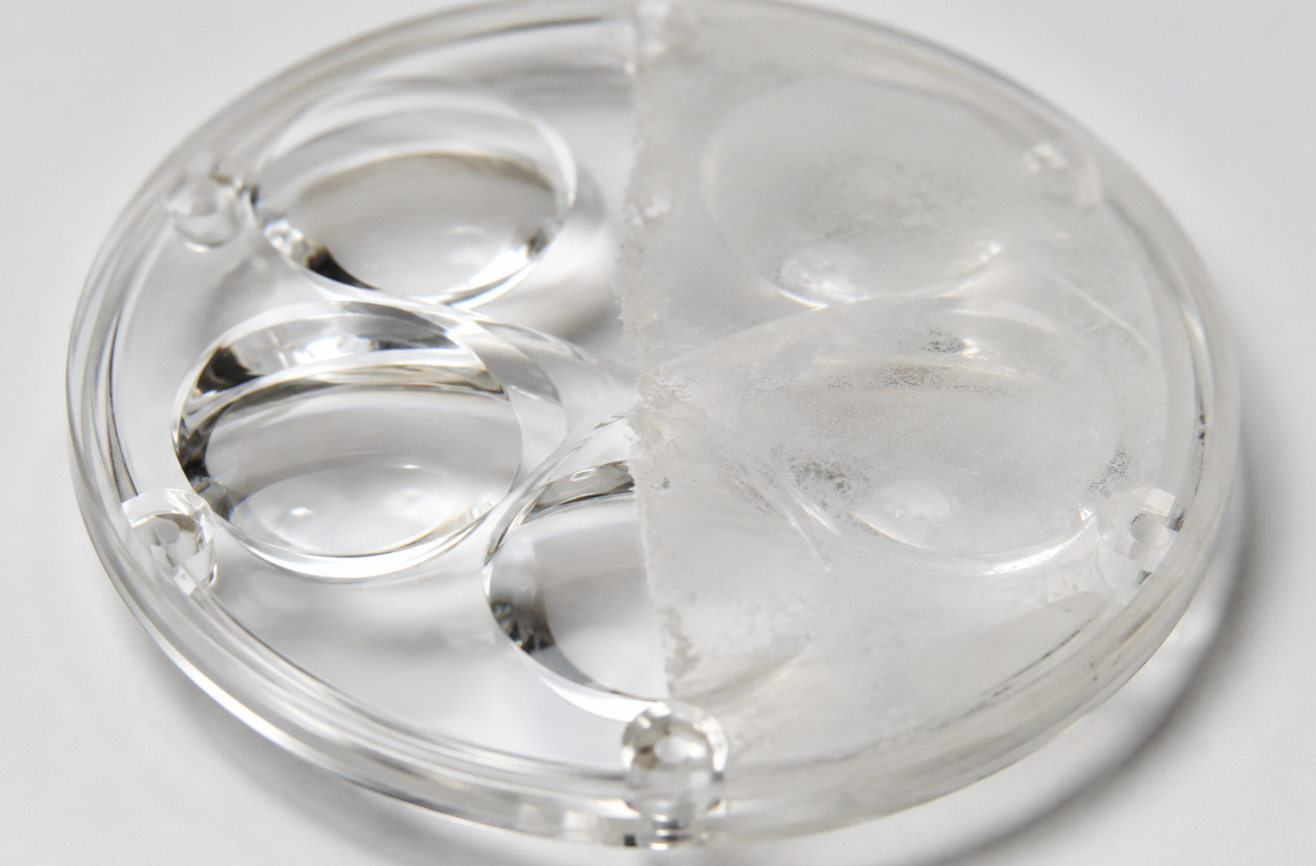
The vapor itself is not immediately visible and does not cause any short-term performance change. The problem develops gradually as the vapor migrates through the sealed enclosure air and condenses on cooler surfaces — including LED emitter faces, lenses, reflectors, and any photodetector or optical sensor present in the assembly.
How it affects luminaire performance:
The condensed deposit is a thin, clear polysiloxane film. On an LED emitter surface or lens, it reduces optical transmittance. On a reflector, it changes the surface reflectance characteristics. The result is progressive lumen depreciation — typically 5–15% over two to three years in affected assemblies — that accumulates steadily through the service life.
Why it gets misattributed:
Lumen depreciation from siloxane contamination is visually indistinguishable from normal LED aging in standard photometric field measurements. Both produce a gradual reduction in light output that follows a similar curve over time. Without chemical surface analysis of the optical components — which is not performed in standard luminaire maintenance or failure analysis — the two causes cannot be separated.
As a result, siloxane-driven lumen depreciation is routinely attributed to LED quality in field failure analysis, the root cause goes uncorrected in subsequent production, and the same failure repeats in the next generation of the product.
Assessing your assembly's risk:
The critical design question is whether the driver circuit and the optical assembly share a sealed air space. If the driver is housed in a separate compartment that is sealed from the optical cavity — a design used in some premium luminaires specifically to address this issue — siloxane vapor from driver TIMs cannot reach the optical surfaces and the risk does not apply.
If both are inside the same sealed enclosure — which is the case in the majority of integrated outdoor luminaires — the risk is present. Its magnitude depends on the operating temperature at the TIM interface (higher temperature increases outgassing rate), the enclosed volume (smaller enclosures concentrate the vapor), and the proximity of the driver PCB to the optical components.
When silicone-free TIM is the correct specification:
For any sealed outdoor luminaire where the driver and optical assembly share an enclosed air space, silicone-free thermal pads at the driver component interfaces are the technically correct specification. The material cost difference at the component level is modest. The warranty cost of replacing prematurely degraded luminaires in the field — or the reputational cost of lumen depreciation that exceeds L70 specifications before rated life — is substantially higher.
TIM Performance Requirements for Sealed Outdoor Enclosures
Operating temperature range — both limits matter:
Most TIM datasheets specify a maximum operating temperature that is easy to check. The minimum temperature is less commonly verified and equally important for outdoor applications. A silicone pad rated for -40°C to 200°C is very different from one rated for 0°C to 150°C — the first is appropriate for northern climate outdoor installation, the second is not.
Verify both limits and apply them to your worst-case conditions: the maximum internal enclosure temperature during peak summer load in the hottest target climate, and the minimum cold startup temperature in the coldest target climate.
Compression set under sustained load:
Compression set is the permanent thickness loss a pad sustains after extended compression at elevated temperature. For indoor drivers with 30,000-hour service life targets, moderate compression set may be acceptable. For outdoor drivers targeting 50,000–100,000 hours at continuously elevated temperatures, compression set directly determines whether the pad maintains adequate contact and thermal resistance through the full service life.
A pad that loses 25% of its original thickness after sustained operation loses a proportional fraction of its contact pressure. The TIM layer thins, contact pressure drops, and thermal resistance increases — progressively, over years, in a sealed assembly where nothing can be done about it. Request compression set data at your operating temperature for 1,000 hours minimum, and verify the residual thickness falls within your mechanical tolerance budget for the full service life.
UV and moisture resistance:
Direct UV exposure on driver enclosure surfaces — less common for the driver itself than for the optical assembly, but relevant where enclosure walls are translucent or where the driver PCB is near an enclosure window — can degrade some pad materials over time. Silicone-based materials are inherently UV resistant. Non-silicone alternatives vary in UV stability and should be verified against your specific exposure conditions.
Moisture resistance matters most at the enclosure sealing interfaces rather than at the TIM itself, but for any TIM used in humid or condensing environments, verify that the material does not absorb moisture in a way that affects thermal or electrical performance over time.
Flame retardancy certification:
UL 94 V-0 rating is the baseline flame retardancy requirement for enclosed luminaire assemblies in most markets. Confirm that your specified TIM carries this certification — not just the enclosure or PCB material, but the pad or gap filler itself. This is particularly relevant when retrofitting drivers into existing luminaire housings where the original design assumptions may not account for TIM flammability.
Low-volatility or silicone-free specification:
For any sealed enclosure where driver and optics share an air space, include a volatility specification in your TIM requirements. The two standard measurement methods are TML (total mass loss) and CVCM (collected volatile condensable materials), tested under ASTM E595 or equivalent conditions. Request these values from your supplier rather than relying on general "low outgassing" claims.
TIM Options for Outdoor LED Driver Applications
| TIM Type | Thermal Conductivity | Outgassing Risk | UV Resistance | Temp Range | Best Fit |
|---|---|---|---|---|---|
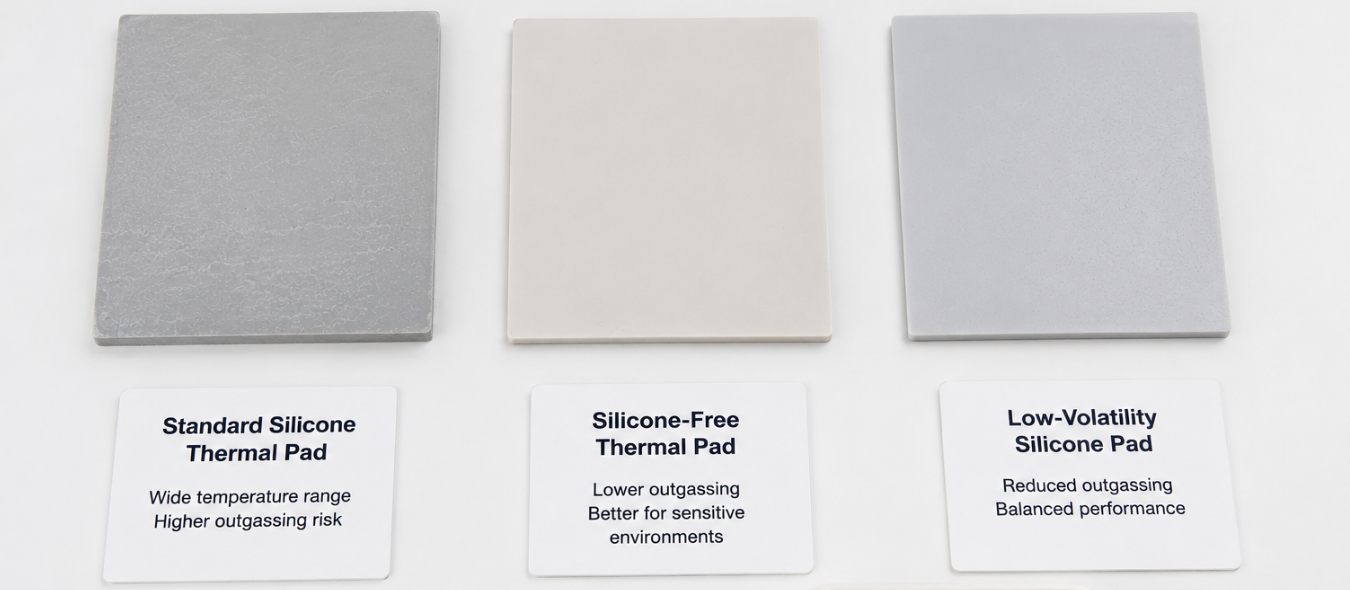
| Standard silicone pad | 1–6 W/m·K | Medium–high | Excellent | -40°C to 200°C | Separate driver compartment |
| Low-volatility silicone pad | 1.5–5 W/m·K | Low | Excellent | -40°C to 180°C | Shared enclosure, moderate risk |
| Silicone-free thermal pad | 2–6 W/m·K | None | Verify by grade | -30°C to 150°C | Shared enclosure, high risk |
| BN-filled silicone pad | 3–8 W/m·K | Medium | Excellent | -40°C to 200°C | High-power, separate compartment |
| Gap filler 1K | 2–5 W/m·K | Low–medium | Good | -40°C to 180°C | Cast enclosure irregular gaps |
| Gap filler 2K | 3–6 W/m·K | Low | Good | -40°C to 200°C | High-power cast enclosure |
Reading this table for outdoor sealed applications:
Standard silicone pads are appropriate only when the driver occupies a separate compartment sealed from the optical assembly — the outgassing risk rules them out for shared enclosures regardless of their thermal performance. Low-volatility silicone pads reduce but do not eliminate outgassing risk — appropriate when the enclosed volume is large, operating temperatures are moderate, and optical components are not in close proximity to the driver PCB. Silicone-free pads eliminate outgassing entirely and are the correct specification when driver and optics share a compact sealed enclosure — verify the temperature rating and compression behavior for your specific application, as silicone-free grades have narrower operating windows than silicone-based alternatives.
BN-filled silicone pads offer the highest conductivity in this application category but carry the same outgassing risk as standard silicone grades — suitable for high-power separate-compartment designs where the electrical isolation and conductivity combination is needed. Gap fillers are the practical choice for cast aluminum enclosure walls where the inner surface finish is too rough for a pad to make adequate contact — request low-volatility formulations for any shared-enclosure application.
Application-Specific Recommendations
Street lighting drivers (high power, long service life)
Street lighting represents the most demanding combination of requirements in outdoor LED applications: high continuous power levels (typically 100–300W per driver), the longest service life targets (often 100,000 hours or more in highway and arterial installations), and deployment in sealed pole-top or side-entry fixtures where internal temperatures are elevated by solar gain in addition to driver dissipation.
TIM selection at the main switching component interfaces should prioritize long-term stability over peak initial conductivity. BN-filled pads at 5–8 W/m·K in a separate driver compartment, or low-volatility silicone pads where compartment separation is not possible, are the appropriate specification range. Compression set data at 105°C for 1,000+ hours should be a standard qualification requirement — not an optional data point — given the expected service life.
Thermal grease is not an appropriate specification for street lighting drivers. The pump-out risk over 100,000 hours of continuous operation in a sealed assembly is real and not recoverable without full luminaire replacement.
Industrial floodlight and high-bay drivers (vibration environments)
Industrial outdoor floodlights and high-bay fixtures used in manufacturing, ports, and transportation infrastructure add vibration to the outdoor sealed enclosure challenge. Forklift traffic, machinery vibration, and wind loading on pole-mounted fixtures create sustained mechanical stress at TIM interfaces.
Softer pads that conform well under low clamping force are mechanically appropriate for gap-filling in these designs, but softness and vibration resistance can conflict — very soft materials are more prone to gradual displacement under sustained vibration than medium-hardness grades. Medium-hardness silicone-free pads at 3–5 W/m·K represent a practical balance for most industrial outdoor floodlight applications. Avoid thermal grease entirely in any vibration-exposed sealed assembly.
Landscape and architectural outdoor drivers (moderate power)
Landscape lighting, building facade illumination, and architectural LED systems typically operate at lower power levels (20–80W) but are often installed in extremely compact sealed housings where space for heatsinking is minimal. Heat must conduct directly from components through a gap filler or pad layer to the enclosure shell.
Gap filler dispensed onto component tops before enclosure assembly is often the most practical TIM solution here — it accommodates the irregular component height variation common in compact driver PCBs and fills the variable gap to the enclosure wall without requiring tight dimensional control. Low-volatility 1K gap filler in the 3–5 W/m·K range covers the thermal requirements of most landscape driver power levels while managing outgassing risk in the shared enclosures typical of this product category.
Horticultural lighting drivers (high humidity environments)
LED grow light drivers combine high continuous power loading with elevated humidity exposure. Sealed enclosures in growing environments may experience condensation during temperature transitions, and any gap in enclosure sealing integrity introduces moisture to the driver assembly.
TIM selection follows the same logic as industrial high-bay drivers at the power component interfaces — medium-hardness, low-volatility pads at appropriate conductivity for the power level. Additional attention should be given to verifying that the TIM does not absorb moisture in a way that affects its electrical insulation properties over time. Request volume resistivity data after humidity exposure conditioning, not just at standard test conditions, for any TIM considered for horticultural applications.
Validation Requirements for Outdoor TIM
Sample validation sequence for sealed outdoor applications:
The validation sequence for outdoor sealed driver TIM goes beyond the standard indoor qualification steps. A complete qualification for this application category should include:
Initial measurement baseline — thickness, hardness, thermal resistance at target BLT under representative clamping, and dielectric strength verification. Establish these values on a minimum of ten samples before any aging begins.
Thermal cycling — minimum 200 cycles across the rated operating temperature range (-40°C to 125°C or as applicable). Re-measure thermal resistance and hardness after cycling and compare to baseline. Any change in Rth greater than 15% warrants investigation before production commitment.
Elevated temperature soak — 1,000 hours at the expected maximum continuous interface temperature. Re-measure compression set, thermal resistance, and hardness. This is the test that catches compression set issues before they appear in field returns.
UV exposure — if the TIM is used in locations with any UV exposure path, ASTM G154 or equivalent accelerated UV testing for 500 hours minimum. Inspect for surface cracking, discoloration, or hardness change.
Outgassing test — for any silicone-based material used in a shared enclosure. ASTM E595 at 125°C for 24 hours, reporting TML and CVCM values. For applications where CVCM below 0.01% is required, this test must be part of the incoming qualification process, not an assumed property.
Post-aging full assembly thermal performance — reassemble five units using aged TIM samples and verify that full assembly thermal resistance remains within design target. This confirms that the aging-induced changes in TIM properties translate to acceptable system-level thermal performance at end of simulated service life.
Revalidation triggers:
Any of the following changes require revalidation before continued production for outdoor sealed driver applications: change of TIM supplier or material lot where outgassing data differs from qualified baseline, change of enclosure design that alters the air volume or compartmentalization between driver and optics, change of operating temperature specification, and any reformulation of the TIM by the supplier — even if described as equivalent.
TaxoTape® Solutions
TaxoTape® focus on low-volatility silicone thermal pads and silicone-free thermal pads for outdoor and sealed LED driver applications, alongside standard silicone grades for driver designs with separated compartment architectures.
Products are available with full outgassing characterization data — TML and CVCM values under ASTM E595 conditions — for applications where outgassing specification is part of the material qualification requirement. Compression set data at elevated temperature, UV resistance test results, and UL 94 V-0 flame retardancy certification are available for relevant grades.
Custom die-cut formats matched to driver PCB component footprints are available for production volume applications. Sample quantities for full qualification testing are available with complete technical documentation.
For outdoor LED driver programs where TIM outgassing risk, long service life requirements, or sealed enclosure thermal design are active challenges, we can provide application-specific grade recommendations and support the full qualification sequence.
Conclusion
Outdoor sealed LED driver applications expose the limits of standard TIM selection approaches. The combination of elevated continuous temperatures, wide thermal cycling range, long service life without maintenance access, and — in shared enclosures — siloxane outgassing risk creates a set of requirements that standard indoor driver TIM specifications do not address.
The most consequential decision in outdoor LED driver TIM selection is often not conductivity grade but material type: whether the outgassing risk in your specific enclosure design warrants silicone-free or low-volatility specification, and whether your compression set requirements at operating temperature are actually met by the material you are considering — not assumed from a general "silicone pad" category.
Getting these decisions right at the design stage, with qualification data that reflects actual outdoor operating conditions rather than standard indoor test conditions, is the difference between a driver that meets its rated service life and one that generates warranty returns at year three.
Contact TaxoTape® to discuss TIM selection for your outdoor LED driver application →
FAQ
Q: How do I know if my luminaire design has a siloxane outgassing risk?
The key question is whether the driver PCB and the optical assembly — LED emitters, lenses, reflectors — share a sealed air space without a dividing barrier. If they do, outgassing from silicone-based TIMs on the driver board can migrate to and deposit on optical surfaces over time. If the driver is in a separate sealed compartment with no air connection to the optical cavity, the risk does not apply. When in doubt, request CVCM values from your TIM supplier and evaluate whether they fall within acceptable limits for your enclosure volume and operating temperature.
Q: What is an acceptable CVCM value for a sealed LED luminaire application?
This depends on enclosure volume, operating temperature, and proximity of optical components to the driver PCB. As a general reference, CVCM below 0.01% under ASTM E595 conditions is commonly used as a threshold for optical-sensitive applications. For large-volume enclosures where driver and optics are separated by distance, higher CVCM values may be acceptable. For compact enclosures with driver and optical components in close proximity, silicone-free TIM — which eliminates CVCM entirely — is the more conservative and defensible specification.
Q: Can I use standard silicone thermal pads in an outdoor sealed fixture if I run the driver at a lower temperature?
Lower operating temperature reduces the outgassing rate from silicone-based materials, which reduces but does not eliminate the risk. If reducing the interface temperature to below 80°C is achievable through enclosure design — larger heatsink area, better thermal coupling to the enclosure wall — it meaningfully reduces siloxane vapor generation. However, for luminaires where service life targets exceed 50,000 hours and optical components share the sealed air space, low-volatility or silicone-free specification remains the more reliable long-term choice regardless of operating temperature reduction.
Q: Does silicone-free thermal pad perform as well as silicone-based pad at the same conductivity rating?
At equivalent conductivity grade, silicone-free and silicone-based pads deliver comparable thermal resistance under the same assembly conditions. The practical differences are in temperature range — silicone-free grades typically have a narrower rated operating range, commonly -30°C to 150°C versus -40°C to 200°C for silicone grades — and in compression behavior, where silicone-free pads are generally slightly firmer and less conformable than silicone equivalents at the same hardness specification. Verify both temperature range and compression behavior for your specific application rather than assuming direct substitution from a silicone grade to a silicone-free equivalent.