Welcome to Taxo Tape
Thermal Interface Materials for Drone Cooling: A Practical Guide
Introduction
Drone thermal design sits at the intersection of two competing demands: dissipate heat effectively, and add as little weight as possible while doing it. Most thermal management approaches developed for stationary or vehicle-mounted electronics simply don't translate — there's no room for a heavy heat sink, no tolerance for bulky TIM layers, and no margin to spare on a platform where every gram affects flight time.
As drones take on heavier payloads, longer flight durations, and more powerful onboard electronics — motor controllers, flight computers, RF modules, battery packs — internal heat generation has increased correspondingly. Without effective thermal interface materials matched to these specific constraints, components run hotter than their design margins allow, shortening service life and increasing failure risk mid-flight.
This guide looks at the practical TIM selection considerations specific to drone applications — where the usual selection criteria of conductivity and cost need to be weighed against weight, vibration tolerance, and the wide temperature range drones experience between ground and altitude.
Why Drone Thermal Design Is Uniquely Challenging
Extreme space constraints with high power density. Motor controllers, ESCs (electronic speed controllers), and flight computers are packed into enclosures with minimal clearance. There's rarely room for a conventional heat sink and fan assembly — TIM often needs to conduct heat directly to a structural component or the airframe itself, which then acts as the primary heat dissipation surface.
Weight sensitivity at every gram. Unlike ground-based electronics, every gram of added material in a drone directly reduces flight time and payload capacity. A thermal pad that would be an unremarkable choice in industrial electronics becomes a meaningful weight consideration when multiplied across a multi-rotor design with several motor controllers, a flight computer, and a battery management system.
Wide operating temperature range. Drones experience ambient temperature swings from ground-level heat (sometimes 40°C+ on hot tarmac) to significantly colder temperatures at altitude, plus the heat generated internally during operation. TIM materials need to maintain consistent performance across this full range, not just at a single design point.
Vibration from motors and propellers. Brushless motors and propeller rotation generate continuous vibration across a range of frequencies, transmitted through the airframe to nearby electronics. Any TIM in this environment needs to maintain interface contact under sustained mechanical vibration — a requirement that rules out some otherwise suitable materials.
TIM Options for Drone Applications
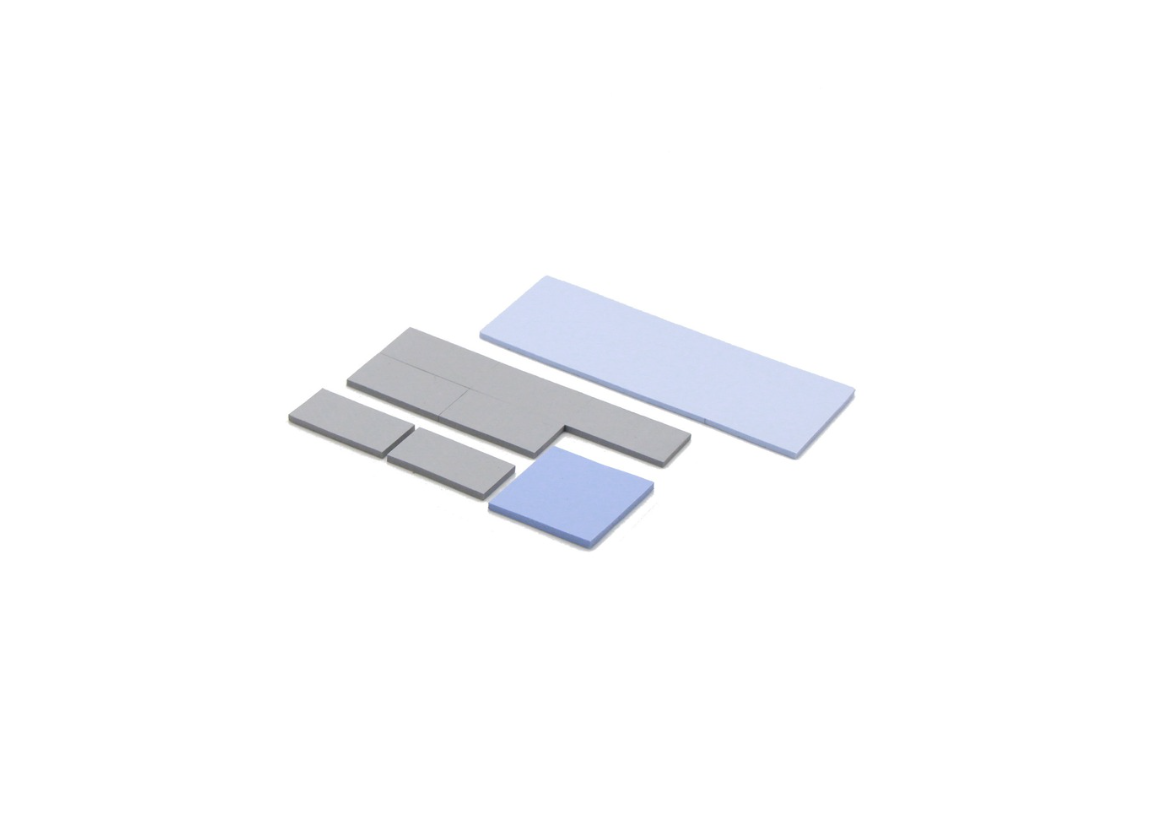
Thermal Pads
Thermal pads remain the most common TIM choice for drone electronics due to their combination of gap-filling ability and electrical insulation.
Thermal conductivity: typically 1.2–25 W/m·K depending on grade (filler-loaded silicone pads at the higher end)
Thickness: available from 0.3 mm upward; ultra-thin grades (0.3–0.5 mm) are preferred where weight matters
Key advantage: built-in electrical insulation eliminates the need for separate dielectric layers — relevant for motor controllers and ESCs operating at battery pack voltage
Where pads are typically used: between motor controller ICs and the controller housing or airframe, battery management system components, and flight computer processors where moderate gap-filling and electrical isolation are both needed.
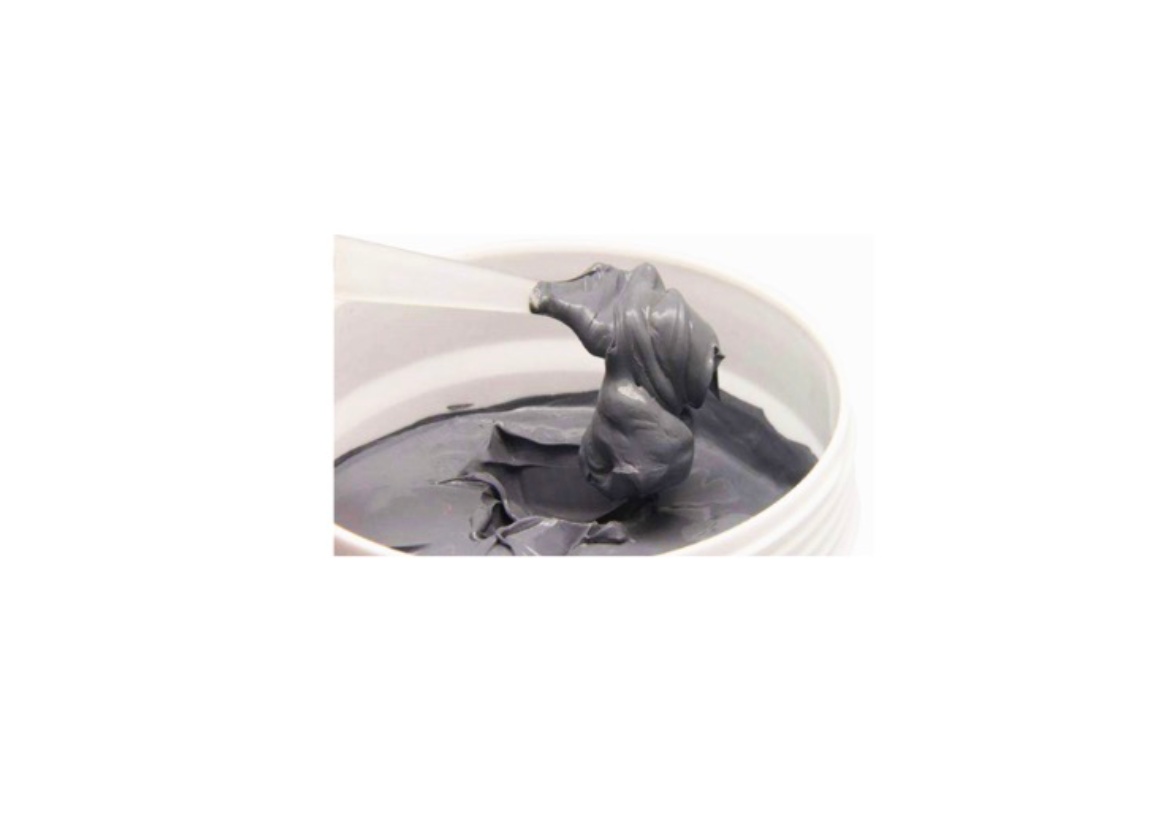
Thermal Grease
Grease offers the lowest thermal resistance per unit weight of the three options, since it adds essentially no mass beyond a thin applied film — a meaningful consideration on weight-sensitive platforms.
Thermal conductivity: typically 3–8 W/m·K for standard formulations
Key advantage: minimal added weight; thin bond line for tight, flat interfaces
Where grease is typically used: high-power processors, RF modules, and image transmission components where the interface is small, accessible during assembly, and vibration exposure is lower than at motor/propeller locations.
Trade-off to note: grease's pump-out tendency under vibration is a real concern at motor-adjacent locations. It performs better at interfaces farther from rotating components — flight computer and RF module locations rather than motor controllers directly.
Thermal Gel
Gel provides a middle ground — better vibration stability than grease, with somewhat better weight efficiency than thick thermal pads.
Thermal conductivity: typically 1.5–5.0 W/m·K
Key advantage: viscoelastic structure resists migration under sustained vibration, while remaining lighter and thinner than compressed silicone pads at equivalent gap-filling capability
Where gel is typically used: battery pack thermal interfaces and power modules where vibration exposure is significant and long-duration reliability matters more than achieving the absolute thinnest bond line.
Head-to-Head Comparison
| Parameter | Thermal Pad | Thermal Grease | Thermal Gel |
|---|---|---|---|
| Thermal conductivity | 1.2–25 W/m·K | 3–8 W/m·K | 1.5–5.0 W/m·K |
| Added weight | Moderate (thickness dependent) | Minimal | Low–moderate |
| Vibration stability | Good | Poor (pump-out risk) | Good |
| Electrical insulation | Built-in (most grades) | Grade dependent | Grade dependent |
| Gap accommodation | Good for moderate gaps | Tight gaps only | Moderate gaps |
| Assembly method | Manual placement | Dispense/manual | Dispense, automated-compatible |
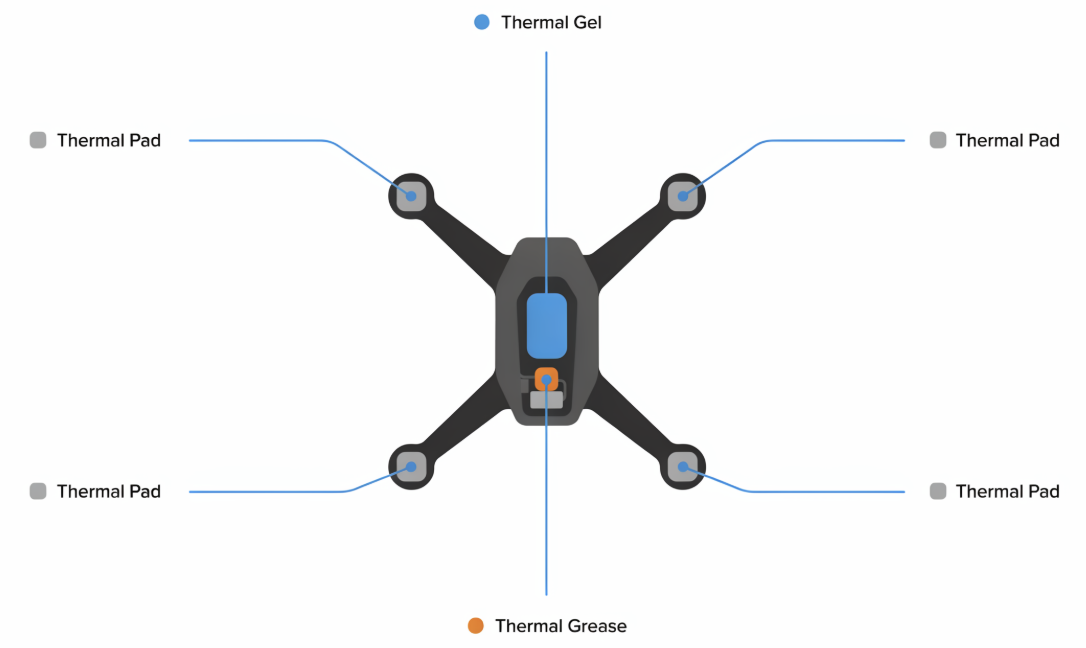
| Best-fit drone components | Motor controllers, ESCs, BMS | RF modules, flight computer | Battery packs, power modules |
Reading the table for drone-specific decisions: weight and vibration stability carry more practical weight in this application than they would in stationary electronics. A material with marginally lower conductivity but significantly less mass, or better resistance to motor vibration, is often the better engineering choice — even if it looks less impressive on a datasheet comparison.
Selection Guide by Component
Motor Controllers / ESCs
These sit closest to the source of vibration and typically carry significant current, generating localized heat at switching components. Thermal pads are the standard choice here — their built-in electrical insulation handles the proximity to motor phase voltages, and their compliance accommodates the often-uneven mounting surfaces inside compact ESC housings. Grease's pump-out risk under direct motor vibration makes it a poor fit at this specific location, even though it might be considered elsewhere on the airframe.
Battery Packs
Battery thermal interfaces need to handle both vibration and the thermal cycling that comes with repeated charge/discharge cycles across many flights. Thermal gel is generally the better fit — it maintains contact under vibration better than grease, while adding less weight than a thick compressed pad would need to achieve similar gap-filling across battery cell surfaces.
Flight Computer / Processors
Flight computers are typically mounted in a more vibration-isolated location than motors, and often have flatter, better-controlled mounting surfaces. This is where thermal grease's weight advantage becomes most valuable — minimal added mass for a component where every gram matters, in a location where pump-out risk is lower than at motor-adjacent positions.
RF Modules / Image Transmission
Similar to flight computers, RF modules benefit from grease's low thermal resistance and minimal weight addition. These components are also often more sensitive to material composition near antennas — confirm any TIM used near RF modules doesn't interfere with signal transmission, particularly with metal-filled high-conductivity formulations.
Common Mistakes in Drone TIM Selection
Optimizing for conductivity while ignoring weight. A thermal pad with the highest W/m·K rating on the datasheet isn't automatically the right choice if it's also the thickest and heaviest option. Calculate the actual thermal performance needed for your specific heat load, and select the lightest material that meets that requirement — not the highest-performing material available.
Skipping vibration validation. A TIM that performs well in static lab testing may behave very differently after dozens of flight hours with continuous motor vibration. If possible, validate material selection — particularly for motor-adjacent components — under representative vibration conditions before committing to production volumes.
Overlooking temperature range at altitude. Material selection based only on ground-level testing can miss performance issues at altitude, where ambient temperature may be significantly lower. Confirm your selected TIM maintains stated performance across your drone's full operating temperature range, not just at sea-level ambient conditions.
TaxoTape® Solutions
TaxoTape® supplies thermal pads, thermal grease, and thermal gel suited to drone and UAV electronics applications, including motor controllers, battery management systems, and flight computer assemblies.
Ultra-thin, lightweight thermal pad grades are available for weight-sensitive designs, along with custom die-cut formats matched to specific component footprints. Full technical documentation — including TDS and RoHS declaration — is provided with sample and production orders.
If you are developing thermal management for a new drone platform or addressing overheating issues in an existing design, we can recommend material grades based on your specific weight, vibration, and power density constraints.
Request samples or technical consultation →
Conclusion
Drone thermal management doesn't follow the same selection logic as stationary power electronics. Weight and vibration tolerance carry as much practical importance as raw thermal conductivity — sometimes more, depending on the specific component and its location relative to motors and propellers.
Matching the right TIM to each component location — pads for motor controllers and ESCs, grease for weight-sensitive low-vibration components, gel for battery packs and vibration-exposed power modules — produces a more reliable and efficient thermal design than applying a single material choice across the entire platform.
As drone designs continue pushing toward higher power and longer flight times, getting this component-by-component selection right becomes an increasingly meaningful factor in overall system reliability.
Contact TaxoTape® to discuss TIM selection for your drone platform →
FAQ
Q: How much does TIM choice actually affect drone flight time?
The weight difference between TIM options is typically small in absolute terms — often a few grams per component. On multi-rotor platforms with several thermally managed components, however, these small differences can add up to a meaningful fraction of payload capacity, particularly on smaller drone platforms where every gram has a larger proportional impact.
Q: Can thermal grease be used near drone motors if vibration-resistant grades are selected?
Some higher-viscosity or specialty grease formulations offer improved pump-out resistance compared to standard grades, but they still generally underperform pads or gel in sustained high-vibration environments. If grease must be used near motor-adjacent components, request vibration test data from your supplier and validate under representative conditions before production use.
Q: Do drone TIMs need to meet specific temperature certifications?
Most drone TIM selection relies on the manufacturer's stated operating temperature range rather than formal certification, though commercial and industrial drone applications may have additional requirements depending on end-use and regulatory context. Confirm your platform's specific certification needs before finalizing material selection.
Q: How do I know if my current TIM choice is causing overheating issues?
Thermal imaging during flight testing is the most direct way to identify hot spots. If specific components run consistently hotter than their rated operating temperature, or if failure rates increase during longer flights or hot weather operation, thermal interface performance is a reasonable first area to investigate.