Welcome to Taxo Tape
RoHS, REACH, and Halogen-Free TIMs Explained
Introduction
Environmental compliance used to be a checkbox handled at the end of the procurement process, after the engineering decisions were already made. That's no longer how it works in most industrial and commercial electronics supply chains. RoHS compliance, REACH substance declarations, and increasingly halogen-free and low-volatility requirements are now procurement entry conditions in European markets, and the expectation is spreading into industrial electronics globally.
For thermal interface materials specifically, this shift has practical consequences that are easy to underestimate. Not every TIM formulation is automatically compliant, compliance documentation varies significantly in quality between suppliers, and the gap between "RoHS-compliant" and genuinely green-spec materials is larger than most procurement teams realize. Specifying "RoHS compliant" on a purchase order and receiving a generic self-declaration back doesn't guarantee the material meets the full set of requirements your end customer or target market actually imposes. This guide walks through what RoHS, REACH, halogen-free, and low-volatility specifications actually mean for TIM procurement, how they interact, and what documentation is worth requiring before a material gets approved.
RoHS Compliance in Thermal Interface Materials
The EU RoHS Directive restricts ten substances in electrical and electronic equipment placed on the European market. The original six — lead, mercury, cadmium, hexavalent chromium, and two brominated flame retardant families (PBB and PBDE) — came under RoHS 1. Four additional phthalates (DEHP, BBP, DBP, DIBP) were added under RoHS 3, fully applicable since 2019.
For TIMs specifically, the substances that actually require attention are the brominated flame retardants and the phthalates. Lead and cadmium don't show up in standard TIM formulations, and hexavalent chromium isn't relevant to polymer-matrix materials — so a supplier declaration that spends most of its language on those substances isn't telling you much. Standard silicone-based pads and gap fillers without flame retardant additives are generally free of restricted substances by default. The complication arises specifically where flame retardancy is required: older formulations used brominated compounds that are now restricted, while current RoHS-compliant flame retardant TIMs rely on phosphorus-based additives, inorganic mineral fillers, or inherently flame-retardant polymer systems instead. Thermal greases with certain carrier fluids and some adhesive tapes with specific plasticizer systems also warrant explicit verification rather than an assumption of compliance based on material type alone.
One common misreading is worth flagging directly: RoHS compliance doesn't mean a material contains no hazardous substances at all — it means the ten specifically restricted substances stay below defined concentration thresholds (0.1% by weight for most, 0.01% for cadmium). A RoHS-compliant TIM can still contain substances that trigger REACH disclosure obligations or fall under other regional restrictions. RoHS is the baseline requirement, not the complete compliance picture.
How to Confirm RoHS Compliance
A reliable RoHS declaration specifies the directive version — 2011/65/EU as amended by 2015/863/EU for RoHS 3 — states that the product meets the maximum concentration values across all ten restricted substances, and identifies the specific product or product family by name and part number. A generic declaration covering an entire product catalog without product-specific identification isn't reliable compliance documentation, no matter how official it looks.
For procurement into European markets, request at minimum: a product-specific declaration of conformance, a full material disclosure or safety data sheet, and third-party lab test reports for any substance category where the supplier's formulation history suggests risk — primarily flame retardants and plasticizers. Also confirm the declaration addresses RoHS 3's phthalate additions specifically. A declaration that only references RoHS 2 without addressing the four added phthalates is incomplete for current procurement standards, even though it may have been accurate when originally issued.
REACH and Substance Restrictions in TIM Supply Chains
REACH operates on a different logic than RoHS. Where RoHS restricts specific substances above defined thresholds in finished products, REACH creates supply-chain-wide obligations tied to Substances of Very High Concern (SVHCs) present above 0.1% by weight in an article — a much broader and more dynamic category. The REACH Candidate List is updated twice yearly by the European Chemicals Agency and currently contains over 200 substances. For TIM procurement, the substances that actually matter are certain phthalates that overlap with the RoHS 3 list, specific siloxane compounds under ongoing regulatory review, and certain flame retardant chemicals.
The practical obligation is straightforward: if a TIM article contains an SVHC above the 0.1% threshold, the supplier must disclose that information to customers on request, and must notify consumers within 45 days if asked. This means you have a legal right to request SVHC disclosure for any TIM product — suppliers are obligated to respond.
Certain cyclic siloxanes — D4, D5, D6 — illustrate how this plays out in practice. These compounds have been under REACH scrutiny for environmental persistence, and while current restrictions don't directly prohibit their use in industrial TIM applications, some European OEM customer specifications restrict these siloxanes beyond what REACH law currently requires. If your end customer specifies low-siloxane or siloxane-free material for environmental rather than contamination reasons, request specific siloxane content data rather than relying on a general REACH declaration that won't address the question.
To verify your own materials, request a REACH SVHC declaration referenced to the current Candidate List version, stating either that no SVHCs are present above 0.1% or identifying which ones are and at what concentration. A declaration that simply states "REACH compliant" without addressing SVHCs specifically isn't meaningful — REACH doesn't have a single pass/fail threshold the way RoHS does, so that phrase alone tells you nothing.
Low-Volatility and Low-Outgassing Specifications
Outgassing refers to volatile compounds releasing from a material under elevated temperature or reduced pressure. In silicone-based TIMs, the primary species involved are low-molecular-weight siloxane oligomers — the same compounds responsible for optical surface contamination discussed in TIM Selection for Outdoor LED Drivers: Sealed Enclosure Requirements. Low-volatility specifications get driven by two distinct concerns that sometimes get conflated — contamination control and environmental or health considerations around VOC emissions — but both point to the same underlying material requirement.
ASTM E595 is the standard test method, measuring Total Mass Loss (TML — the percentage of mass lost during 24 hours at 125°C in vacuum) and Collected Volatile Condensable Materials (CVCM — the fraction of that loss that condenses on a collector plate at 25°C). Aerospace-derived thresholds of TML below 1.0% and CVCM below 0.1% serve as common reference benchmarks across electronics applications, including industrial TIM specifications, even though the test originated for spacecraft materials.
Low-volatility silicone formulations achieve these thresholds through higher-molecular-weight polymer systems that are less prone to volatilization, combined with post-curing to drive off residual low-molecular-weight species before shipping. Silicone-free TIMs — acrylic or polyurethane-based — inherently produce no siloxane outgassing at all, which is part of why they show up in optical and precision instrument applications beyond just contamination concerns. Thermal grease, by contrast, typically shows the highest outgassing of any TIM format due to its liquid carrier, and is usually the first format ruled out when low-volatility specification is a hard requirement rather than a general preference.
Halogen-Free TIM Specifications
Halogens — primarily bromine and chlorine — show up in TIM formulations mainly through flame retardant additives. Brominated flame retardants were the dominant route to UL 94V-0 flame retardancy in polymer-matrix materials for decades, and older formulations still reflect that history. The environmental concern is end-of-life behavior: incinerating brominated or chlorinated materials can generate dioxins and furans, persistent toxic pollutants, which has driven regulatory and customer specifications away from halogenated flame retardants independent of RoHS status.
This is where genuine procurement confusion tends to happen. RoHS restricts two specific brominated flame retardant families — PBB and PBDE — but doesn't restrict halogenated compounds generally. A TIM can be fully RoHS-compliant and still contain brominated or chlorinated flame retardants that simply fall outside RoHS's specific restrictions. Halogen-free specifications go further, typically defined under IEC 61249-2-21 as bromine content below 900 ppm and chlorine content below 900 ppm by weight. A material meeting that threshold is RoHS-compliant by definition for flame retardant substances — but the reverse isn't true, and RoHS documentation alone doesn't satisfy a halogen-free requirement when one exists.
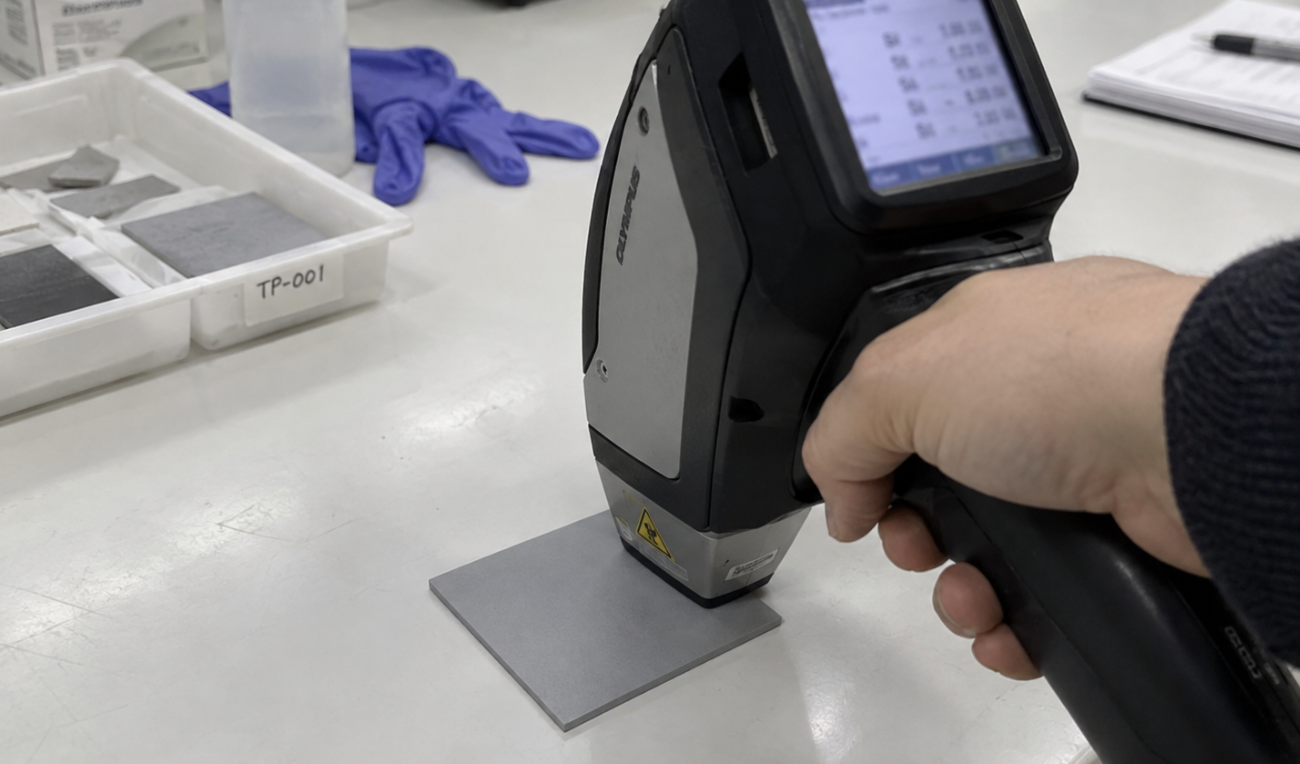
Halogen-free requirements show up most often in OEM specifications from companies with established environmental programs — particularly in European consumer electronics, automotive, and industrial equipment — and in some IPC/IEC standards for PCB materials that get extended to ancillary materials including TIMs. For products targeting the German industrial market specifically, halogen-free specification is increasingly a standard OEM requirement rather than an exception. To verify a supplier's halogen-free claim, request the supporting test report rather than accepting the declaration alone — XRF testing or ion chromatography from a third-party lab is considerably more reliable than self-declaration, particularly for flame-retardant-containing formulations where measurement accuracy matters.
Does Going Green Cost You Performance?
This is the question procurement teams actually care about, and the honest answer is: less than most people expect, with a few specific exceptions worth knowing.
For thermal conductivity specifically, RoHS compliance has essentially no effect — the restricted substances (flame retardants, plasticizers, heavy metals) aren't thermally functional components, so swapping a restricted flame retardant for a compliant alternative doesn't touch the filler loading or polymer matrix that determines conductivity. The one place compliance-driven reformulation can shift mechanical behavior is flame retardancy itself: phosphorus-based or mineral-based alternatives sometimes require higher additive loading than brominated compounds did to hit the same UL 94V-0 rating, which can slightly increase stiffness or reduce compressibility in some formulations — worth checking the datasheet if you're switching from an older halogenated grade.
Low-volatility formulations show a similar pattern: the higher-molecular-weight silicone systems used to reduce outgassing are generally somewhat stiffer than lower-molecular-weight equivalents at the same cross-link density, so low-volatility pads may run slightly firmer than standard formulations at equivalent conductivity — relevant if your application needs a very soft, conformable pad at low clamping pressure, otherwise not a meaningful concern. Halogen-free flame retardancy, achieved through phosphorus additives, mineral fillers, or inherently flame-retardant polymers, produces materials that hit the same UL 94V-0 classification as halogenated equivalents without a significant performance gap for most industrial applications.
The honest bottom line: conductivity, operating temperature range, and long-term stability across current green-spec formulations are comparable to conventional equivalents for the performance tiers relevant to industrial power electronics. The real gap is cost and supplier availability — green-spec formulations come from a narrower supplier base, carry modest price premiums, and sometimes involve longer lead times for custom thicknesses. Those are procurement considerations, not performance limitations.
What to Request From Your Supplier
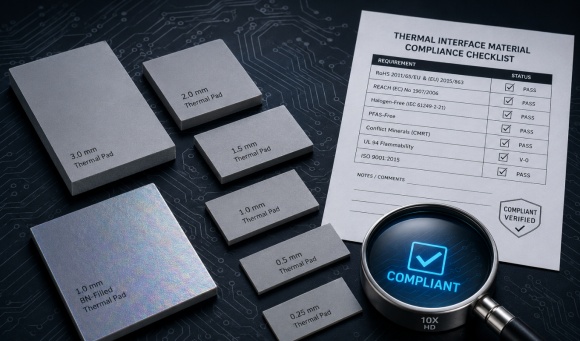
Before approving a TIM for a product with environmental compliance requirements, a minimum documentation set is worth establishing as standard practice: a RoHS declaration specifying the directive version and covering all ten substances by specific product and part number; a REACH SVHC declaration referenced to the current Candidate List version; a material safety data sheet in the language your market requires; and — where applicable — a halogen content test report against IEC 61249-2-21 thresholds, or ASTM E595 TML/CVCM data for low-volatility requirements. Each of these should name the testing lab and test date rather than arriving as an unreferenced summary statement.
Red Flags in Supplier Documentation
A few patterns signal documentation that shouldn't be relied on without follow-up. A declaration covering an entire product catalog rather than a specific product suggests the supplier hasn't actually conducted product-level verification. Generic language — "our products comply with all applicable regulations" — without substance-specific data isn't compliance documentation at all, regardless of how official the letterhead looks. Declarations with no issue date, or no reference to the specific directive version in force, can't be relied on as current. And a missing or generic-category SDS — one that describes a material family rather than the specific product — points to incomplete characterization that's worth resolving before the material gets approved for production.
FAQ
Q: Is a supplier's self-declaration enough, or do I need third-party testing?
Self-declaration is generally acceptable for RoHS compliance in standard commercial procurement, provided it's product-specific and backed by the supplier's internal material disclosure process. For halogen-free claims and SVHC disclosures — where the stakes of non-compliance are higher, particularly in automotive and regulated industrial markets — third-party lab confirmation provides meaningfully more assurance than self-declaration alone. For critical applications where non-compliance risks a recall or regulatory action, request third-party reports at initial qualification rather than relying on the supplier's word.
Q: What happens if my supplier reformulates a material that was already qualified?
This is a real and recurring risk — suppliers reformulate in response to raw material changes, regulatory updates, or performance improvements, and a material that was compliant at initial qualification can shift without a corresponding documentation update, especially for substances newly added to the REACH Candidate List. Build a formulation-change notification requirement into your supplier agreement, and for critical applications, treat a significant reformulation as a trigger for re-qualification testing rather than assuming continuity based on the original approval.
Q: My end customer specifies "low-siloxane" but doesn't cite a specific standard — what do I ask for?
This usually reflects a contamination-avoidance concern rather than a strict REACH-driven restriction, since REACH doesn't currently prohibit D4/D5/D6 siloxanes in industrial TIM applications outright. Ask the customer whether they have a specific threshold in mind, and in the absence of one, request siloxane content data directly from your TIM supplier rather than assuming a general low-volatility or RoHS declaration addresses the concern — it typically doesn't.
Conclusion
Environmental compliance in TIM procurement isn't a single checkbox — it's a layered set of requirements starting with RoHS, extending into REACH substance disclosure, and potentially including halogen-free and low-volatility specifications depending on your application and target market. Knowing which requirements actually apply to your product, and verifying them through specific documentation rather than assuming a general compliance statement covers everything, is what separates real compliance from paper compliance.
The reassuring part for procurement teams: current green-spec TIM formulations don't require meaningful performance trade-offs relative to conventional equivalents across the conductivity, temperature range, and stability tiers that matter for industrial power electronics. The premium is modest, and it's manageable with the right supplier relationships and documentation practices in place — covered in more detail in How to Validate a TIM Supplier.