Welcome to Taxo Tape
Thermal Interface Materials for LED Drivers: Selection Guide
Introduction
When an LED driver fails ahead of schedule, heat is usually the culprit — and more specifically, heat that had nowhere efficient to go.
Most engineers spend considerable effort managing thermal conditions at the LED chip level: selecting the right thermal pad beneath the package, optimizing the MCPCB, specifying the heat sink. That attention is well-placed. But the driver circuit behind the LED often receives less scrutiny — until something fails.
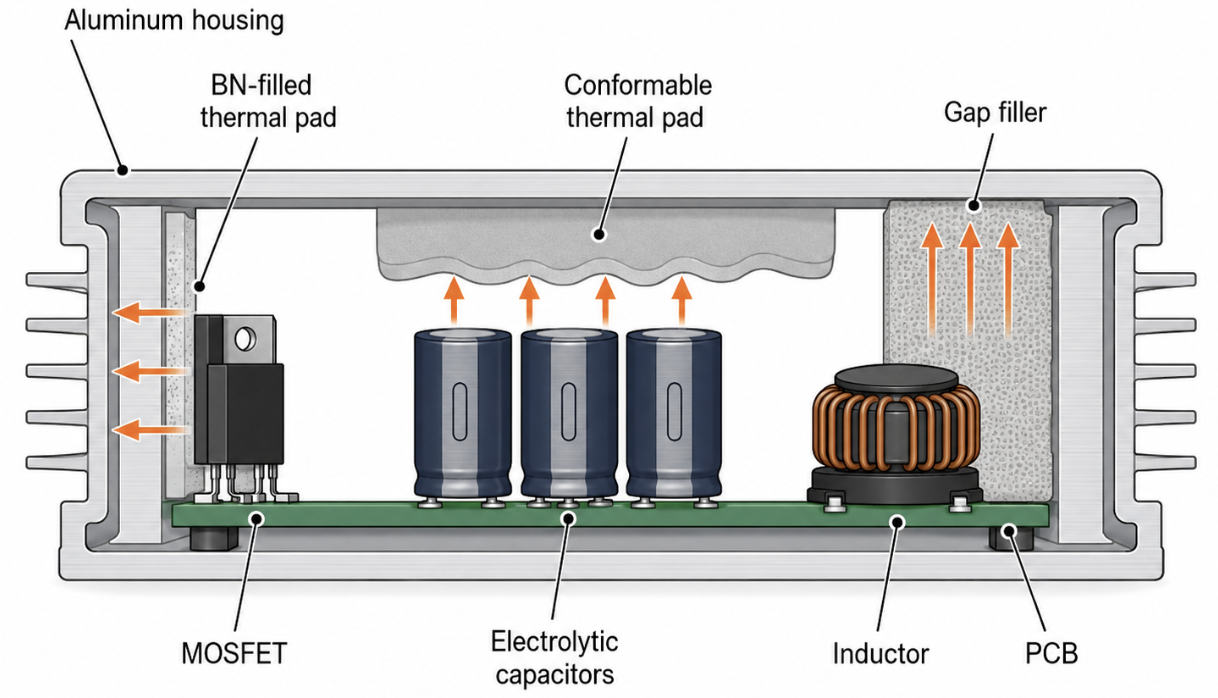
LED drivers run dense power electronics in increasingly compact enclosures. MOSFETs switching at high frequency, inductors under continuous load, electrolytic capacitors sensitive to even moderate temperature rise — all packed together, often with no active cooling. The thermal interface material bridging those components to the heat sink or housing wall plays a more critical role than many designs account for.
This guide covers how to evaluate and select the right TIM for LED driver applications — key material parameters, a practical comparison of TIM types, and the variables that most often get missed during the design phase.
Why LED Drivers Are Thermally Critical
It helps to think about heat flow as a chain. Heat originates at the LED junction, travels through the thermal pad into the MCPCB, then moves toward the driver circuitry and enclosure. In many luminaire designs — particularly integrated or sealed units — the driver shares the same thermal path and sometimes the same housing as the LED assembly. The driver's internal components are already operating in an elevated ambient before they begin generating heat themselves.
Inside a typical high-power LED driver, three component types contribute most to heat load:
MOSFETs and switching transistors generate heat through conduction and switching losses. In high-frequency topologies, switching losses alone account for a significant portion of total driver dissipation — often 30–50% of total thermal load in designs above 100W.
Inductors and transformers build heat through core losses and winding resistance under sustained load. In continuous conduction mode topologies, inductor temperature rise is often underestimated relative to the switching devices.
Electrolytic capacitors are the most temperature-sensitive component in the assembly. The widely cited 10°C rule — every 10°C rise above rated temperature approximately halves capacitor service life — has direct implications for driver longevity. A capacitor rated for 2,000 hours at 105°C operating temperature delivers roughly 8,000 hours at 85°C and 32,000 hours at 65°C. Getting junction temperature down by 20°C through better thermal management is not a marginal improvement — it is a 4x service life multiplier for the most failure-prone component in the assembly.
When the thermal interface between these components and the heat sink or chassis wall is inadequate — wrong conductivity, inconsistent contact, excessive bond line thickness — heat accumulates at the component junction rather than dissipating. Industry failure analysis data consistently identifies electrolytic capacitor degradation as among the leading causes of LED driver field failures, with thermal stress as the primary contributing factor.
Key TIM Parameters for LED Driver Applications
Thermal conductivity (W/m·K)
Conductivity is the most commonly referenced TIM specification, but it is frequently over-weighted in isolation. For LED driver applications, requirements vary with power density:
30–100W drivers: 1.5–4 W/m·K typically sufficient
100–200W high-density designs: 4–6 W/m·K appropriate
Above 200W or high-frequency compact designs: 6–8 W/m·K may be warranted
Chasing higher conductivity numbers without addressing bond line thickness or surface contact quality produces diminishing returns. A 6 W/m·K pad at 2 mm BLT has higher thermal resistance than a 3 W/m·K pad at 0.5 mm BLT — the calculation is straightforward: R = thickness ÷ conductivity.
Thickness and conformability
Driver PCBs and internal components rarely present perfectly flat mating surfaces. Capacitors, through-hole components, and solder joints create surface irregularities that rigid materials cannot bridge effectively. A TIM's conformability — its ability to fill surface voids under compression — directly affects real-world thermal resistance, independent of the conductivity datasheet value.
For gap-filling between components and a chassis wall, compressed thicknesses from 0.5 mm to 3 mm are typical. Select initial thickness and compressibility to ensure adequate contact without applying damaging mechanical load to sensitive components.
Electrical insulation (dielectric strength)
In isolated LED driver topologies — flyback, isolated buck-boost — the TIM may sit across a high-voltage boundary between a primary-side switching component and a grounded heat sink. In these configurations, dielectric strength is not optional. Boron nitride (BN) filled pads offer a useful combination: thermal conductivity in the 3–6 W/m·K range with dielectric strength of 15–25 kV/mm. For non-isolated topologies, standard silicone-filled grades at 8–15 kV/mm typically satisfy isolation requirements.
Operating temperature range
Outdoor and industrial LED systems cycle between cold startup and full operating load — commonly -40°C to 125°C for street lighting and industrial high-bay applications. A TIM that performs adequately at room temperature but becomes brittle at -30°C or loses conformability above 100°C introduces long-term reliability risk. Verify the material's rated range covers the full operational envelope, not just nominal steady-state.
Volatility and outgassing
In sealed or poorly ventilated enclosures, volatile compounds from thermal materials can condense on optical components, PCB surfaces, or connector contacts. Low-volatility thermal pads are specifically formulated to minimize this risk. For any LED driver housed in a sealed enclosure — integrated street light heads, waterproof industrial fixtures — outgassing specification should be part of material qualification criteria.
Compressive load limits
Compressive load tolerance matters where components have tight mechanical stress limits. Electrolytic capacitors can be damaged by excessive clamping force — most aluminum electrolytic capacitors specify maximum radial or axial load limits in their datasheets. Understand the compression force versus thickness curve of your TIM and verify assembly clamping loads against component specifications before finalizing material selection.
TIM Options Compared
| TIM Type | Thermal Conductivity | Typical BLT | Dielectric Strength | Key Advantage | Primary Limitation |
|---|---|---|---|---|---|
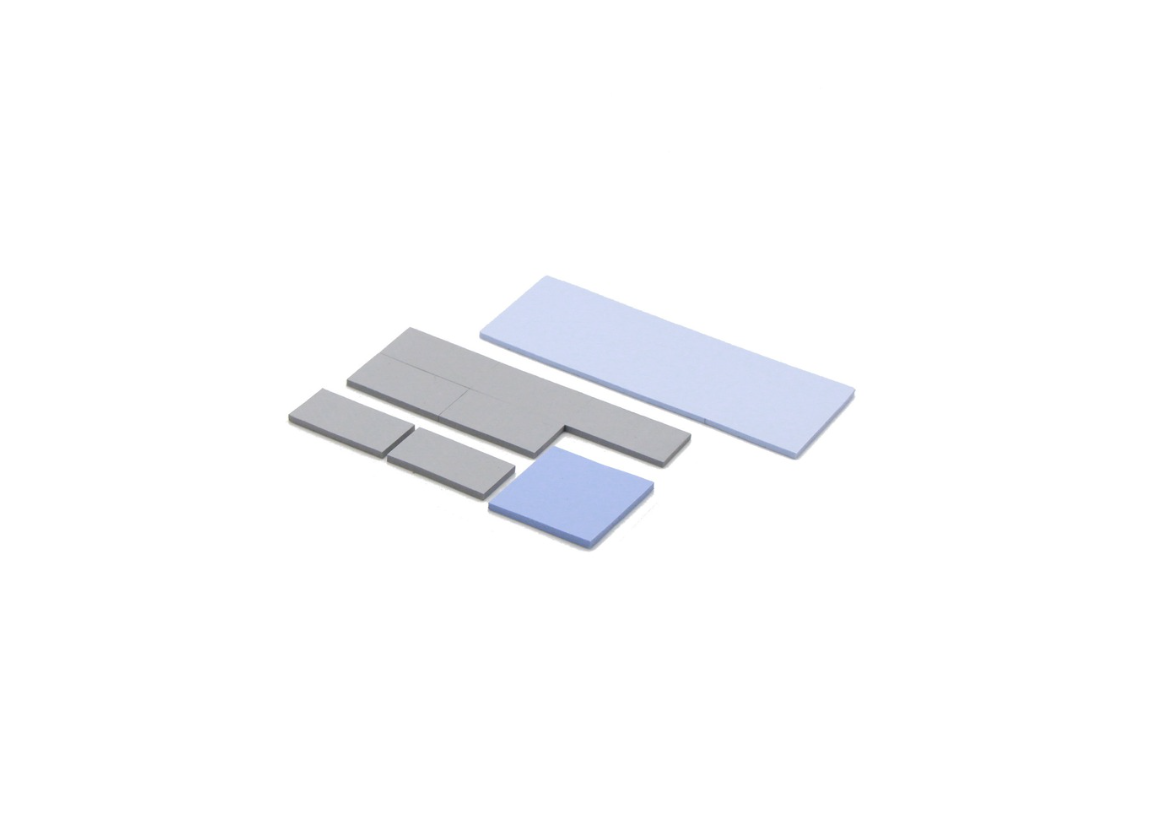
| Silicone thermal pad | 1–6 W/m·K | 0.3–3 mm | 8–15 kV/mm | Versatile, easy assembly, wide thickness range | Moderate conductivity ceiling |
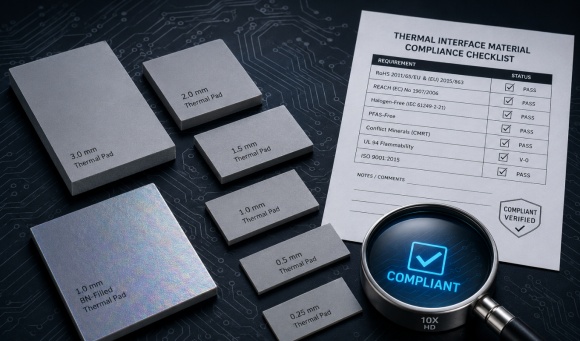
| BN-filled pad | 3–8 W/m·K | 0.3–2 mm | 15–25 kV/mm | High insulation + conductivity | Higher cost, less conformable |
| Low-volatility pad | 1.5–4 W/m·K | 0.5–2 mm | 8–15 kV/mm | Sealed enclosure safe | Narrower conductivity range |
| Phase change material | 3–8 W/m·K | 20–80 µm | Requires separate layer | Lowest thermal resistance | Flat surfaces only, higher cost |
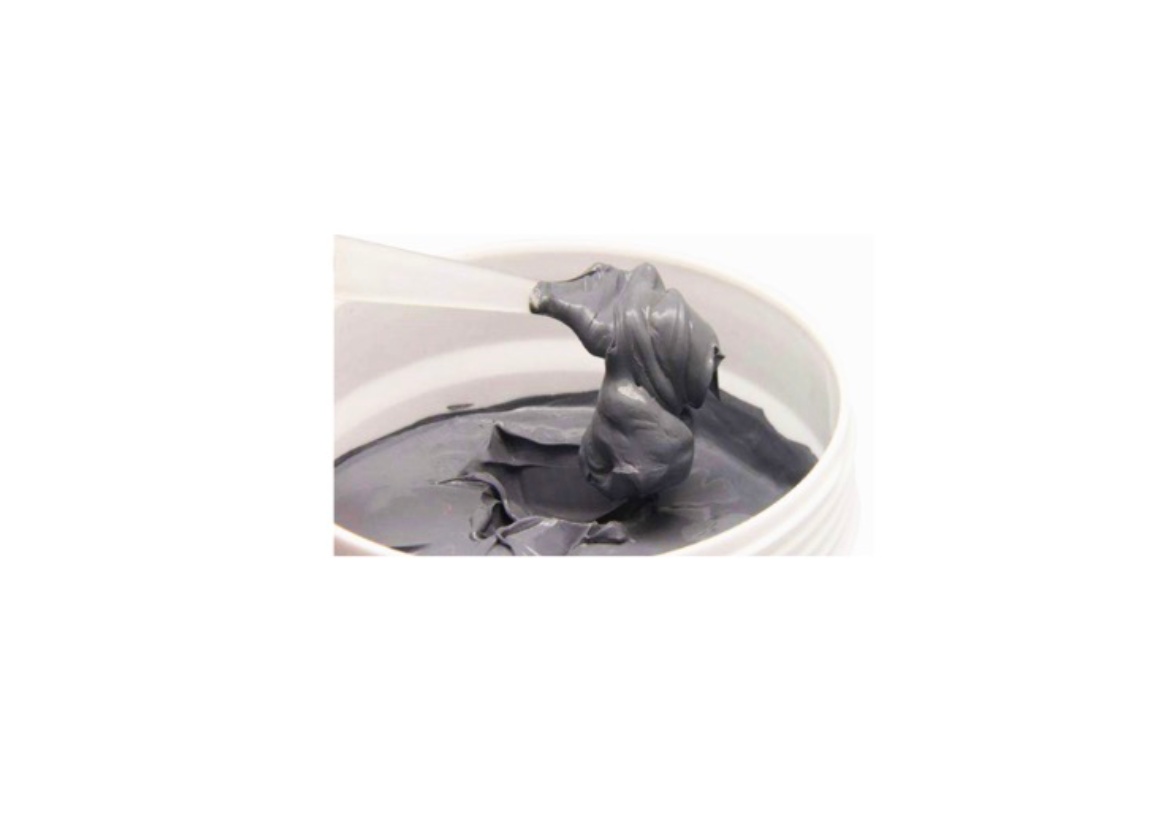
| Thermal grease | 3–10+ W/m·K | 20–150 µm | Grade dependent | Maximum initial conductivity | Pump-out risk, process sensitive |
| Gap filler (gel) | 1–4 W/m·K | 0.5–5 mm | Grade dependent | Large gaps, complex geometry | Lower conductivity ceiling |
How to read this table for LED driver selection:
Silicone thermal pads cover the majority of LED driver applications — standard commercial and industrial drivers where reliable performance across production volume is the priority. BN-filled pads are the solution when both high conductivity and high dielectric strength are required simultaneously, as in isolated high-power topologies. Low-volatility pads address sealed enclosure outgassing concerns that standard silicone grades do not. Phase change materials suit controlled flat interfaces — discrete transistor mounting — rather than the irregular geometries typical of driver PCB assemblies. Thermal grease delivers the lowest initial resistance but requires careful process control and is poorly suited to vibration environments or sealed designs where rework is not possible.
Outdoor and sealed LED driver applications introduce additional requirements beyond standard indoor designs — particularly around siloxane outgassing risk in shared enclosures and compression set over long service life. For sealed IP66/IP67 driver applications, see [our dedicated guide on outdoor LED driver TIM selection].
Common Selection Mistakes
Over-specifying conductivity while ignoring bond line thickness.
A 6 W/m·K pad assembled with a 2 mm bond line produces higher thermal resistance than a 3 W/m·K pad at 0.5 mm. Thermal resistance is R = thickness ÷ (conductivity × area) — both variables matter equally. Optimizing the conductivity number on the datasheet without controlling the actual compressed thickness in the assembly is the single most common source of unexpected thermal performance in production LED driver builds. Measure actual BLT in assembled units, not just nominal pad thickness.
Using thermal grease in vibration-prone environments.
Grease delivers excellent initial thermal contact but has no mechanical cohesion. In applications subject to vibration — transportation infrastructure, industrial machinery-adjacent installations, outdoor fixtures subject to wind loading — grease migrates over time, leaving dry spots and progressively rising thermal resistance. Phase change materials or conformable pads with structural integrity hold up significantly better under dynamic loading. If initial thermal performance data drove the grease selection, rerun the analysis with a high-conductivity PCM or BN-filled pad — the thermal resistance difference is often smaller than expected, and the reliability difference is substantial.
Ignoring compressive load limits on electrolytic capacitors.
Applying a high-hardness pad across a zone that includes electrolytic capacitors creates a mechanical risk that is straightforward to miss during material selection. The thermal requirement drives the pad choice, and the capacitor's compressive load tolerance gets treated as a secondary concern. Most aluminum electrolytic capacitors specify maximum radial load in their datasheets — commonly 10–30 N depending on package size. Specify compression force curves alongside conductivity, verify assembly clamping loads against component datasheets, and consider softer pad grades or local cutouts where capacitors sit in the thermal interface zone.
Skipping accelerated aging qualification.
A TIM that passes initial thermal resistance testing may behave differently after 500 hours at 85°C or 100 thermal cycles between -40°C and 125°C. Pump-out, delamination, and hardening are real degradation modes that only appear under accelerated aging. For LED driver applications where the design life target is 50,000 hours or more, qualifying only at initial room-temperature conditions is not a meaningful reliability assessment. Add thermal cycling and elevated temperature soak to the qualification sequence before production commitment.
How to Validate TIM for Your LED Driver Design
Information to prepare before supplier engagement:
The faster a supplier can narrow the sample field, the faster your qualification moves. Before contacting a TIM supplier, have the following defined: nominal gap dimension and tolerance, operating temperature range (minimum cold start to maximum steady-state), electrical isolation requirements and any applicable voltage rating, compressive load constraints for the most sensitive components in the interface zone, and whether the enclosure is sealed or vented. With this information, a supplier can recommend two or three specific grades for evaluation rather than sending a generic sample kit that requires internal screening.
Practical validation sequence:
A structured sample evaluation for LED driver applications typically follows this order:
Initial thickness and hardness check against specification — verify the received sample matches the datasheet values before investing time in thermal testing.
Thermal resistance measurement at the target BLT under representative clamping conditions — not at nominal pad thickness, but at the compressed thickness achieved in your actual assembly.
Compressive load characterization across the range of assembly torque variation in production — confirm the maximum load at the tightest tolerance does not exceed the most sensitive component's specification.
Accelerated aging — minimum 100 thermal cycles across the rated temperature range, plus 500-hour elevated temperature soak at 85°C or higher depending on application. Re-measure thermal resistance post-aging and compare to initial values.
Outgassing test if the enclosure is sealed — place a sealed sample assembly at 85°C for 500 hours and inspect internal optical or contact surfaces for visible condensate.
Custom formats:
Standard sheet stock works for prototyping and low-volume production. For production volumes above a few hundred units per month, die-cut pads matched to your PCB layout reduce assembly time, improve placement consistency, and eliminate manual cutting variability. Perforated formats that allow gas escape from sealed enclosures during thermal cycling are also available for applications where outgassing is a qualification concern.
TaxoTape® Solutions
TaxoTape® supplies silicone thermal pads, low-volatility pads, BN-filled high-dielectric pads, phase change materials, and thermal grease for LED driver applications across commercial, industrial, and outdoor lighting segments.
Available in standard sheet formats and custom die-cut dimensions matched to PCB or component footprints. Full technical documentation is provided with sample and production orders, including TDS, dielectric strength data, compression force versus thickness curves, volatility test data where applicable, and RoHS declaration.
For LED driver development programs, we can recommend specific grades based on your power density, gap geometry, enclosure type, and isolation requirements — and support the full validation sequence from initial sample through production qualification.
Request samples or technical consultation →
Conclusion
Selecting a thermal interface material for an LED driver is not a single-variable decision. Thermal conductivity matters, but bond line thickness, dielectric requirements, environmental durability, outgassing behavior, and long-term stability under thermal cycling all affect whether the material performs in the field — not just in initial testing.
The payoff from getting this right is measurable: lower electrolytic capacitor junction temperatures, longer driver service life, fewer field failures, and LED systems that perform to their rated lifespan. It rarely requires exotic or expensive materials — it requires the right material, properly specified for the actual operating conditions and qualified under representative aging conditions before production commitment.
Contact TaxoTape® to discuss TIM selection for your LED driver application →
FAQ
Q: What thermal conductivity grade is sufficient for a 100W LED driver?
For most 100W LED driver designs, a silicone thermal pad in the 2–4 W/m·K range provides adequate thermal resistance margin at typical bond line thicknesses of 0.5–1.5 mm. The more important variable is achieving consistent BLT across production units — a 3 W/m·K pad at controlled 0.8 mm BLT will outperform a 5 W/m·K pad applied inconsistently at 1.5–2.5 mm BLT. Confirm against your thermal model using the actual compressed thickness, not the nominal pad thickness.
Q: Does the TIM need to be electrically insulating in all LED driver designs?
Not in all designs, but in many. Non-isolated LED driver topologies — constant current buck converters referenced to output ground — may not require electrical isolation at the TIM interface if the component case is at a safe potential relative to the heat sink. Isolated topologies — flyback, isolated buck-boost — typically do require insulating TIM at primary-side switching components. Verify the electrical potential at each interface in your specific design before specifying insulating versus non-insulating grades.
Q: How do I address TIM outgassing in a sealed LED driver enclosure?
Specify low-volatility thermal pads that are formulated to minimize siloxane and volatile organic compound release. Request outgassing test data from the supplier — ideally TML (total mass loss) and CVCM (collected volatile condensable materials) values measured under representative temperature and duration conditions. Avoid standard silicone thermal pads in tightly sealed enclosures unless outgassing test data confirms compliance with your contamination sensitivity threshold.
Q: Can I use the same thermal pad grade for both the LED assembly and the driver circuit?
Sometimes, but not always. LED assembly interfaces typically require high conductivity and good electrical insulation — the MCPCB interface is usually flat and controlled, favoring thinner, stiffer pads. Driver circuit interfaces often have larger and more variable gaps due to component height variation — favoring softer, more compressible grades. The two interfaces may have different optimal grades. Evaluate them separately based on their specific gap size, power density, and electrical requirements rather than standardizing on one grade for both.