Welcome to Taxo Tape
BN vs. Alumina Thermal Pads: Thermal Conductivity, Dielectric Strength, and When to Use Each
Introduction
When specifying a thermal pad, most engineers start with thermal conductivity. But for pads filled with ceramic particles, the filler type shapes nearly every property that matters — not just how well heat moves, but how the material behaves under voltage stress, how it conforms to a surface, and what it costs at volume.
Boron nitride (BN) and alumina (Al₂O₃) are the two fillers you'll encounter most often. On paper, both are electrically insulating ceramics used to load a silicone matrix. In practice, they serve different application profiles — and picking the wrong one doesn't just leave thermal performance on the table. It can introduce dielectric risk in high-voltage systems, or add cost that the application simply doesn't justify.
This article breaks down both fillers across the parameters that actually drive a material selection decision.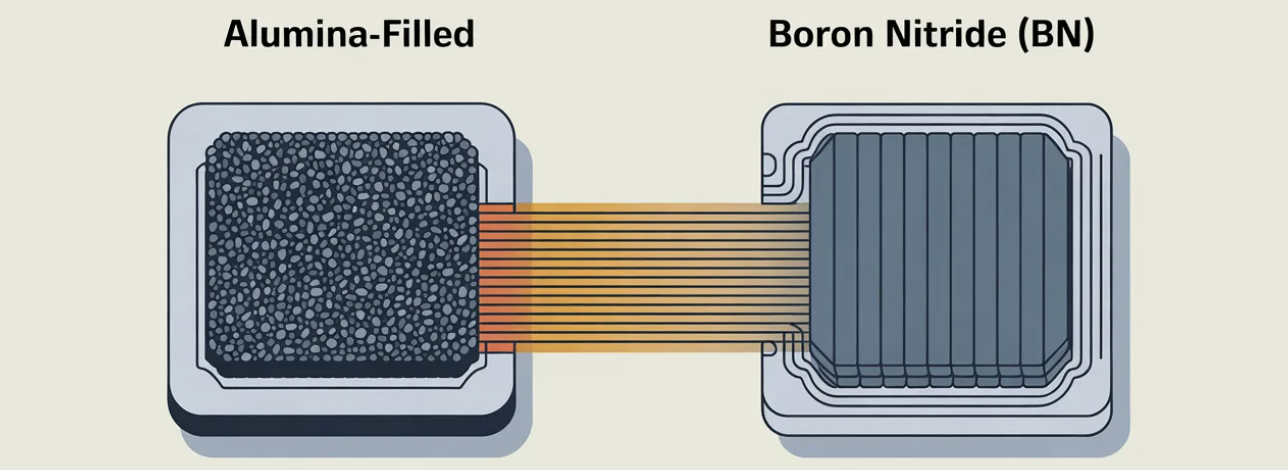
What Makes a Thermal Pad Filler?
Pure silicone is a poor thermal conductor — typically around 0.2 W/m·K. Ceramic fillers suspended in that matrix bridge the gap between adjacent surfaces and create pathways for heat to travel through. But the choice of filler, its particle morphology, and its loading level determine where the ceiling is.
Engineers evaluating a thermal pad typically look at four properties: thermal conductivity (W/m·K), dielectric strength (kV/mm), volume resistivity (Ω·cm), and mechanical hardness (often Shore OO). These properties don't move independently. A filler that pushes thermal conductivity up often affects hardness, which in turn affects how well the pad conforms to rough or stepped surfaces — and therefore what the actual interface resistance looks like once assembled.
Understanding the filler is the fastest way to understand those trade-offs before you request a sample.
Alumina (Al₂O₃): The Workhorse Filler
Alumina is the most widely used filler in commercial thermal pads — for good reason. It's abundant, relatively inexpensive to process, and delivers reliable thermal and electrical performance across a broad range of industrial applications.
Thermal conductivity in alumina-filled pads typically falls between 3 and 8 W/m·K, depending on filler loading and particle size distribution. Higher conductivity is achievable, but pushing alumina-filled formulations significantly above this range runs into diminishing returns: the loading required to maintain performance starts to compromise flexibility and increase hardness, making the pad harder to compress and less able to conform to surface irregularities.
On the electrical side, alumina performs adequately for most standard applications. Volume resistivity is generally in the range of 10¹² to 10¹³ Ω·cm, and dielectric strength typically measures around 10–15 kV/mm. These numbers satisfy isolation requirements in many industrial power designs — but they leave limited margin in high-voltage environments or where long-term reliability under repetitive electrical stress matters.
Hardness is worth flagging. Alumina particles are relatively rigid, which tends to produce pads with higher Shore OO values. In a clean, flat assembly — a flat-bottom MOSFET bolted to a machined heatsink — this is manageable. On PCBs with component height variation, or heatsinks with surface roughness from extrusion, harder pads can bridge imperfectly and leave air pockets that undermine thermal resistance.
Where alumina-filled pads make sense: LED driver boards, motor drive modules, industrial control electronics, general-purpose power conversion below 1 kV. Anywhere cost efficiency matters and the electrical environment is moderate.
Boron Nitride (BN): The High-Performance Alternative
Hexagonal boron nitride — the form used in thermal pads — has a layered platelet structure, similar in geometry to graphite. That structure is responsible for both its performance advantages and one design consideration engineers need to account for.
Thermal conductivity in BN-filled pads typically ranges from 6 to 15+ W/m·K, with some engineered formulations exceeding that through filler orientation or hybrid loading. The platelet geometry, when oriented along the Z-axis (the through-thickness direction), creates more direct thermal pathways between the two mating surfaces — which is exactly where the heat needs to go in most electronics cooling assemblies.
The electrical properties are where BN clearly separates from alumina. Volume resistivity typically exceeds 10¹⁴ Ω·cm, and dielectric strength commonly falls in the 15–25+ kV/mm range. BN also has a low dielectric constant and low loss tangent — properties that matter in high-frequency switching environments. SiC and GaN power devices operating at switching frequencies above 100 kHz generate conditions where the electrical properties of the thermal interface material are no longer invisible to circuit behavior.
BN platelets are also soft — softer than alumina particles at equivalent loading. This translates to thermal pads that conform more readily to surfaces, compress at lower applied pressures, and achieve lower real-world interface resistance relative to what the bulk conductivity number might suggest.
The honest trade-off: BN carries a meaningful cost premium over alumina, and the anisotropic nature of the filler means Z-axis and X-Y conductivity values can differ significantly. When requesting data from a supplier, always confirm which axis the quoted conductivity was measured along.
Where BN-filled pads make sense: high-voltage power supplies, EV charging stations, string inverters, IGBT and SiC module assemblies, telecom rectifiers — anywhere the design demands both strong thermal performance and reliable electrical isolation under elevated voltage stress.
Direct Comparison
| Property | Alumina-Filled | BN-Filled |
|---|---|---|
| Typical Thermal Conductivity | 3–8 W/m·K | 6–15+ W/m·K |
| Dielectric Strength | ~10–15 kV/mm | ~15–25+ kV/mm |
| Volume Resistivity | ~10¹²–10¹³ Ω·cm | >10¹⁴ Ω·cm |
| Conformability | Moderate to firm | Soft to moderate |
| Dielectric Constant / Loss | Moderate | Low |
| Relative Cost | Lower | Higher |
| Filler Isotropy | Isotropic | Anisotropic (platelet) |
A few rows deserve a closer look. The conformability difference matters most in assemblies where applied clamping force is limited — spring clips instead of screws, or thermal pads used in consumer products where torque specs aren't tightly controlled. In those scenarios, a softer BN pad can outperform a higher-conductivity alumina pad simply by making better contact.
The dielectric constant and loss tangent row is easy to skip, but shouldn't be in wide-bandgap applications. A higher dielectric loss in the thermal interface material can contribute to parasitic capacitance and influence switching behavior in fast-edge GaN or SiC topologies.
Choosing Between Them: A Practical Framework
Neither filler wins universally. The decision follows a few clear criteria:
Voltage class first. If your application operates above 1 kV, involves reinforced insulation per IEC 60664, or is subject to hipot testing at elevated voltages, BN's dielectric margin gives you a more defensible position. Alumina can pass standard isolation tests, but the headroom is narrower.
Thermal budget second. If junction-to-case thermal resistance is a bottleneck and your power density requires conductivity above 6–8 W/m·K, alumina-filled pads are unlikely to solve the problem. BN opens up the range.
Surface quality and assembly conditions. Rough heatsink surfaces, component height variation across a PCB, or low and inconsistent clamping force all favor a softer, more conformable pad — which points toward BN-filled formulations.
Cost sensitivity and volume. For high-volume, lower-voltage applications — LED street lighting, consumer power adapters, SMPS in home appliances — alumina-filled pads typically deliver the required performance at a fraction of the cost. The BN premium is hard to justify where neither the voltage nor thermal requirements demand it.
Switching frequency. If your power stage uses SiC or GaN devices and operates at high frequency, don't overlook the dielectric properties. BN's lower loss tangent is a design asset in these environments, even when thermal performance alone wouldn't require it.
A Note on Hybrid Fillers and Other Options
Some thermal pad formulations use mixed filler systems — alumina combined with BN, or alumina with aluminum nitride (AlN) — to dial in a specific conductivity range at a lower cost than pure BN. These hybrid pads can be a reasonable middle ground when the application sits between the two profiles described above.
AlN deserves a brief mention: its intrinsic thermal conductivity is higher than both alumina and BN, and its electrical properties are excellent. But AlN is brittle, expensive, and less commonly available in pad form. It appears more often in substrate materials than in polymer composite pads.
One thing worth keeping in mind throughout this comparison: the filler is one lever among several. Pad thickness, surface finish on both mating surfaces, applied pressure, and long-term compression set all contribute to actual interface resistance. Two pads with identical conductivity specs can perform very differently in a real assembly. Conductivity data from a supplier is a starting point — not a final answer.
Closing
BN and alumina thermal pads solve overlapping but distinct problems. Alumina is cost-effective, proven, and appropriate for the majority of standard industrial and commercial power applications. BN is the right call when voltage class, thermal requirements, or switching conditions push beyond what alumina can reliably cover.
When you're qualifying a thermal pad from a supplier, ask for: thermal conductivity test standard (ASTM D5470 or equivalent), the axis along which conductivity was measured, dielectric strength test method and sample thickness, and hardness in Shore OO. Those four data points will tell you far more than a headline conductivity number.
If your application sits at the boundary — moderate voltage, thermal conductivity requirement around 6–8 W/m·K — it's worth testing both. Real-world thermal resistance at your actual clamping force, on your actual surface finish, may resolve the comparison faster than any datasheet comparison will.