Welcome to Taxo Tape
Thermal Grease vs. Thermal Gel for EV Battery Pack Assembly
Introduction
EV battery pack thermal management presents a different set of engineering constraints than most power electronics applications. The TIM is not interfacing a single chip to a single heat sink — it is covering large surface areas across dozens or hundreds of cells, operating in a vibration environment most consumer electronics never experience, and expected to perform without maintenance access for the full vehicle service life.
These conditions change which TIM properties actually matter. A material that performs well in a stationary, low-vibration application may behave very differently inside a battery pack subjected to years of road vibration, thermal cycling between charging and discharge events, and zero opportunity for field service.
This article looks specifically at thermal grease versus thermal gel in the context of EV battery pack assembly — where the general tradeoffs between the two materials get amplified, and where the wrong choice carries higher consequences than in most other applications.
Why Battery Pack Thermal Management Is Different
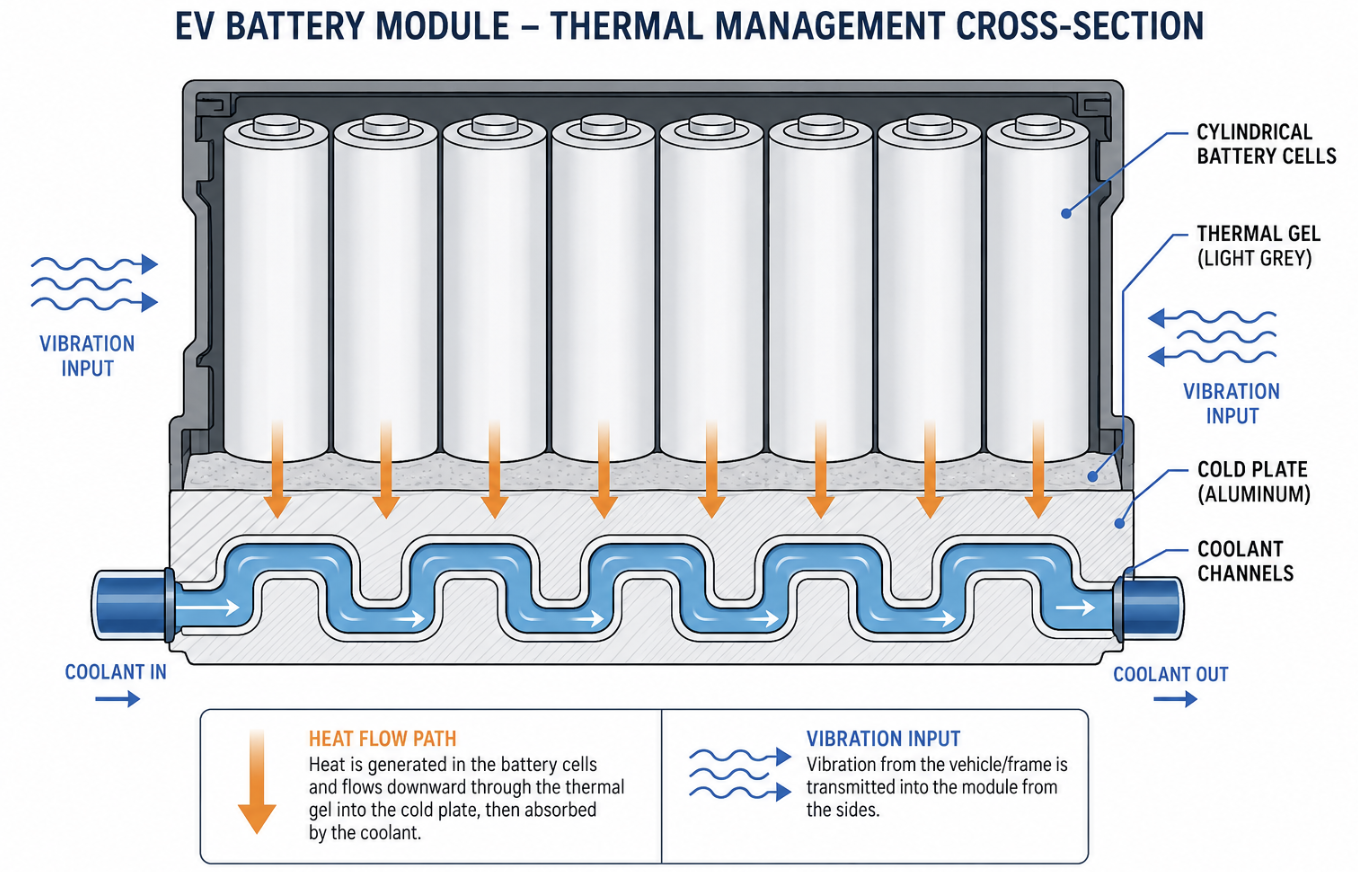
Large-area coverage. A typical EV battery module requires TIM coverage across cell-to-cell interfaces, cell-to-cold-plate contact areas, or module-to-enclosure surfaces — often hundreds of square centimeters per module, multiplied across the full pack. Coverage consistency across that area directly affects pack-level thermal balance; uneven TIM application creates localized hot spots that can accelerate cell degradation unevenly across the pack.
Vibration and mechanical shock. Vehicles generate sustained vibration across a wide frequency range throughout their operating life, plus occasional shock loading from road impacts. Any TIM in this environment needs to maintain interface contact under continuous mechanical stress, not just thermal cycling.
Safety sensitivity. Battery packs carry inherent thermal runaway risk if cell temperatures exceed safe operating limits. TIM failure that leads to localized overheating is not just a performance issue — it is a safety consideration. Electrical insulation requirements are also typically stricter, given the high pack voltages involved (400V–800V in most modern EV architectures).
Long service life without maintenance access. Vehicle design life targets typically run 8–15 years or 150,000–300,000 km. Battery packs are sealed assemblies; once installed, the TIM inside is essentially permanent. There is no realistic field service path to reapply degraded thermal grease mid-vehicle-life. Whatever material goes in during pack assembly needs to perform for the full service life.
Thermal Grease in Battery Pack Applications
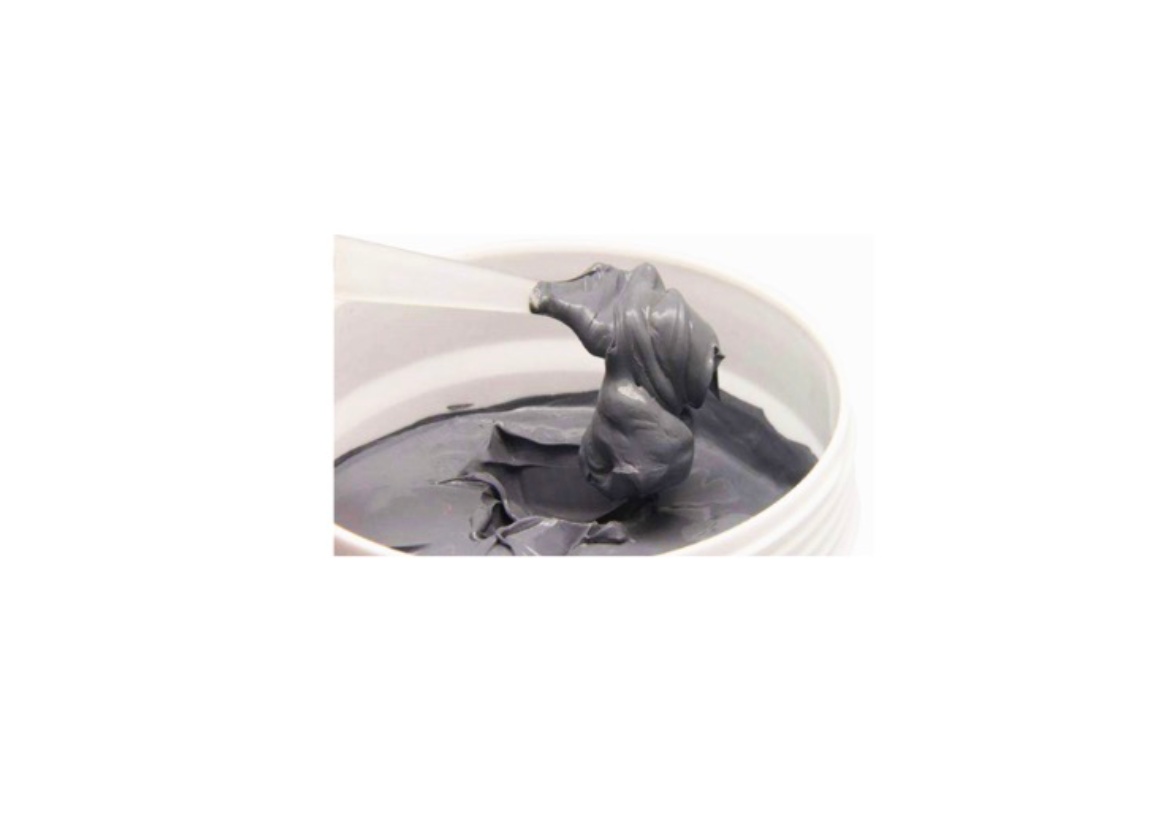
Thermal grease does appear in some battery pack designs — typically at smaller, accessible interfaces such as BMS (battery management system) board components or auxiliary power electronics within the pack, rather than at the primary cell-to-cold-plate or cell-to-cell thermal paths.
Where grease still gets used: Small-scale applications within the pack — discrete power components on the BMS board, DC-DC converter modules, or other localized heat sources where the interface is small, accessible during assembly, and not subject to the same vibration loading as the primary battery structure.
Why it's rarely used at the pack/module level: The core limitations of grease — pump-out under cycling and mechanical stress, and inconsistent coverage at scale — are both significantly amplified in this application.
Pump-out risk increases substantially under sustained vehicle vibration compared to grease's typical performance envelope in stationary electronics. Combined with thermal cycling between charging, driving, and ambient temperature swings, grease applied across large module surfaces is prone to migration over the vehicle's service life — exactly the failure mode that cannot be corrected once the pack is sealed.
Coverage consistency across large surface areas is also difficult to control with grease in production. Manual or even semi-automated grease application across dozens of cell interfaces per module introduces volume and thickness variation that affects pack-level thermal uniformity — a meaningful concern when cell-to-cell temperature differences directly impact battery degradation rates and safety margins.
Thermal Gel in Battery Pack Applications
Thermal gel has become the standard TIM choice for primary thermal paths in EV battery pack assembly — cell-to-cold-plate interfaces, module-to-enclosure bonding, and large-area thermal management surfaces.
Why gel dominates this application:
Vibration resistance through viscoelastic behavior. Gel's semi-cured, crosslinked structure allows it to deform under mechanical stress and recover, rather than migrating away from the contact area the way grease does. This viscoelastic property is specifically what makes gel suitable for sustained vehicle vibration over years of operation — it absorbs mechanical energy at the interface rather than being displaced by it.
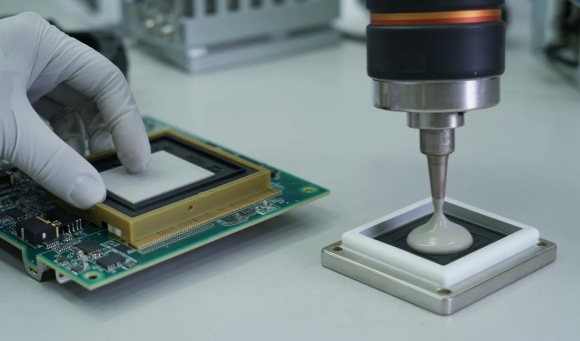
Automated large-area dispensing. Battery module production is high-volume and heavily automated. Gel's stable, thixotropic consistency — holding its shape after dispensing but flowing under applied pressure — makes it compatible with robotic dispensing systems that apply consistent bead or dot patterns across cell arrays. This produces repeatable coverage and bond line thickness module-to-module, which grease application cannot reliably match at this scale.
Long-term stability without field access. Because gel does not rely on a migrating carrier fluid, its thermal performance remains stable across the vehicle's full service life without requiring any maintenance. Accelerated aging data on gel formulations consistently shows stable thermal resistance after thousands of thermal cycles — directly relevant given that a battery pack experiences continuous charge/discharge thermal cycling for its entire operating life.
Compression set behavior under sustained loading. Battery modules are typically assembled under continuous compressive load to maintain cell stack integrity. Gel formulations are designed to maintain consistent thickness and contact pressure under this sustained compression, supporting stable thermal resistance over years of structural loading — a requirement that doesn't apply in most other TIM applications.
Head-to-Head: Battery Pack Specific Comparison
The table below focuses on the parameters most relevant to battery pack assembly specifically — not general TIM performance, but behavior under the vibration, scale, and service-life conditions unique to this application.
| Parameter | Thermal Grease | Thermal Gel |
|---|---|---|
| Vibration stability | Poor — prone to pump-out under sustained vibration | Strong — viscoelastic recovery resists migration |
| Large-area coverage consistency | Difficult to control at scale | Repeatable via automated dispensing |
| Performance after 1,000+ thermal cycles | Significant degradation typical | Stable (within ~10-15% of initial) |
| Compression set under sustained load | Not applicable (flows continuously) | Maintains thickness under module clamping |
| Field maintenance requirement | None possible once pack sealed | None required |
| Electrical insulation (typical) | Grade-dependent, verify dielectric spec | Grade-dependent, verify dielectric spec |
| Automated dispensing compatibility | Limited, sensitive to timing | Well suited — stable pre-cure consistency |
| Typical use point in pack | BMS board, small auxiliary components | Cell-to-cold-plate, module-level bonding |
| Safety margin under failure mode | Lower — degradation increases hot spot risk | Higher — stable performance reduces risk |
The key takeaway for battery pack design: in nearly every parameter that matters specifically for sealed, vibration-exposed, long-service-life assemblies, gel outperforms grease. This is why gel has become the default at the module and pack level, while grease retains a narrow role only at small, accessible, low-vibration interfaces within the broader pack architecture.
Process Considerations for Battery Pack Production
Automated dispensing equipment compatibility. Battery module production lines typically run robotic dispensing systems applying gel in dot or bead patterns across cell arrays at high throughput. Confirm your gel formulation's viscosity and cure behavior are compatible with your specific dispensing equipment — needle gauge, dispense pressure, and pattern geometry all need validation before full production ramp.
Pressure and gap control during module assembly. Battery modules are typically assembled under controlled compressive load — both to maintain cell stack mechanical integrity and to achieve the design bond line thickness for the TIM layer. Verify your assembly fixture applies consistent, specified pressure across the full module area; uneven clamping force creates the same coverage inconsistency problems that affect manual grease application, even when using gel.
Batch-to-batch consistency and yield impact. At the production volumes typical of EV battery manufacturing, even small variations in TIM coverage or thickness compound across thousands of modules. Request batch consistency data from your supplier — viscosity tolerance, filler distribution uniformity, and cure time variation all affect downstream thermal performance consistency, which directly impacts yield in thermal testing and final pack qualification.
Common Mistakes in Battery TIM Selection
Selecting based on thermal conductivity alone. A higher W/m·K number does not guarantee better pack-level thermal performance if the material cannot maintain consistent coverage under vibration or sustained compression. Evaluate vibration stability and compression set behavior with equal weight to conductivity.
Underestimating production-scale consistency requirements. A TIM that performs well in small-batch testing may introduce unacceptable variation when scaled to full production volume. Validate consistency at production-representative volumes before finalizing material selection, not just at prototype scale.
Overlooking safety and insulation certification requirements. Battery pack TIMs at high-voltage interfaces often need to meet specific dielectric strength and flammability standards relevant to automotive applications. Confirm your material meets the relevant certifications for your target market before specifying it in production — this is not always equivalent to general industrial TIM certification.
TaxoTape® Solutions
TaxoTape® supplies thermal gel formulations specifically suited to EV battery pack assembly, including cell-to-cold-plate and module-level thermal interfaces, with formulations validated for vibration resistance and long-term thermal cycling stability.
Products are available in dispensable formats compatible with automated production line equipment, with full technical documentation including TDS, dielectric strength data, and thermal cycling test reports. We also support batch consistency validation for high-volume production qualification.
If you are developing or scaling a battery pack thermal management design, we can provide samples and technical support to validate material performance under your specific assembly conditions.
Request samples or technical consultation →
Conclusion
EV battery pack assembly is one of the clearest cases where general TIM selection rules don't directly apply — the combination of large-area coverage, sustained vibration, and zero field maintenance access changes which material properties actually matter.
Thermal gel's viscoelastic stability and automated dispensing compatibility make it the practical default at the module and pack level, while thermal grease retains a narrow role limited to small, accessible, low-vibration interfaces elsewhere in the pack architecture.
For teams currently specifying TIM for battery pack production — or troubleshooting field reliability issues traced back to thermal interface degradation — validating material performance under representative vibration and thermal cycling conditions before production scale-up remains the most reliable way to avoid costly field failures.
Contact TaxoTape® to discuss your battery pack thermal management requirements →
FAQ
Q: Why is thermal grease almost never used at the cell-to-cold-plate interface in EV battery packs?
The primary thermal path in a battery pack is subject to sustained vehicle vibration and years of thermal cycling without maintenance access. Grease's tendency to migrate under these conditions creates an unacceptable long-term reliability risk at a location where failure directly affects battery safety and degradation rate.
Q: How is thermal gel typically applied in battery module production?
Gel is most commonly applied via automated robotic dispensing in dot or bead patterns across cell arrays or module surfaces, then compressed to design thickness during module assembly under controlled clamping pressure. This produces repeatable coverage at the volumes required for EV production.
Q: What vibration testing standards are relevant for validating TIM performance in battery applications?
Automotive vibration testing typically references standards such as SAE J2380 or ISO 16750-3, simulating road vibration profiles over extended duration. Request vibration test data referenced to relevant standards from your TIM supplier rather than relying on thermal cycling data alone.
Q: Can thermal gel be used for cell-to-cell interfaces within a module, not just cell-to-cold-plate?
Yes, depending on module design — gel is commonly used for both cell-to-cold-plate thermal paths and structural/thermal bonding between cells within a module. The specific gel formulation, viscosity, and cure profile should be matched to the application — confirm with your supplier whether a single grade serves both interfaces or whether different formulations are needed.