Welcome to Taxo Tape
Thermal Grease vs. Thermal Gel: Which TIM Should You Use?
Introduction
Thermal grease and thermal gel look similar on a datasheet — both are dispensable, both fill interface gaps, and both improve heat transfer between components and heat sinks. In practice, they behave differently enough that choosing the wrong one can create assembly problems, reliability issues, or unnecessary cost.
The distinction matters most in production environments and long-life applications. A material that works fine on a lab bench may be impractical on an automated assembly line, or may degrade faster than expected after years of thermal cycling in the field.
This article breaks down the real differences between thermal grease and thermal gel — how they work, where each performs better, and how to make the selection decision based on your actual application requirements rather than datasheet numbers alone.
What Is Thermal Grease?
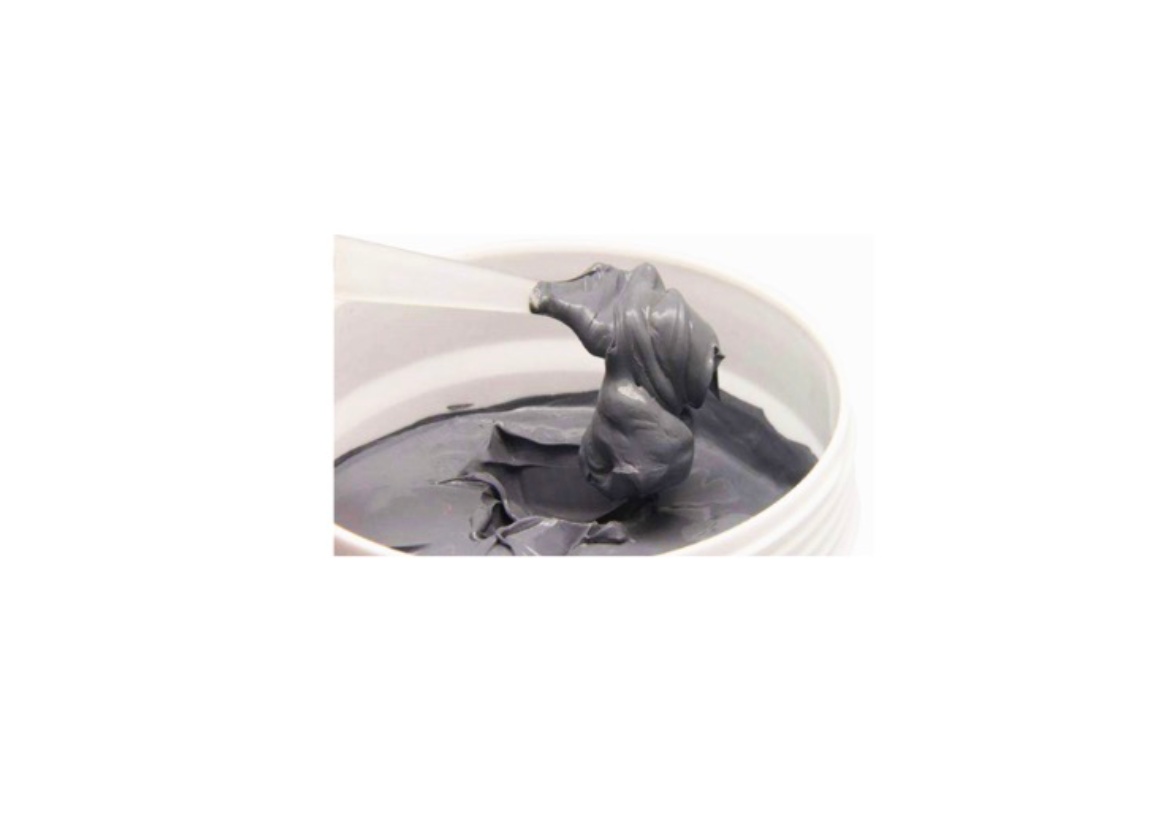
Thermal grease — also called thermal compound or thermal paste — is a viscous, paste-like material consisting of a silicone or hydrocarbon oil carrier loaded with thermally conductive filler particles. Common fillers include zinc oxide, aluminum oxide, and in higher-performance grades, silver or carbon-based compounds.
The carrier oil gives thermal grease its defining characteristic: it flows freely under pressure, conforming to microscopic surface irregularities and displacing air from the interface. This flow behavior is what allows grease to achieve very thin bond lines — often below 50–100 µm on well-prepared surfaces — and correspondingly low thermal resistance.
Key technical characteristics:
Thermal conductivity: 3–8 W/m·K for standard silicone-based grades; 8–12+ W/m·K for premium metal-filled formulations
Bond line thickness: 20–100 µm achievable under controlled conditions
Viscosity: high flow under pressure, no structural integrity at rest
Electrical insulation: most standard grades are electrically insulating; verify for metal-filled variants
Where grease works well:
In applications with tight, flat interfaces — CPU modules, power transistors, discrete MOSFETs — grease achieves thermal resistance values that are difficult to match with any other TIM category. For cost-sensitive designs with shorter service lives or periodic maintenance access, the lower material cost is also a genuine advantage.
Where grease creates problems:
Grease has no structural integrity. It cannot be pre-positioned and held in place before assembly. Application consistency depends heavily on operator technique or dispense equipment calibration. More critically, the carrier oil is not permanently bonded to the interface — under thermal cycling and mechanical vibration, it migrates over time, a phenomenon known as pump-out.
What Is Thermal Gel?
Thermal gel is a silicone-based TIM that has been partially or fully pre-cured, giving it a semi-solid consistency that holds its shape while remaining soft and compliant under mounting pressure. Think of it as thermal grease that has been stabilized — it retains the conformability of a paste but with enough structure to be handled, positioned, and dispensed consistently.
The higher filler content in most gel formulations — necessary to compensate for the structural matrix — means gel thermal conductivity typically sits in the 1–6 W/m·K range. This is below what high-end greases can achieve, but the tradeoff comes in process consistency and long-term stability.
Key technical characteristics:
Thermal conductivity: 1–6 W/m·K depending on filler type and loading
Bond line thickness: 100–500 µm typical under standard mounting pressure
Viscosity: thixotropic — stable at rest, flows under applied pressure or dispensing
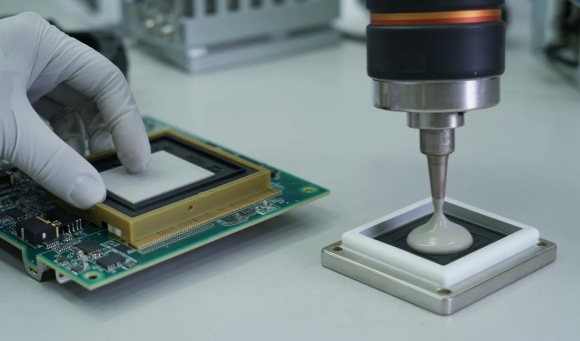
Dispensing: compatible with automated syringe dispensing and robotic dot/bead patterns
Where gel works well:
Gel is the preferred choice where production consistency matters. Because it holds its shape after dispensing, dot or bead patterns remain stable until the assembly is closed and pressure is applied — eliminating the "grease smear" variability that affects manual application. For high-volume production lines with automated dispensing, gel delivers repeatable coverage and consistent thermal resistance unit-to-unit.
Gel also performs better than grease in applications with larger gaps (0.1–0.5 mm), uneven surfaces, or components at varying heights on the same board. Its structural compliance allows it to fill these geometries without the pump-out risk that affects grease under cycling conditions.
Where gel has limitations:
Gel cannot achieve the ultra-thin bond lines that grease can. For applications where maximum conductivity and minimum BLT are the primary requirements — and the surface geometry supports it — grease remains the more thermally efficient choice. Some gel formulations also require controlled curing conditions after assembly, adding a process step.
Head-to-Head Comparison
The values below reflect typical commercial grade ranges. Performance varies by specific formulation, surface condition, gap size, and clamping pressure.
| Parameter | Thermal Grease | Thermal Gel |
|---|---|---|
| Thermal conductivity | 3–12+ W/m·K | 1–6 W/m·K |
| Minimum bond line thickness | 20–100 µm | 100–500 µm |
| Thermal resistance (interface) | Very low (thin BLT) | Low to moderate |
| Pump-out risk | Medium to high | Low |
| Dry-out risk | Medium | Low |
| Long-term stability | Degrades under cycling | Stable |
| Automated dispensing | Possible but sensitive | Well suited |
| Application consistency | Variable (operator dependent) | Consistent |
| Reworkability | Requires solvent cleaning | Clean separation, minimal residue |
| Contamination / bleed risk | Higher | Lower |
| Electrical insulation | Most grades yes | Most grades yes |
| Relative material cost | Lower | Moderate to higher |
| Suitable gap range | <0.1 mm | 0.1–0.5 mm |
What the numbers mean in practice:
The conductivity gap between high-end grease and standard gel is real — a 10 W/m·K grease will outperform a 3 W/m·K gel on bulk thermal conductivity. But thermal resistance at the interface depends on bond line thickness as well as conductivity, and in many real assemblies, the gel's stable, repeatable BLT produces competitive or equivalent interface performance compared to grease applied with variable coverage.
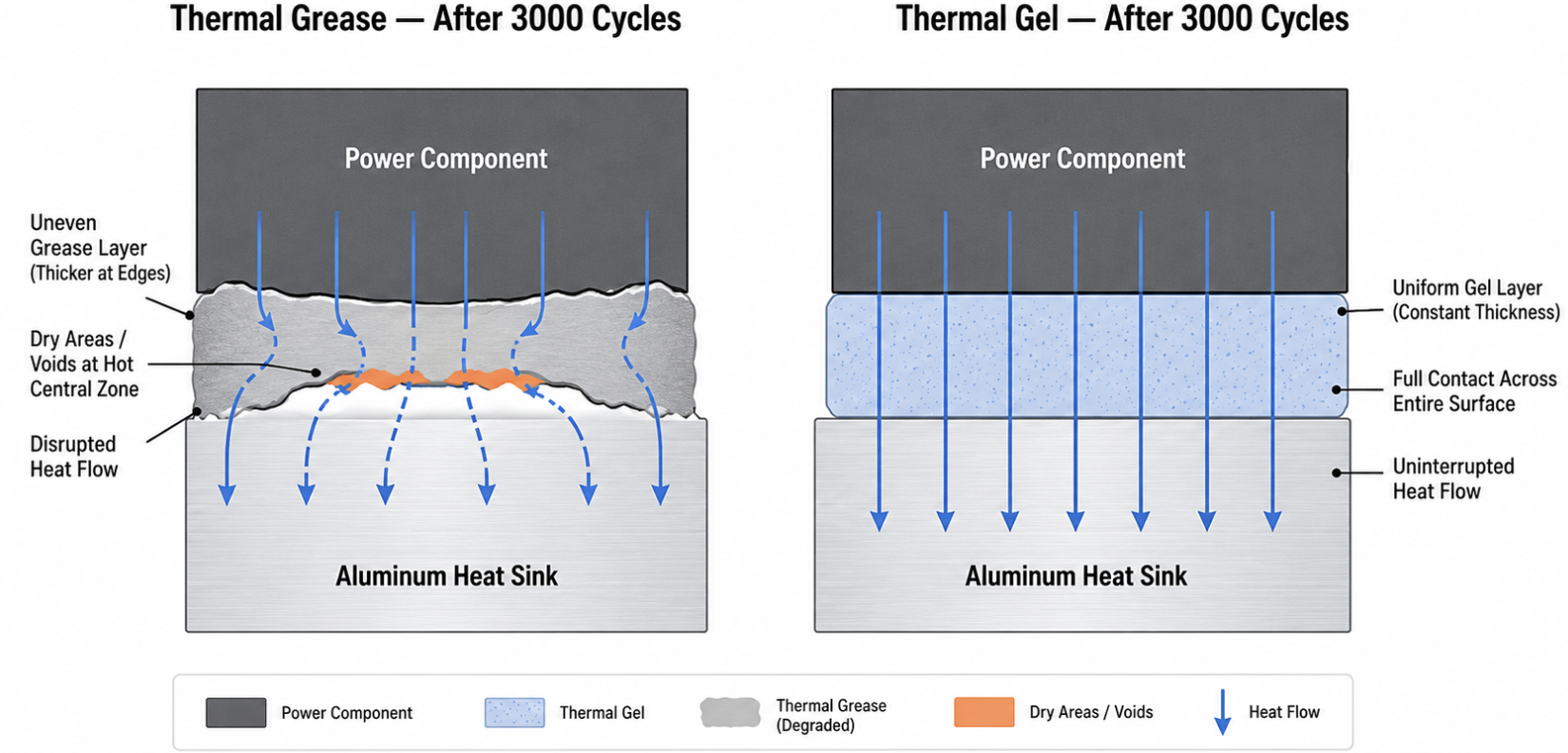
The more decisive difference is long-term behavior. Grease that achieves excellent initial thermal resistance may degrade meaningfully after 1,000–3,000 thermal cycles as the carrier migrates. Gel maintains its interface geometry through cycling, vibration, and sustained operation — which is why it has become the default choice in EV battery modules, inverter assemblies, and telecom power systems where field reliability is non-negotiable.
When Thermal Grease Is the Right Choice
Grease remains the better option in a defined set of conditions — not because it is simpler or cheaper, but because the application genuinely favors its characteristics.
Ultra-thin bond line requirements. When component and heat sink surfaces are flat, well-machined, and the gap is below 0.1 mm, grease achieves bond line thicknesses that gel physically cannot match. At 20–50 µm BLT with a high-conductivity formulation, grease delivers thermal resistance values that represent the practical floor for most interface designs.
Maximum conductivity is the primary constraint. In high-power discrete devices — IGBTs, SiC MOSFETs, power diodes — where junction temperature must be kept as low as possible and surface geometry supports it, premium metal-filled or carbon-based greases at 8–12+ W/m·K outperform any standard gel grade. If the design sits at the thermal limit and every degree of junction temperature matters, grease gives you more headroom.
Short service life or maintainable systems. Consumer electronics, desktop computing hardware, and lab instruments are regularly serviced or replaced within 3–5 years. At that timescale, pump-out degradation may not reach performance-critical levels. The lower material cost and simpler procurement make grease the practical default.
Prototyping and design iteration. When testing multiple heat sink configurations or validating thermal models, grease is faster to apply, easier to remove, and cheap enough to discard between iterations. Production material selection can come later.
When Thermal Gel Is the Right Choice
Gel's advantages become decisive when production consistency, long service life, or large-area coverage are the governing requirements.
Automated or high-volume production. Gel is dispensable through standard syringe and needle equipment, robotic dot dispensers, and jetting systems. Because it holds its shape after dispensing, patterns remain stable until the assembly is closed — eliminating the timing sensitivity that affects grease in automated lines. Unit-to-unit thermal resistance variation is significantly lower with gel than with manually applied grease.
Large gap sizes or uneven surfaces. When component height variation across a board exceeds 0.2 mm, or the interface gap is 0.3–0.5 mm, gel fills the geometry reliably. Grease at those thicknesses cannot support itself and risks uneven coverage. Gel maintains structural integrity across the gap under mounting pressure.
Long service life in sealed or inaccessible systems. Industrial inverters, UPS systems, EV charging infrastructure, and telecom power modules are designed for 10–15 year service lives with no maintenance access to internal thermal interfaces. Gel's resistance to pump-out and migration makes it the lower-risk choice for those applications. Grease in the same environment may degrade to the point of measurable thermal resistance increase within 3–5 years.
EV battery module assembly. Battery pack thermal management requires TIM coverage over large surface areas — often hundreds of square centimeters per module. Gel is dispensable in consistent bead patterns across these surfaces and maintains contact under the compression loads applied during module assembly. Grease at that scale introduces coverage variability that affects both thermal performance and safety.
Rework-intensive production. When assemblies are regularly opened for inspection, component replacement, or quality control, gel's clean separation and minimal residue reduce rework time and solvent consumption compared to grease cleanup.
Common Misconceptions
"Higher W/m·K always means better thermal performance."
Bulk conductivity is one factor in interface thermal resistance — bond line thickness is the other. A gel at 3 W/m·K with a stable 150 µm BLT may produce similar or better real-world thermal resistance than a grease at 6 W/m·K that has pumped out to 300 µm coverage after 2,000 cycles. Evaluate total interface thermal resistance under actual assembly conditions, not datasheet conductivity alone.
"Grease and gel are interchangeable — just pick whichever is in stock."
They have different viscosity profiles, different dispensing requirements, different BLT capabilities, and different long-term behavior under cycling. Substituting one for the other without process revalidation risks assembly inconsistency, coverage variation, and thermal performance outside design targets.
"Long-term stability only matters for automotive or aerospace."
Industrial inverters, telecom base stations, and commercial EV chargers all have 10+ year design life targets and may experience thousands of thermal cycles in service. TIM degradation in these applications is a real field failure mode — not a theoretical concern. Any sealed system with a long service life target should be evaluated with long-term stability data, not just initial thermal resistance.
TaxoTape® Solutions
TaxoTape® supplies both thermal grease and thermal gel for industrial power electronics applications, including inverter assemblies, UPS systems, EV battery modules, LED driver boards, and telecom power equipment.
Thermal gel is available in standard syringe packaging compatible with manual and automated dispensing systems. Thermal grease is available in multiple conductivity grades for high-performance discrete device applications. Both products are supplied with full technical documentation including TDS, RoHS declaration, and reliability test data.
If you are evaluating dispensable TIMs for a current design or transitioning from grease to gel for production consistency, we can recommend specific grades based on your gap size, dispensing equipment, and reliability requirements. Sample quantities are available for process qualification.
Request samples or technical consultation →
Conclusion
Thermal grease and thermal gel are not competing products fighting for the same application — they occupy different positions in the TIM selection matrix.
Grease delivers maximum conductivity and minimum bond line thickness in flat, tight interfaces where that performance is achievable and maintainable. Gel delivers production consistency, long-term stability, and reliable coverage in automated assembly, large-gap geometries, and sealed long-life systems.
Most production environments end up using both: grease for discrete high-power devices where peak thermal performance is needed, gel for module-level assemblies, battery packs, and production lines where consistency and reliability govern the selection.
The decision becomes straightforward once gap size, production method, service life, and maintenance access are defined. Where those parameters are still unclear, validating both materials under your actual assembly conditions is the fastest path to a confident choice.
Contact TaxoTape® to discuss which dispensable TIM fits your application →
FAQ
Q: Can I use thermal gel in a CPU or GPU application?
Technically yes, but it is rarely the optimal choice. CPUs and GPUs have flat, precision-machined surfaces designed for ultra-thin bond lines. High-conductivity grease achieves lower thermal resistance in these geometries. Gel is better suited to power module and industrial electronics applications where gap size and production consistency matter more than minimum BLT.
Q: Does thermal gel require curing after assembly?
It depends on the formulation. Some gels are pre-cured and require no post-assembly processing — they function immediately under mounting pressure. Others are two-part systems that cure after mixing or after exposure to heat. Check the TDS for your specific product; most single-component gels used in power electronics are ready-to-use without a cure step.
Q: How do I transition from grease to gel in an existing production line?
The main considerations are dispensing equipment compatibility, BLT change, and thermal resistance revalidation. Gel typically requires different needle gauge and dispense pressure settings compared to grease. Bond line thickness will increase, which needs to be factored into thermal modeling. Run a process qualification with samples before full production transition.
Q: Is thermal gel electrically insulating?
Most standard silicone-based thermal gels are electrically insulating, with dielectric strength typically in the range of 10–20 kV/mm. However, formulations with high metal filler content may have reduced insulation properties. Always verify the dielectric specifications of your specific gel grade for high-voltage applications.