Welcome to Taxo Tape
The Real Cost of Skipping Proper TIM Selection
Introduction
A thermal interface material typically accounts for a few cents to a few dollars of a product's bill of materials — a fraction of a percent of total cost in most designs. That small line item is easy to treat as a commodity decision late in the design process, filled in with whatever pad or grease is already on hand or offered at the lowest quote. In most cases, that shortcut costs nothing. In a meaningful number of cases, it costs considerably more than the price difference between the material that was chosen and the one that should have been.
The gap between "TIM selection is a minor decision" and "TIM selection is what determines whether this product survives its warranty period" isn't obvious at the point of purchase. It becomes obvious later — in field returns, in warranty claims, in a redesign that could have been avoided. This article looks at where that cost actually shows up, why it's easy to underestimate at the design stage, and what proper selection and validation actually require to avoid it.
Why TIM Failures Are Easy to Overlook Until They're Expensive
Most TIM failures don't announce themselves. A pad that pumps out under thermal cycling, a grease that dries out after a few hundred hours at elevated temperature, a material that never quite met its datasheet conductivity in the first place — none of these produce an immediate, obvious malfunction. What they produce is a gradual rise in interface thermal resistance, which shows up as a slow creep in operating temperature, which shows up as accelerated component aging, which eventually shows up as a field failure months or years after the product shipped.
By the time the failure is visible, the chain of causation is no longer obvious either. A capacitor that failed early looks like a capacitor problem, not a TIM problem — unless someone specifically traces the elevated operating temperature back to a degraded interface. This lag between cause and visible effect is exactly what makes TIM selection easy to under-invest in during design: the consequences of getting it wrong don't show up on the same timeline as the decision itself, so there's little immediate feedback connecting the two.
The True Cost Structure of a TIM Failure
When a TIM-related failure does surface, the cost rarely stops at the material itself. A useful way to think about it is as a stack of costs that compound on top of each other rather than a single line item.
Warranty and field service cost is the most direct layer — replacement units, service calls, and in some cases full product recalls if the failure pattern is systemic rather than isolated. Engineering re-validation cost follows close behind: once a field failure is traced to a thermal interface issue, the team has to re-test the corrected material, often under compressed timelines and with the scrutiny that comes from having already shipped a defective design. Customer trust and reputation cost is harder to quantify but often larger in aggregate — a product line associated with early field failures faces longer sales cycles and more skeptical customers on its next generation, regardless of how thoroughly the underlying issue gets fixed. And where the failure involves a safety-relevant application — a battery pack, a high-voltage isolation interface — there's a fourth layer: regulatory and liability exposure that dwarfs the original material cost difference by orders of magnitude.
None of these costs appear in a bill-of-materials comparison at the point of selection. They only appear after the fact, which is exactly why they're so easy to discount when a cheaper or less-validated TIM option is on the table during design.
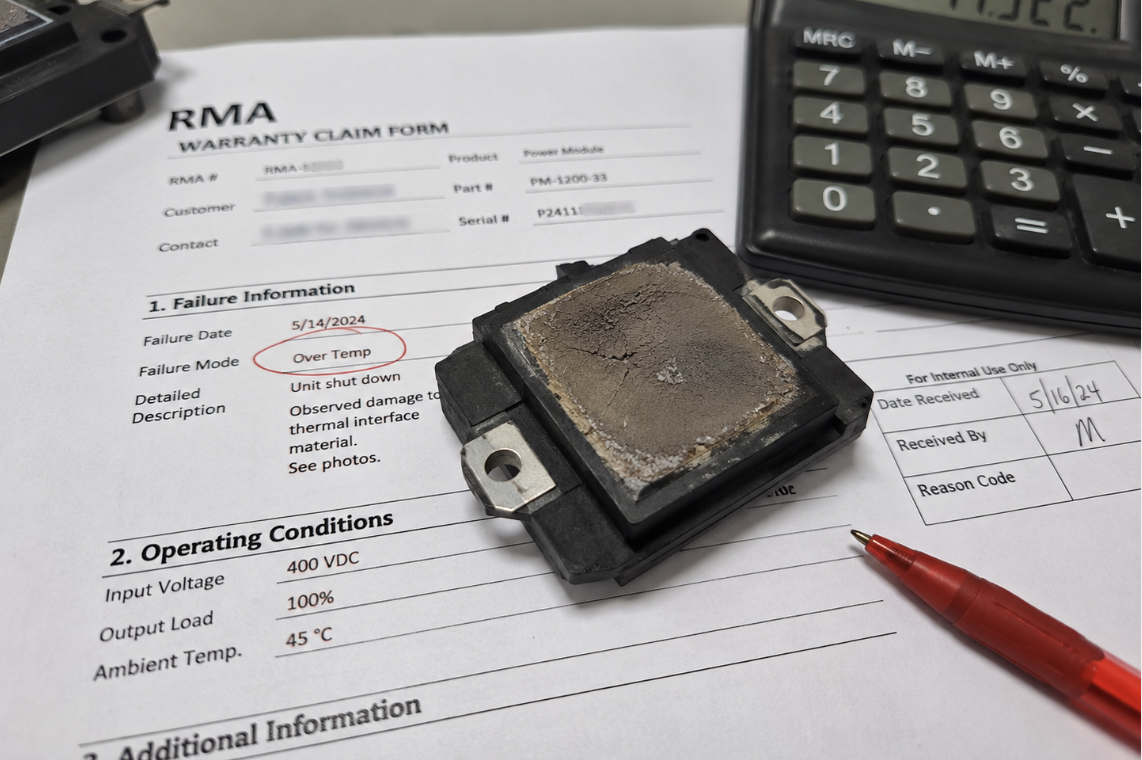
Case Pattern: What Undersized or Misapplied TIM Actually Costs
A pattern that shows up repeatedly across power electronics and battery applications looks something like this: a design passes thermal qualification using a nominal bond line thickness and a datasheet conductivity value, without accounting for the production variation in either. The design ships. Some fraction of the production population — the units at the unfavorable end of the thickness and pressure tolerance stack — run consistently hotter than the units that were actually tested. Those units don't fail immediately; they simply age faster, and their failures cluster months into the field deployment rather than showing up in initial burn-in testing.
By the time the pattern is recognized, the affected units are often already deployed across multiple customers or installations, which turns what should have been a design-stage correction — tightening the thickness tolerance, requesting better batch consistency data, or specifying a more forgiving material — into a field retrofit or a warranty program. The corrective material cost is usually modest. The logistics, labor, and reputational cost of correcting it in the field is not.
Why "It Passed Initial Testing" Isn't Enough
Initial qualification testing confirms that a TIM performs adequately under the specific conditions it was tested at — a specific sample, a specific bond line thickness, often measured on a smooth laboratory fixture rather than a production heatsink surface. It doesn't confirm how that material performs across the full range of production variation, or how it holds up after months or years of thermal cycling and sustained operating temperature.
This gap between initial test results and real-world, long-term performance is a large part of why datasheet values so often diverge from field behavior — a topic covered in more depth in Why Same W/m·K Ratings Perform Differently in TIMs and Why Your TIM Datasheet Doesn't Match Real Performance. The short version relevant here: a material that passes initial testing has cleared a necessary bar, not a sufficient one. Treating "it passed initial testing" as the end of the qualification process is one of the more common ways an otherwise reasonable material selection turns into a field reliability problem later.
Where the Hidden Costs Concentrate: High-Consequence Applications
Not every application carries the same downside risk from a marginal TIM selection, and it's worth being specific about where the stakes are highest.
Battery packs sit at the top of that list. A degraded TIM at the cell-to-cooling-plate interface doesn't just raise temperature at one point — it produces non-uniform cell aging across the pack, which compounds into capacity fade and, in the worst cases, contributes to the conditions that precede thermal runaway. The failure mode here isn't a warranty inconvenience; it's a safety event. Power inverters and IGBT modules carry similarly asymmetric risk: a pump-out or dry-out failure at a switching device interface can produce a sharp, localized temperature spike rather than a gradual drift, sometimes fast enough to damage the semiconductor before any protective circuit responds. LED drivers present a subtler but well-documented version of the same problem — electrolytic capacitors are the most temperature-sensitive component in a typical driver assembly, and the widely cited rule that capacitor life roughly halves for every 10°C rise in operating temperature means a TIM that's a few degrees worse than intended can cut the weakest component's service life by a meaningful fraction, well before the LED itself shows any sign of degradation.
In each of these cases, the cost of an inadequate TIM isn't proportional to the material's price — it's proportional to the value of whatever fails downstream of it.
The Cost of Getting It Right Early vs. Late
Design changes get more expensive the later they happen in a product's development cycle — this isn't specific to thermal materials, it's a general pattern across engineering disciplines. A material substitution made during initial component selection costs essentially nothing beyond the evaluation time. The same substitution made after tooling is committed, after production has started, or after units are already in the field, carries the cost of tooling changes, requalification, inventory write-offs, and in the worst case, a formal recall process.
TIM selection sits squarely in this pattern, but it's easy to treat differently because the material itself is inexpensive and the interface is, quite literally, hidden inside the assembly — out of sight during most of the review process that catches other design issues. The practical implication is straightforward: the validation work covered in the next section is worth doing at the point where changes are still cheap, not after a field issue forces the question.
What "Proper TIM Selection" Actually Requires
Avoiding the costs described above doesn't require exotic materials or an unusually large budget — it requires a validation process that goes slightly beyond comparing datasheet numbers.
At minimum, this means confirming the test method and pressure behind any conductivity or thermal resistance value before using it in a comparison or a thermal model, since nominally identical numbers generated by different methods aren't directly comparable — see Why Same W/m·K Ratings Perform Differently in TIMs for the specifics. It means applying realistic correction factors and accounting for production tolerance stacking rather than designing to a single nominal value, covered in Why Your TIM Datasheet Doesn't Match Real Performance. And it means qualifying the supplier itself — requesting batch consistency data, long-term aging data, and compression set data rather than relying solely on a first-sample datasheet — a process outlined in How to Validate a TIM Supplier.
None of these steps are expensive relative to the cost of skipping them. They add time to the qualification process — typically measured in days or weeks — not significant cost to the bill of materials.
A Note on Total Cost of Ownership
"Cheap TIM saves cost" is one of the more persistent misconceptions in component selection, and it's persistent specifically because it's true in the narrow sense and false in the sense that actually matters. A lower-cost material genuinely does reduce the bill-of-materials line item it replaces. What it doesn't account for is everything covered in section 3 — the warranty claims, the re-validation cycles, the reputational cost — that a poorly formulated or poorly characterized material tends to generate downstream.
The more useful comparison isn't unit cost against unit cost, but total cost of ownership across the product's service life: unit cost, plus the probability-weighted cost of field failures, plus the engineering time spent re-qualifying a replacement material if the first choice doesn't hold up. Framed that way, a moderately more expensive TIM with documented long-term stability data frequently comes out ahead of a cheaper alternative with no such data — not because the cheaper material is necessarily worse, but because its long-term performance is genuinely unknown until it's already in the field.
FAQ
Q: Is it worth redesigning an existing product to upgrade its TIM specification?
It depends on the failure risk and consequence in that specific application. For a product with a documented pattern of field failures traceable to TIM degradation, or for a safety-relevant application like a battery pack, the cost of a redesign is usually justified relative to the ongoing warranty and liability exposure. For a product with no observed field issues, a reactive upgrade generally isn't necessary — the priority is building proper validation into future designs rather than retrofitting past ones without evidence of a problem.
Q: How do I justify a TIM validation budget to management when there's no current field issue?
Frame it in terms of the cost asymmetry covered in section 7: validation costs are small and predictable; field failure costs are larger and unpredictable, and they tend to surface after the design is already locked in and difficult to change cheaply. Referencing the general pattern of design-change costs escalating later in a product's lifecycle — a widely recognized principle in engineering project management — is usually a more persuasive argument than any single hypothetical failure scenario.
Q: How much does proper TIM validation actually add to a development timeline?
Typically measured in days to a few weeks, depending on how much of the process — test method confirmation, batch data request, sample validation — is already part of your standard supplier qualification workflow. This is small relative to most product development timelines, and considerably smaller than the timeline impact of a field failure investigation and corrective redesign after the fact.
Conclusion
The real cost of a thermal interface material was never the number on the purchase order — it's the cost of whatever happens downstream if that material doesn't hold up under real operating conditions over the product's actual service life. That cost is invisible at the point of selection and very visible months or years later, which is exactly why it's so easy to underweight during the design process.
Closing that gap doesn't require expensive materials or an elaborate qualification program — it requires treating TIM selection with the same rigor applied to any other component that determines long-term reliability: understanding what the datasheet numbers actually mean, validating performance under representative conditions, and qualifying suppliers on more than a single sample measurement. For a fuller look at TIM types, selection criteria, and where to start, see What Are Thermal Interface Materials? A Guide for Engineers.
Contact TaxoTape® to discuss TIM selection and validation for your application →