Welcome to Taxo Tape
Silicone vs. Silicone-Free Thermal Pads: Which Should You Specify?
Introduction
At some point in the design or procurement process, most power electronics engineers face the same question: does it actually matter whether the thermal pad is silicone-based or silicone-free?
For the majority of applications, the honest answer is no — silicone-based pads perform well, they are widely available, and cost is predictable. But for certain assembly types, specifying the wrong category causes real problems that do not appear until the product is in the field, at which point they are expensive to diagnose and correct.
This guide covers what actually differs between silicone and silicone-free thermal pads, the specific conditions that make each type the correct choice, and what to verify in the datasheet before finalizing a material specification. It is written for engineers and procurement managers working on industrial power electronics — LED drivers, inverters, UPS systems, telecom power modules, and EV charging equipment.
How Silicone-Based Thermal Pads Work
Silicone thermal pads are built on a polydimethylsiloxane (PDMS) polymer matrix, filled with thermally conductive particles. The most common fillers are aluminum oxide (Al₂O₃) and boron nitride (BN), used individually or in combination depending on the target conductivity and electrical insulation requirements.
Thermal performance:
Al₂O₃-filled grades: typically 1.0–3.0 W/m·K — cost-effective, covers most standard industrial power electronics requirements
BN-filled grades: typically 4.0–8.0 W/m·K — higher conductivity with lower dielectric constant, suited to high-power-density and high-frequency applications
Operating temperature range: −40°C to +200°C for most commercial grades
Mechanical behavior:
The silicone base gives pads their characteristic softness and compressibility. Under moderate assembly pressure — typically 50–150 kPa — silicone pads conform well to surface irregularities on both component and heat sink sides, reducing contact resistance. This conformability is a genuine advantage in production-line assemblies where mating surfaces are not perfectly flat and component height variation exists across the board.
The outgassing mechanism:
Silicone polymers contain low-molecular-weight siloxane compounds that volatilize at elevated temperatures — a process called outgassing. The volatilization rate increases with temperature: meaningful outgassing begins above 80–100°C for most commercial grades, accelerating at higher interface temperatures.
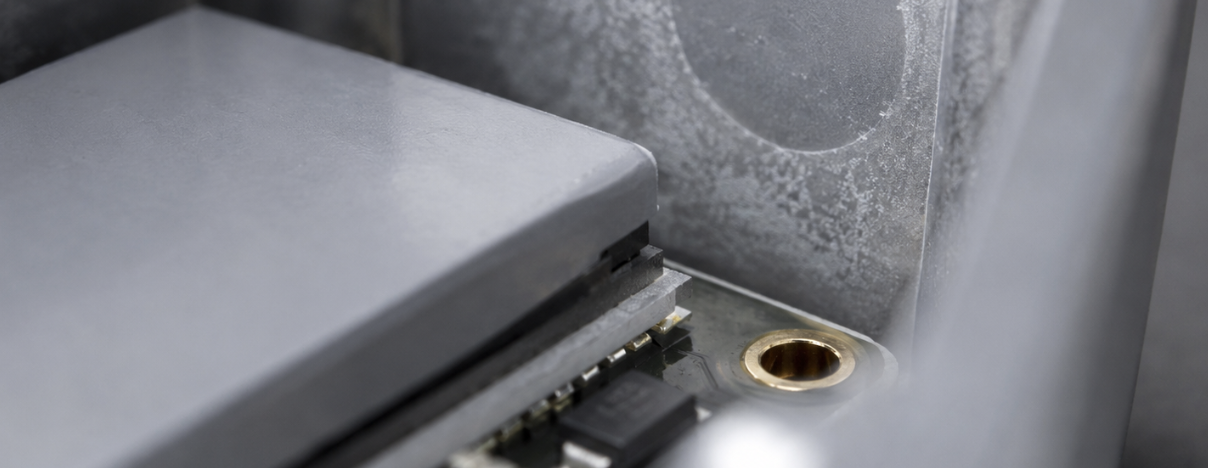
Inside a sealed enclosure, siloxane vapor has nowhere to escape. It migrates through the air space and condenses on cooler surfaces — including optical components, relay contacts, and sensor surfaces — as a thin polysiloxane film. In open or well-ventilated enclosures, the vapor dissipates and the risk does not apply. The problem is specific to sealed assemblies where sensitive components share the same enclosed air space as the thermal pad.
How Silicone-Free Thermal Pads Work
Silicone-free thermal pads use a different polymer base — typically acrylic or polyurethane — filled with the same thermally conductive ceramic particles used in silicone pads. The thermal conduction mechanism is identical; what changes is the matrix material and its behavior in service.
Thermal performance:
Standard grades: 1.0–3.0 W/m·K
Higher-performance BN-filled grades: up to 4.0–5.0 W/m·K
For equivalent filler loading, silicone-free grades typically run 10–20% lower in conductivity than silicone-based equivalents — a difference that is small enough to be irrelevant in most applications but becomes a constraint in high-power-density designs where the thermal budget is tight
Mechanical behavior — the most noticeable practical difference:
Silicone-free pads are firmer and less compressible than silicone pads. They require higher clamping pressure to achieve equivalent contact — typically 100–250 kPa versus 50–150 kPa for silicone grades at comparable hardness. They are also less tolerant of surface finish variation. In assemblies with low fastener torque, flexible substrates, or clip-mounted components that cannot apply high assembly pressure, specifying a silicone-free pad often means accepting higher contact resistance than expected — which can partially or fully cancel the benefit of switching away from silicone.
Operating temperature range:
Most silicone-free formulations are rated for −20°C to +150°C, compared to −40°C to +200°C for standard silicone grades. This narrower window requires verification against worst-case interface temperature — not just ambient — before specifying silicone-free in outdoor or wide-temperature-range applications.
Why silicone-free exists:
The sole engineering reason for silicone-free thermal pads is the elimination of siloxane outgassing. No silicone polymer means no siloxane migration, regardless of operating temperature or enclosure design. For assemblies where contamination of nearby components is a real concern, this is a direct solution — accept slightly reduced compressibility and a narrower temperature window, eliminate the contamination risk entirely.
There is also a compliance-driven use case. Certain OEM programs — automotive Tier 1 supplier requirements, some aerospace and medical-adjacent electronics programs — maintain documented restrictions on silicone materials independent of whether outgassing is actually a risk in the specific assembly. In those cases, silicone-free is not a performance decision but a specification compliance requirement.
Head-to-Head Comparison
| Parameter | Silicone-Based | Silicone-Free |
|---|---|---|
| Thermal conductivity range | 1.0–8.0 W/m·K | 1.0–5.0 W/m·K |
| Compressibility | High | Moderate to low |
| Typical assembly pressure | 50–150 kPa | 100–250 kPa |
| Surface finish tolerance | Forgiving | Less forgiving |
| Operating temperature range | −40°C to +200°C | −20°C to +150°C (typical) |
| Siloxane outgassing | Present above 80–100°C | None |
| Contamination risk to adjacent components | Present in sealed assemblies | Not applicable |
| Electrical insulation | Available across grades | Available across grades |
| RoHS compliance | Available | Available |
| Supplier availability | Wide | More limited |
| Relative material cost | Lower | Higher (typically 20–40%) |
| Typical application fit | General industrial power electronics | Optical, contact-sensitive, or silicone-restricted assemblies |
Reading the table in context:
The conductivity gap between the two categories is real but rarely the deciding factor — for the majority of standard industrial applications, both categories offer adequate performance in the relevant conductivity range. The operating temperature gap matters more than it appears: the −20°C lower limit on most silicone-free grades rules them out for outdoor applications in northern climates without careful grade-by-grade verification. The cost difference is real but secondary to the contamination risk assessment — if siloxane contamination causes a field failure, the warranty and rework cost far exceeds any material savings.
When Silicone-Free Is the Right Choice
The decision to specify silicone-free should be driven by a specific, identifiable risk in your assembly — not a general preference for "cleaner" materials. The following are the conditions where silicone-free is the technically correct specification.
Assemblies with optical components in a shared sealed enclosure.
Siloxane deposits on optical surfaces — LED emitter faces, lenses, photodetectors, optical sensors — cause permanent and progressive reduction in optical transmittance. In sealed LED luminaires where the driver PCB and optical assembly share a common air space, even low outgassing rates accumulated over years of operation at elevated temperatures produce measurable lumen depreciation. This failure mode is well-documented in outdoor luminaire field data and is frequently misattributed to LED degradation because the contamination is not visible without chemical surface analysis.
The proximity and enclosed volume both matter. A large luminaire housing with the driver mounted far from the optical components carries lower risk than a compact integrated fixture where driver PCB and LED module are centimeters apart inside the same sealed cavity. When in doubt, request CVCM outgassing data from the supplier and evaluate against your enclosure volume and operating temperature.
Low-voltage relay contacts and signal connectors in proximity.
Siloxane film on contact surfaces increases contact resistance, causing intermittent failure in low-voltage signal circuits. This is a documented failure mode in automotive relay assemblies and industrial control boards where thermal pads sit in the same sealed enclosure as relay contacts or low-force connector interfaces. Signal-level contacts operating below 12V are most susceptible because the contact force is insufficient to break through a siloxane film the way higher-voltage contacts can.
If the thermal pad and any relay contact or low-force connector are inside the same sealed enclosure, evaluate whether the proximity creates a contamination risk. For assemblies where signal integrity is critical and maintenance access is limited, silicone-free is the lower-risk specification.
Applications under explicit silicone-restriction specifications.
Some OEM customers maintain documented restrictions on silicone materials in their assembly specifications — common in automotive Tier 1 supply chains, certain aerospace programs, and medical device manufacturing. In these cases, silicone-free is not optional regardless of whether the outgassing risk is present in the specific assembly. Verify the customer specification before material selection, and obtain a formal material declaration from the supplier confirming absence of silicone compounds for compliance documentation.
Cleanroom and precision instrument environments.
Any assembly that will be used in or adjacent to a cleanroom, or integrated into precision measurement or analytical instruments, should avoid silicone-based materials as a default. Contamination control requirements in these environments are strict enough that even low-level outgassing is unacceptable, and the consequences of siloxane contamination on precision optical or electronic measurement components can be severe.
When Silicone-Based Remains the Better Choice
Silicone-free pads solve a specific problem. When that problem does not exist in your assembly, there is no engineering reason to pay more for them or accept the trade-offs in mechanical behavior and temperature range. The following conditions favor silicone-based specification.
High power density applications where conductivity ceiling matters.
When junction temperature is close to the thermal budget limit, every fraction of a degree of interface resistance counts. Silicone-based pads with BN filling reach 6–8 W/m·K — above what most silicone-free formulations currently achieve at comparable cost. In IGBT modules, high-current MOSFET assemblies, or any design where the thermal resistance budget is genuinely tight, the higher conductivity ceiling of silicone-based BN-filled grades is a real advantage that silicone-free cannot currently match without significant cost premium.
Wide temperature cycling environments.
Industrial outdoor equipment, EV battery modules, and motor drive systems experience significant temperature swings — often from below −30°C to above 100°C junction temperature — across their service life. The −40°C to +200°C rated range of standard silicone-based pads covers these conditions without qualification concerns. Silicone-free formulations rated to −20°C lower limit require verification against worst-case cold startup conditions before use in outdoor or wide-range cycling applications, adding qualification time without a corresponding benefit if outgassing is not a risk in the assembly.
Assemblies with low clamping pressure.
Some enclosure designs — clip retention, lightweight brackets, flexible PCB substrates, or components where maximum compressive load is limited by component fragility — cannot apply the higher assembly pressure that silicone-free pads require for full contact. Silicone-based pads conform under lower pressure and maintain good contact without tight mechanical tolerances. Specifying silicone-free in a low-pressure assembly typically means accepting higher contact resistance than anticipated, which negates any thermal performance difference between the two categories.
Cost-sensitive production at volume without contamination risk.
For high-volume manufacturing where siloxane contamination is not a risk factor — standard industrial inverters, UPS systems, motor drives, power supplies without optical components — silicone-based pads offer better cost predictability and significantly wider supplier availability. Silicone-free formulations are produced by fewer manufacturers, which affects lead time, pricing flexibility, and minimum order quantity constraints, particularly at lower volume tiers.
Application-Specific Recommendations
Industrial inverters and UPS systems
Default recommendation: silicone-based.
These assemblies involve high-power semiconductors, wide operating temperature ranges, and typically no optical components or low-voltage signal contacts in proximity to the thermal interface. The thermal budget is often the primary design constraint, which favors the higher conductivity ceiling of silicone-based BN-filled grades. Outgassing is not a meaningful concern in these enclosures.
Conductivity recommendation: 4–8 W/m·K for IGBT and MOSFET primary interfaces; 1.5–3 W/m·K for PCB-level components with lower dissipation.
LED drivers — standard commercial and industrial
Default recommendation: silicone-based, unless optics share the enclosure.
Most LED driver boards mount the thermal pad between a power component and the board or heat sink, inside a housing that is either separate from the optical assembly or large enough that siloxane migration is not a meaningful risk. Silicone-based pads are appropriate in these configurations.
If the LED driver PCB and LED emitters are inside the same compact sealed enclosure — common in integrated downlights, compact street light heads, and small industrial fixtures — evaluate silicone-free for the pad locations nearest to the optical components.
Conductivity recommendation: 3–6 W/m·K depending on component power dissipation.
Outdoor sealed LED luminaires
Default recommendation: silicone-free or low-volatility silicone at any interface where the pad shares a sealed air space with optical components.
This is the application segment where the silicone-free decision is most clearly justified and most frequently overlooked. The combination of elevated operating temperatures, long service life without maintenance access, and optical components in a shared sealed enclosure creates the conditions where siloxane contamination produces measurable lumen depreciation over years of operation.
Conductivity recommendation: 2–5 W/m·K for most outdoor LED driver power levels.
Telecom power modules and base station equipment
Recommendation: evaluate case by case.
Telecom power equipment varies significantly in internal layout. Some designs place thermal pads near connector interfaces or signal conditioning circuits where contact contamination is a real risk. Others are straightforward power conversion assemblies with no sensitive contacts nearby. Review the internal layout before defaulting to either type. Temperature range also requires verification — outdoor base station equipment in cold climates may approach the lower limit of some silicone-free formulations.
EV battery management electronics
Default recommendation: silicone-based for power components; evaluate silicone-free for boards with integrated sensor arrays.
BMS electronics often integrate current sensors, voltage measurement circuits, and communication interfaces alongside power components. If sensor elements are on the same board in proximity to the thermal pad location, evaluate the contamination risk. For pure power component cooling on BMS boards without adjacent sensors, silicone-based pads are appropriate.
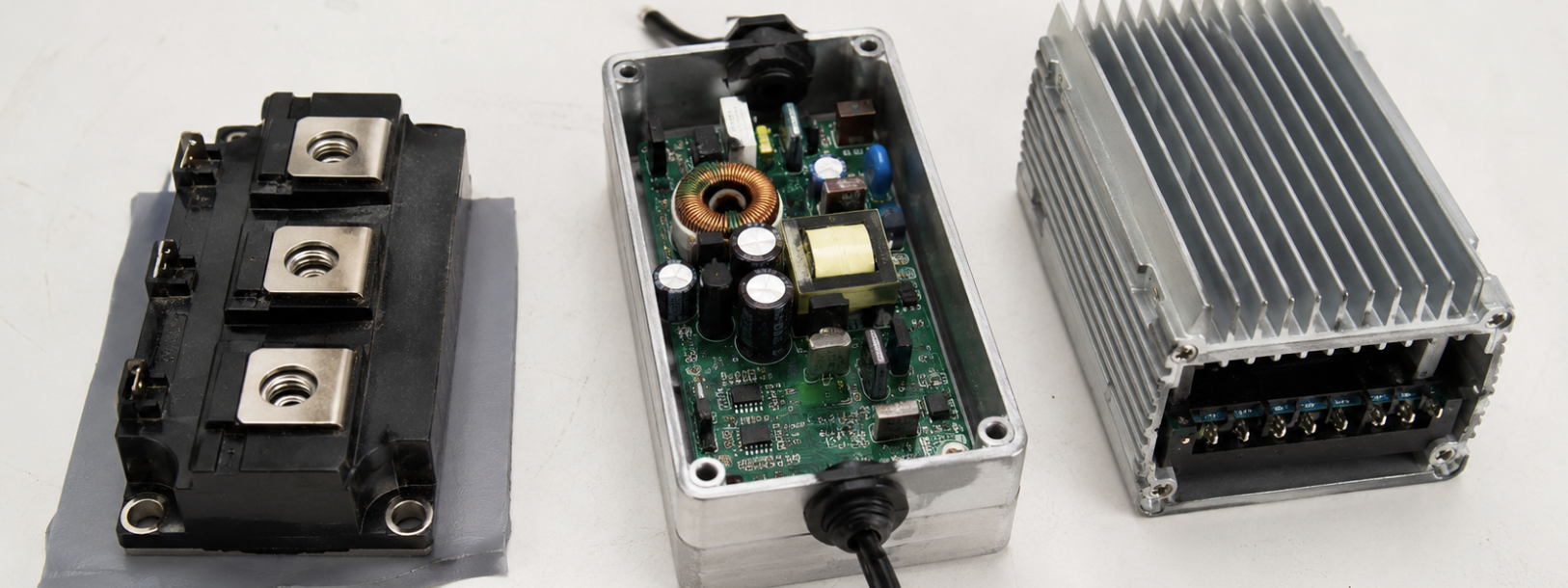
Motor drives and industrial control units
Default recommendation: silicone-based.
Motor drive enclosures typically have thermal interfaces on power modules that are physically separated from signal-level components. Wide temperature operation and high power density both favor silicone-based materials. Unless a silicone restriction appears in the customer specification, silicone-free offers no meaningful advantage in this application.
Key Datasheet Parameters to Check
Outgassing data — TML and CVCM values.
For any application where contamination is a concern, request outgassing data measured to ASTM E595. The two key values are Total Mass Loss (TML) and Collected Volatile Condensable Materials (CVCM). Standard thresholds used in aerospace specifications — TML below 1.0% and CVCM below 0.1% — are a reasonable benchmark for sensitive industrial applications. If a supplier cannot provide these values and your application involves optical or contact-sensitive components, do not assume compliance. Request the data or switch to a silicone-free grade.
Compression stress versus thickness curve.
This tells you how much pressure is required to compress the pad to its working thickness. A steep curve means the pad resists compression and requires higher clamping force. A flat curve means it conforms under light pressure. Match this against your assembly's actual clamping arrangement — do not assume a silicone-free pad will behave like the silicone pad it replaces without comparing compression curves directly. The difference is often larger than the conductivity difference between the two categories.
Operating temperature range versus actual interface temperature.
The datasheet temperature range is the rated range for the bulk material. Your actual interface temperature — particularly at the component side — will be higher than ambient and may approach the upper limit of some silicone-free formulations. Calculate your expected interface temperature under maximum load and confirm it falls within the rated range with adequate margin. Applying a pad rated to 150°C maximum at an interface that reaches 135°C junction temperature leaves insufficient margin for a 10-year service life at continuous load.
Thermal conductivity test method.
Conductivity values on datasheets are not always measured the same way. ASTM D5470 is the most widely used method for TIM characterization and produces results that are directly comparable between suppliers. Some suppliers report values from laser flash diffusivity measurements, which can produce higher numbers that do not translate directly to interface thermal resistance. When comparing products across suppliers, confirm the test method before drawing conclusions from the conductivity numbers.
Explicit silicone-free material declaration.
If silicone-free is a specification requirement, do not rely on product naming alone. Confirm that the datasheet or product specification explicitly states silicone-free composition, and for regulated applications — automotive, aerospace, medical — obtain a formal material declaration confirming absence of silicone compounds as part of the qualification documentation package.
TaxoTape® Solutions
TaxoTape® supplies both silicone-based and silicone-free thermal pads for industrial power electronics applications, including alumina-filled standard grades, BN-filled high-conductivity grades, and low-volatility silicone options for sealed enclosure applications.
For silicone-free grades, outgassing characterization data — TML and CVCM values under ASTM E595 — is available on request. Compression force versus thickness curves and operating temperature range data are provided in technical datasheets for all grades.
Both categories are available in standard sheet formats and custom die-cut dimensions. Full documentation including TDS, RoHS declaration, and material composition statements is provided with sample and production orders.
If you are working through the silicone versus silicone-free decision for a specific assembly and need grade recommendations or sample material for evaluation, we can provide application-specific guidance based on your enclosure type, operating temperature, and assembly clamping arrangement.
Request samples or technical consultation →
Conclusion
Silicone and silicone-free thermal pads are not competing products where one is categorically better — they address different engineering constraints.
For the majority of industrial power electronics applications — inverters, UPS systems, motor drives, standard LED drivers in non-optical enclosures — silicone-based pads remain the practical default. They offer higher conductivity at the top end, better compressibility under low assembly pressure, a wider operating temperature range, and lower cost with wider supplier availability.
Silicone-free pads are a deliberate engineering decision made to eliminate a specific risk. When that risk is present — optical components sharing a sealed enclosure, low-voltage contacts in proximity, an explicit silicone-restriction specification, or a cleanroom environment — silicone-free is the correct choice and the cost premium is justified.
The practical guidance for procurement: do not treat silicone-free as a default upgrade. Identify whether the contamination risk actually exists in your assembly, verify the temperature range and compression behavior against your specific design conditions, and select accordingly.
Contact TaxoTape® to confirm which grade fits your application →
FAQ
Q: If I switch from silicone to silicone-free pads in an existing design, do I need to requalify the thermal interface?
Yes, in most cases. Silicone-free pads have different compression behavior than silicone equivalents — typically firmer, requiring higher clamping pressure to achieve equivalent contact. Switching without requalification risks higher contact resistance than the original design achieved, particularly if your assembly uses low clamping force. Re-measure thermal resistance in the actual assembly after switching materials, and verify that the new pad's compression curve is compatible with your clamping arrangement before production transition.
Q: How do I know if my sealed enclosure actually has a siloxane contamination risk?
The key factors are operating temperature at the TIM interface, enclosure air volume, and proximity of optical or contact-sensitive components to the pad. Outgassing rate increases with temperature — interfaces above 100°C in a compact sealed enclosure with optical components present the highest risk. If your interface operates below 80°C in a large-volume enclosure with optical components far from the driver PCB, the risk is lower but not zero over a 50,000+ hour service life. Request CVCM data from your supplier and assess whether the value is acceptable for your specific enclosure volume and service life target rather than relying on a categorical yes/no.
Q: Can I use silicone-free pads in outdoor applications where temperatures drop to −30°C?
Most standard silicone-free formulations are rated to −20°C, which does not provide adequate margin for −30°C cold startup conditions. Some specialized silicone-free grades extend to −30°C or lower — verify the lower temperature limit in the specific product datasheet rather than assuming the category. If no silicone-free grade meets your cold temperature requirement, low-volatility silicone — which retains the −40°C lower limit of standard silicone grades while reducing outgassing rate — may be the appropriate middle-ground specification.
Q: Is there a meaningful thermal performance difference between silicone and silicone-free pads at standard industrial conductivity grades (3–4 W/m·K)?
At the 3–4 W/m·K conductivity range, both categories offer commercially available grades with comparable datasheet values. The more meaningful performance difference in practice is in compression behavior — silicone-free grades at this conductivity level are typically firmer and require higher assembly pressure to achieve the contact resistance that their conductivity specification implies. Under identical assembly conditions, a 3 W/m·K silicone pad will usually produce lower actual interface thermal resistance than a 3 W/m·K silicone-free pad if the assembly clamping force is at the lower end of the recommended range.