Welcome to Taxo Tape
PCM vs. Thermal Paste: Which Performs Better in High-Power Electronics?
Introduction
Thermal paste has been the default TIM choice in electronics assembly for decades — cheap, widely available, and easy to apply. Phase change materials entered the market as a cleaner, more stable alternative, but carry a higher price tag and less familiarity in procurement.
For low-power consumer devices with short service lives, the choice rarely matters much. For industrial inverters, UPS systems, EV chargers, and high-power LED drivers — where systems run continuously for years in harsh environments — it matters considerably.
This article compares PCM and thermal paste across the factors that determine real-world reliability: not just initial thermal conductivity, but long-term stability, pump-out behavior, assembly process, and total cost over the product lifetime.
How Each Material Works
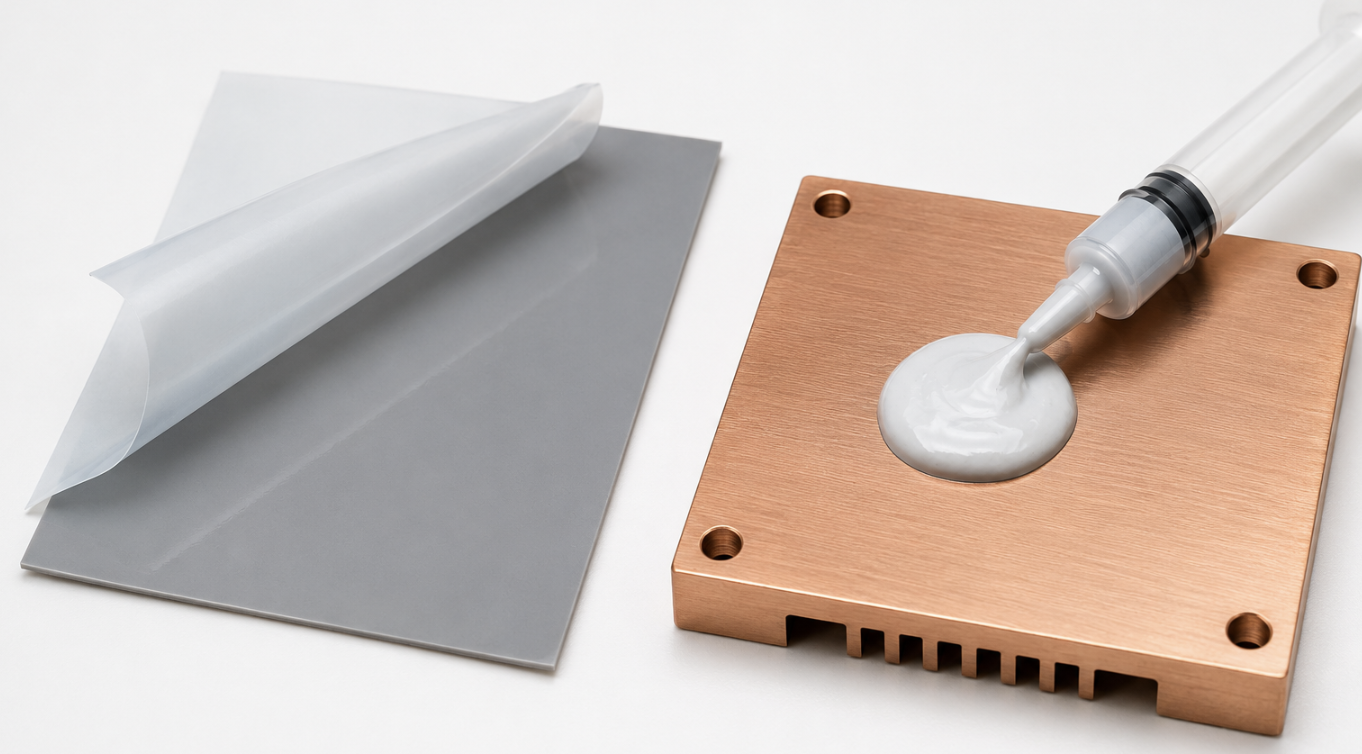
Phase Change Material (PCM)
PCMs are solid films or sheets at room temperature. When the assembly reaches operating temperature — typically between 45°C and 70°C depending on formulation — the material softens and flows slightly, conforming to microscopic surface features on both the component and heat sink. As the system cools, it re-solidifies.
This phase transition cycle repeats with every power-on and power-off event. The material re-wets the interface each time it heats up, which is what gives PCMs their long-term stability advantage. There is no carrier fluid to migrate or evaporate — the thermally conductive matrix stays at the interface.
Typical composition: polymer or wax-based matrix filled with aluminum oxide, boron nitride, or graphite particles. Thermal conductivity typically ranges from 3 to 8 W/m·K depending on filler loading and grade.
Thermal Paste
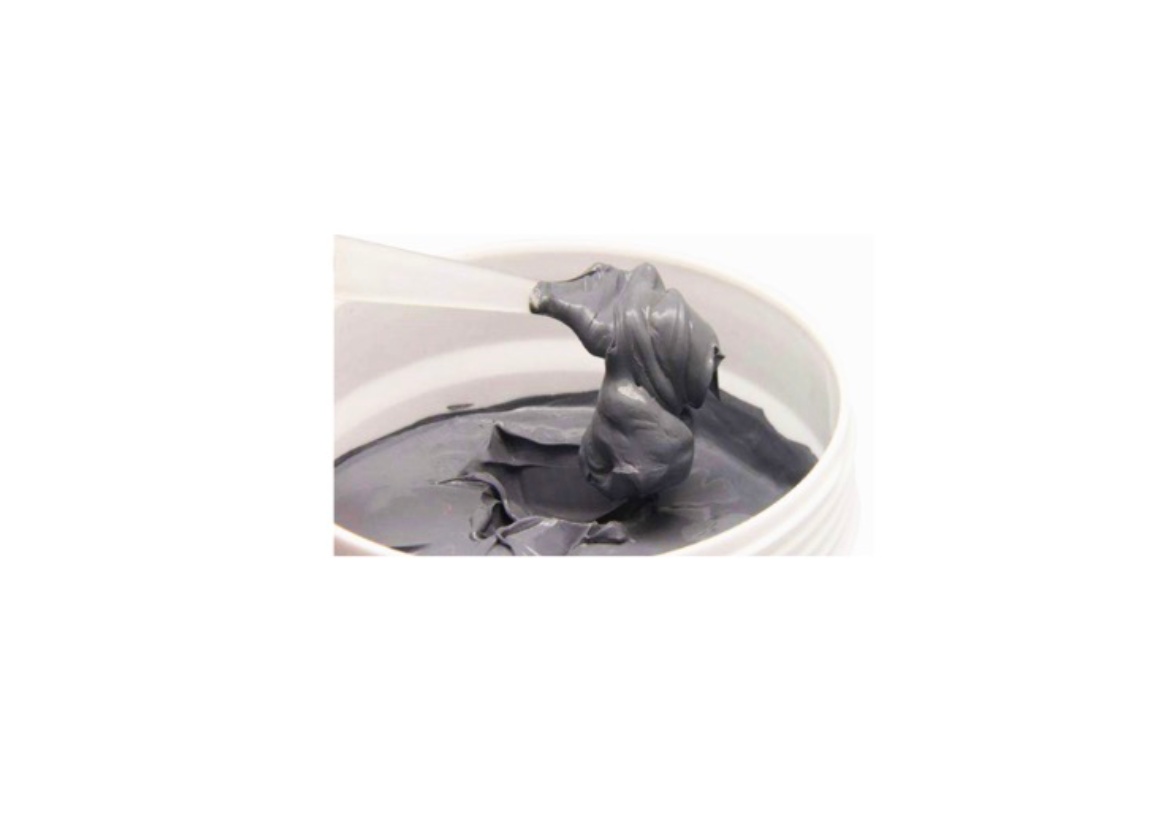
Thermal paste — also called thermal compound or thermal grease — is a viscous material composed of a silicone or hydrocarbon oil carrier loaded with thermally conductive particles. Common fillers include zinc oxide, aluminum oxide, and silver or carbon-based compounds in higher-performance grades.
The carrier oil gives thermal paste its initial advantage: it flows easily under pressure, fills surface irregularities well, and achieves very low initial contact resistance. Standard silicone-based pastes reach 3–8 W/m·K; premium metal-filled formulations can exceed 10 W/m·K.
The problem is the carrier oil itself. It is not permanently bonded to the interface. Under repeated thermal cycling, mechanical vibration, and sustained heat exposure, the carrier migrates — and once it moves, performance degrades.
Thermal Performance: Initial vs. Long-Term
Initial performance — thermal paste has a narrow edge
Out of the box, high-quality thermal paste can slightly outperform a comparable PCM grade in initial thermal resistance measurements. Paste flows under any clamping pressure, achieving a bond line thickness often below 50–100 µm on well-prepared surfaces. PCMs require reaching phase transition temperature before they fully conform, meaning initial performance during the first power cycle may be slightly higher in thermal resistance than steady-state.
For most applications, this difference is small and stabilizes quickly once the system reaches operating temperature. It is not a meaningful factor in material selection for power electronics.
Long-term performance — where the gap opens up
The more significant difference appears after extended operation.
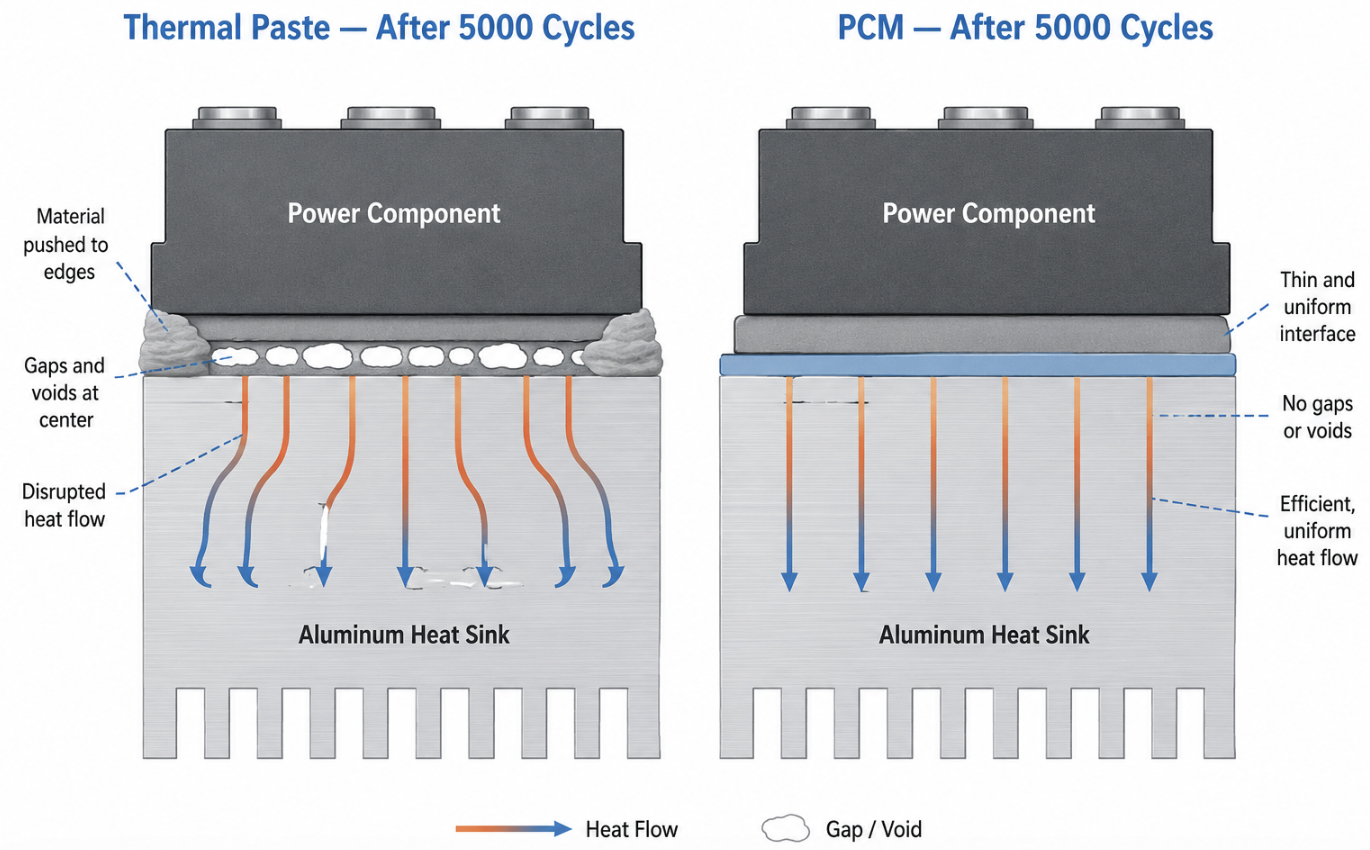
Pump-out is the primary failure mode for thermal paste in cycling applications. As components heat and cool, differential thermal expansion causes slight movement at the interface. Over hundreds or thousands of cycles, this mechanical action gradually pushes paste outward from the center of the contact area — the hottest point — toward the edges. The result is a progressively thinning TIM layer at the location where heat flux is highest, and increasing thermal resistance over time.
Studies on thermal paste pump-out in IGBT modules and CPU applications consistently show measurable thermal resistance increase after 500–1000 thermal cycles, with degradation accelerating beyond that point. The rate depends on paste formulation, clamping pressure, surface flatness, and cycle severity.
Dry-out compounds the problem. Silicone oil carriers gradually volatilize at elevated temperatures, particularly above 100°C junction temperature. As the carrier evaporates, the remaining filler particles become less mobile, the material hardens, and thermal resistance increases further.
PCMs avoid both mechanisms. There is no carrier oil to pump out or evaporate. The phase transition re-wets the surface on each cycle rather than degrading it. Accelerated aging data for commercial PCM grades typically shows less than 10–15% change in thermal resistance after 1000 thermal cycles — a level of stability that thermal paste cannot reliably match over the same period.
Head-to-Head Comparison
The values below represent typical commercial grade ranges. Actual performance depends on specific product formulation, surface preparation, and assembly conditions.
| Parameter | PCM | Thermal Paste |
|---|---|---|
| Thermal conductivity | 3–8 W/m·K | 3–10+ W/m·K |
| Initial bond line thickness | 20–80 µm (after phase transition) | 20–150 µm (pressure dependent) |
| Thermal resistance (interface) | Very low | Low (initially) |
| Pump-out risk | Low | Medium to high (cycling applications) |
| Dry-out risk | None | Medium (temperature dependent) |
| Performance after 1000 cycles | Stable (< 15% change typical) | Degraded (varies by formulation) |
| Electrical insulation | Grade dependent | Grade dependent |
| Assembly process | Peel-and-place, controlled pressure | Dispense or manual apply, variable |
| Reworkability | Clean peel-off | Requires solvent cleaning |
| Contamination risk | Low | Medium (bleed, migration) |
| Relative material cost | Higher | Lower |
Reading the table in context:
The conductivity overlap is real — a premium thermal paste outperforms a standard PCM grade on bulk conductivity. But conductivity is only part of the thermal resistance equation. Bond line thickness and interface contact resistance are equally important, and long-term stability determines whether initial performance is maintained over the product lifetime.
For a 10-year industrial application with 2–3 thermal cycles per day, that represents roughly 7,000–10,000 cycles over the product life. At that scale, the long-term stability column matters far more than the initial conductivity number.
Where Thermal Paste Still Makes Sense
Thermal paste is not obsolete — it remains the right choice in specific situations.
Short service life or maintainable systems. Desktop CPUs, consumer electronics, and lab equipment are regularly serviced or replaced within 3–5 years. At that timescale, pump-out and dry-out may not reach performance-critical levels, and the lower material cost is a genuine advantage.
Prototyping and development. When testing multiple heat sink configurations or iterating on thermal designs, thermal paste is faster to apply, easier to remove, and cheap enough to discard. PCMs are better suited to production; paste is better suited to the bench.
Very high conductivity requirements on a budget. Premium silver-filled or metal-based thermal pastes can reach 10–12 W/m·K — above what most standard PCM grades offer. If peak conductivity matters more than long-term stability, and the application allows periodic reapplication, paste remains competitive.
Low-volume or manual assembly. Applying paste requires no phase transition temperature, no peel film, and no pressure specification. For small-batch production or field repair, that simplicity has real value.
Where PCM Has the Advantage
PCM's strengths become decisive in a specific set of conditions — and those conditions describe a large share of industrial power electronics.
Long service life in sealed or inaccessible systems. Industrial inverters, grid-tied power supplies, and telecom power modules are often designed for 10–15 year service life with no scheduled maintenance access to internal components. In these applications, a TIM that degrades after 2,000 thermal cycles is a warranty liability. PCM's stability under cycling eliminates that risk.
High thermal cycling frequency. EV charging stations, motor drives, and UPS systems cycle frequently — sometimes multiple times per day. Each cycle is a pump-out event for thermal paste. PCM re-wets the interface on each cycle rather than degrading it.
Automated or high-volume production. PCM films are dimensionally consistent, peel-and-place compatible, and produce repeatable bond line thickness across units. Paste application — even with dispensing equipment — introduces variability in volume, coverage, and thickness that affects thermal resistance unit-to-unit.
Clean assembly requirements. In power electronics with tight component spacing, paste migration and bleed can contaminate adjacent components or insulating surfaces. PCM films stay within their footprint, reducing contamination risk and rework rate.
Total Cost of Ownership
Material price is the most visible cost in TIM selection. It is rarely the largest one.
Consider an industrial UPS system with a 10-year design life, operating in a temperature range that produces two thermal cycles per day. Over the product lifetime, that is roughly 7,000 cycles. If thermal paste begins degrading measurably after 1,000–2,000 cycles — which is consistent with published pump-out data for standard silicone-based formulations — the system enters a zone of elevated thermal resistance well before end of life.
The consequences are not always dramatic. Junction temperatures rise gradually. Efficiency drops slightly. In some cases, thermal protection circuits trigger more frequently. In others, component degradation accelerates quietly until a field failure occurs.
The cost of that failure — field service, replacement components, downtime, warranty claims — typically exceeds the PCM price premium by a wide margin. A PCM that costs two to three times more per unit than thermal paste represents a small fraction of the total system cost, and eliminates a failure mode that is difficult to predict and expensive to address after the fact.
For cost-sensitive designs, the calculation is straightforward: estimate the probability and cost of a TIM-related field failure against the PCM price premium. In high-volume, long-life applications, the math consistently favors PCM.
TaxoTape® Solutions
TaxoTape® supplies phase change materials and thermal paste products for industrial power electronics applications including inverters, UPS systems, EV chargers, and LED driver assemblies.
PCM is available in standard sheet formats and custom die-cut dimensions to match component footprints. Full technical documentation — TDS, RoHS declaration, and thermal cycling test data — is provided with sample and production orders.
If you are currently using thermal paste and experiencing reliability or rework issues, or evaluating TIM options for a new design, we can recommend specific grades based on your power density, gap geometry, and production process.
Conclusion
Thermal paste and PCM both fill the same interface gap — but they age differently, assemble differently, and carry different risk profiles over a product lifetime.
Thermal paste wins on initial cost and simplicity, and remains the practical choice for short-life, maintainable, or cost-sensitive applications. PCM wins on long-term stability, assembly consistency, and total cost of ownership in high-cycling, long-life, or sealed-system applications.
The decision point is not which material has higher conductivity — it is how long your system needs to maintain thermal performance, and what the cost of a TIM-related failure looks like in your application.
FAQ
Q: Can thermal paste and PCM achieve the same initial thermal resistance?In many cases, yes. High-quality thermal paste and PCM grades with similar conductivity can achieve comparable initial thermal resistance under controlled conditions. The performance gap becomes significant after extended thermal cycling, not at initial assembly.
Q: How many thermal cycles can thermal paste typically handle before performance degrades?This depends heavily on formulation, clamping pressure, surface flatness, and cycle severity. As a general reference, standard silicone-based pastes show measurable thermal resistance increase after 500–1,500 cycles in accelerated testing. Premium formulations perform better but still degrade over time due to carrier migration.
Q: Is PCM suitable for high-voltage applications?Most standard PCM grades are not electrically insulating. For applications requiring dielectric isolation — such as IGBT modules at 400V+ bus voltage — confirm the dielectric strength of the specific PCM grade, or use a separate insulating layer. Some PCM grades are formulated with electrically insulating fillers; verify specifications with your supplier.
Q: Does PCM work in applications where the system never reaches phase transition temperature?If the operating temperature consistently stays below the PCM's phase transition point (typically 45–70°C), the material will not fully conform to the interface. In that case, a thermal pad or paste is more appropriate. Confirm the expected component temperature range before specifying PCM.