Welcome to Taxo Tape
PCM vs. Graphite Sheets: Thermal Interface or Heat Spreader?
Introduction
Phase change materials and graphite sheets are both found in power electronics thermal management designs, and they are sometimes compared as if they are competing solutions for the same problem. They are not.
PCM is an interface material — its function is to minimize thermal resistance at the contact boundary between a heat-generating component and a heat sink. Graphite sheets are heat spreaders — their function is to distribute concentrated heat laterally across a surface before it reaches a cooling structure. One reduces resistance in the vertical heat flow path; the other reduces peak temperature by expanding the effective heat dissipation area.
Understanding this distinction changes how you approach the selection decision. The question is not which material has better thermal performance — it is which problem you are actually trying to solve at each specific location in your assembly.
This article covers how each material works, where each belongs in a power electronics design, and how they can work together in applications that need both functions.
How PCM Works at the Thermal Interface
A phase change material is solid and dry at room temperature, making it straightforward to handle and position during assembly. When the assembly reaches operating temperature — typically crossing a phase transition point between 45°C and 65°C depending on formulation — the material softens and flows microscopically into the surface irregularities on both the component baseplate and the heat sink mounting surface.
This microscopic flow is the mechanism that matters. Even machined metal surfaces are not perfectly flat at the microscopic scale — they have peaks and valleys on the order of micrometers that trap air when two surfaces are pressed together. Air has thermal conductivity of approximately 0.026 W/m·K. PCM, once softened, displaces that trapped air and replaces it with a material typically rated at 3–8 W/m·K — a two-order-of-magnitude improvement at the contact zone.
Key technical characteristics:
Thermal conductivity: 3–8 W/m·K (bulk, through-plane)
Bond line thickness (BLT): 20–80 µm under typical clamping pressure
Phase transition temperature: 45–65°C (product-dependent)
Electrical insulation: most grades are electrically insulating; verify for specific products
Form: sheets, films, or pre-applied to heat sink surfaces
What PCM does not do:
PCM does not spread heat laterally. Its function is to improve the contact quality between two surfaces in the vertical heat flow direction — from component to heat sink. Once heat is through the interface, PCM's role is complete. If the problem is a concentrated hot spot that needs to be distributed across a wider area before reaching the cooling surface, PCM alone does not address that.
How Graphite Sheets Work as Heat Spreaders
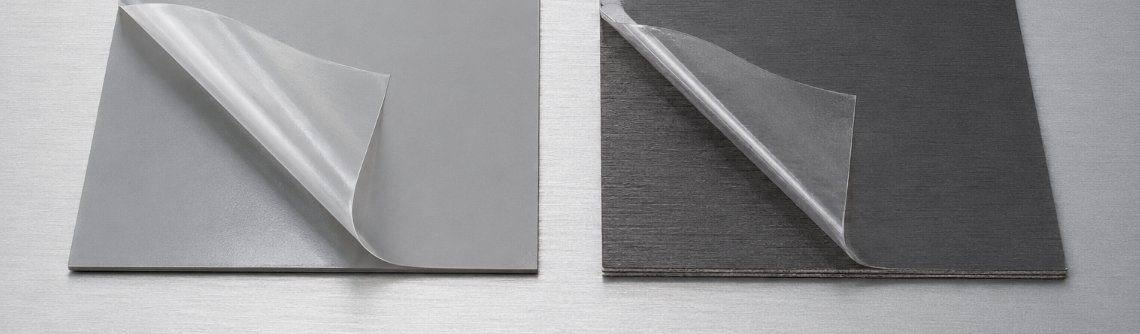
Synthetic graphite sheets are produced by high-temperature processing of polymer films, which creates a layered crystal structure of aligned carbon atoms. This crystal structure is the key to understanding graphite's thermal behavior — and its limitations as a standalone TIM.
The aligned carbon layers conduct heat extremely efficiently in the plane of the sheet — in-plane thermal conductivity of commercial synthetic graphite sheets typically ranges from 300 to 700+ W/m·K depending on grade. This is significantly higher than copper (approximately 400 W/m·K) and aluminum (approximately 200 W/m·K) at equivalent thickness.
However, heat transfer perpendicular to those layers — through the thickness of the sheet — is much lower. Through-plane conductivity for synthetic graphite sheets typically falls in the range of 3–10 W/m·K, comparable to a moderate thermal pad. The material is highly anisotropic: exceptional in one direction, moderate in the other.
Key technical characteristics:
In-plane thermal conductivity: 300–700+ W/m·K
Through-plane thermal conductivity: 3–10 W/m·K
Typical thickness: 0.1–0.5 mm (thinner grades available for compact designs)
Electrical conductivity: graphite is electrically conductive — requires insulation consideration in high-voltage assemblies
Mechanical behavior: flexible in-plane but brittle in bending; may require carrier film for handling
What graphite sheets do:
A graphite sheet placed between a heat source and a cooling structure takes concentrated heat from a small area and distributes it across the full sheet area before it reaches the cooling interface. This reduces peak temperature at the hot spot by spreading the thermal load over a larger effective area. The benefit is proportional to the ratio between the hot spot area and the sheet area — the larger the spreading ratio, the greater the temperature reduction.
What graphite sheets do not do:
Graphite sheets do not minimize interface thermal resistance in the conventional sense. Their through-plane conductivity is moderate, and they do not conform to surface irregularities the way PCM does. A graphite sheet placed directly between a component and heat sink will not eliminate the microscopic air gaps at those contact surfaces — and those air gaps contribute meaningfully to total interface thermal resistance.
Head-to-Head Comparison
| Parameter | PCM | Graphite Sheet |
|---|---|---|
| Primary function | Interface resistance reduction | Lateral heat spreading |
| Through-plane conductivity | 3–8 W/m·K | 3–10 W/m·K |
| In-plane conductivity | 3–8 W/m·K (isotropic) | 300–700+ W/m·K |
| Bond line / thickness | 20–80 µm (after phase transition) | 0.1–0.5 mm (fixed) |
| Surface conformability | Excellent (flows at transition temperature) | Poor (does not conform to micro-gaps) |
| Interface air gap elimination | Yes — primary function | No |
| Heat spreading capability | Minimal | Excellent — primary function |
| Phase transition requirement | Yes — 45–65°C activation | None |
| Electrical insulation | Most grades: yes | No — electrically conductive |
| Mechanical flexibility | Moderate (solid at room temp) | Flexible in-plane, brittle in bending |
| Assembly handling | Clean, peel-and-place | Requires care; carrier film often needed |
| Gap accommodation | Tight gaps only (<0.1 mm) | Fixed thickness, no gap filling |
| Pump-out risk | None | None |
| Reworkability | Moderate | Moderate–easy if undamaged |
| Relative cost | Higher | Moderate |
The table's key insight:
Both materials have similar through-plane conductivity in absolute terms. The difference is not in that number — it is in what each material does with heat once it enters the material. PCM uses surface conformability to eliminate air gaps and reduce contact resistance. Graphite uses its crystalline structure to move heat laterally at very high speed before it exits through the thickness. Choosing between them based on through-plane conductivity alone misses the point of what each material is designed to do.
When PCM Is the Right Choice
Direct component-to-heat-sink interfaces with flat, controlled surfaces.
PCM's performance advantage — the elimination of interface air gaps through surface wetting — requires that both mating surfaces are reasonably flat and that clamping pressure is sufficient to maintain contact during and after phase transition. Well-machined heat sink surfaces and standard power module baseplates meet this requirement. Cast or rough surfaces with irregularities above 15–20 µm Ra are less suitable.
IGBT, SiC MOSFET, and high-power module interfaces.
These devices generate concentrated heat flux — typically 10–30 W/cm² in industrial inverter and EV traction applications — that must transfer vertically from the device baseplate to a liquid-cooled or air-cooled heat sink. The interface thermal resistance at this location directly determines junction temperature. PCM's ability to achieve BLT of 20–80 µm with full surface contact makes it the highest-performing interface material for this application, outperforming thermal pads and competitive with or better than thermal grease in long-term stability.
Sealed systems with long service life requirements.
In industrial inverters, UPS systems, EV chargers, and other sealed power electronics where the thermal interface is not accessible for maintenance, PCM's resistance to pump-out under thermal cycling is a significant reliability advantage over grease. The material re-wets the interface on each thermal cycle rather than gradually migrating outward over thousands of cycles.
High-volume automated assembly.
PCM in sheet or pre-applied film format integrates cleanly into automated production lines — consistent thickness, peel-and-place handling, and no dispensing equipment required. Production consistency is higher than grease dispensing and comparable to thermal pad placement.
When operating temperature reliably exceeds the activation threshold.
PCM only delivers its full performance after the phase transition temperature is reached. In an IGBT module running at rated load in an industrial inverter, the baseplate temperature reliably exceeds 60–70°C — well above the 45–65°C activation range of most commercial PCM grades. In a low-power application where the interface temperature stays below activation temperature under normal load, PCM's performance advantage does not materialize and a thermal pad is more appropriate.
When Graphite Sheets Are the Right Choice
Battery module temperature uniformity management.
In EV battery packs and stationary energy storage systems, temperature non-uniformity across cells is a more important design problem than minimizing a single interface thermal resistance value. Cells at different temperatures age at different rates — a 5°C difference between the hottest and coolest cell in a module meaningfully accelerates differential capacity fade over the battery's service life.
Graphite sheets placed between cell groups or between the cell array and a structural plate distribute heat laterally across the module, reducing the temperature differential between cells before heat reaches the cooling system. No other thin-format material achieves comparable lateral heat distribution at the same thickness and weight.
Hot spot management in power electronics with non-uniform heat generation.
Power electronic assemblies rarely have perfectly uniform heat distribution. In a multi-IGBT inverter module, switching losses concentrate in the active device area while surrounding areas run cooler. A graphite sheet on the module surface or between layers spreads the concentrated heat from active switching areas across the full module footprint before it reaches the heat sink, reducing peak hot spot temperature without requiring a larger or more capable cooling system.
Space-constrained designs requiring ultra-thin heat management layers.
Synthetic graphite sheets are available in thicknesses from 0.1 mm, providing effective heat spreading at a mass and volume penalty that no other heat spreading material matches. In compact power supplies, LED driver assemblies, and thin power modules where every millimeter of z-height matters, graphite achieves heat spreading that a copper or aluminum layer would require significantly more thickness and weight to match.
As a complementary layer in a multi-material thermal stack.
Graphite sheets are rarely used in isolation in high-performance power electronics — they are most effective as part of a thermal stack that includes a dedicated interface material at the component contact surfaces. The graphite layer handles lateral distribution; a separate interface material handles the contact resistance problem at the component boundary.
Can They Work Together?
In many power electronics designs, PCM and graphite sheets are not competing choices — they address different parts of the thermal problem and can be used together in a layered thermal stack.
The logic of combining them:
PCM minimizes the contact resistance at the primary device-to-heat-sink interface. Graphite distributes the heat load laterally before or after that interface, reducing the peak heat flux that the primary interface must handle. Used together, the combination achieves lower junction temperatures than either material can produce independently.
Typical layered design examples:
In a high-power industrial inverter with multiple IGBT modules on a common cold plate, a graphite sheet between the module baseplate and the cold plate surface can spread each module's heat load across a larger cold plate area before the PCM layer at the direct contact zone handles the final interface resistance. The result is lower junction temperature and more uniform cold plate temperature distribution across the multi-module assembly.
In an EV battery module, graphite layers between cell groups manage temperature uniformity across the cell array, while PCM or thermal gel at the module-to-cold-plate interface handles the primary heat extraction path. The two materials operate at different levels of the thermal hierarchy without competing.
In an EV charging station power module — a relevant application for your target customers — a graphite heat spreader layer on the IGBT module top surface distributes switching losses across the full module area, while PCM at the baseplate-to-liquid-cold-plate interface minimizes the final interface resistance on the extraction path.
Design parameters to evaluate when combining:
Total stack thermal resistance — adding a graphite layer adds its through-plane resistance in series with the interface material. Confirm the combined stack resistance still meets the junction temperature budget. Electrical isolation — graphite is conductive; when using it in a stack with PCM or other materials near high-voltage surfaces, verify that the insulation requirements are met at the system level, not just at each individual layer. Mechanical thickness — each additional layer adds to the assembly height and clamping stack. Verify that total compressed thickness remains within the mechanical tolerance of the mounting hardware.
Common Selection Mistakes
Using graphite sheet as a primary interface material expecting grease-like performance.
This is the most common misapplication of graphite in power electronics. A graphite sheet placed directly between a component baseplate and heat sink does not eliminate microscopic air gaps — it sits on top of them. The through-plane thermal resistance of the graphite layer is moderate (3–10 W/m·K), and the contact resistance at both faces remains because graphite does not conform to surface irregularities. Engineers who specify graphite at a primary interface expecting the performance of a phase change material or high-conductivity grease consistently see higher-than-expected junction temperatures.
Using PCM where lateral heat spreading is the actual requirement.
PCM reduces contact resistance in the vertical heat flow path. If the design problem is a concentrated hot spot that needs to be spread across a wider area before reaching the cooling surface, PCM does not address that — it only improves what happens at the contact boundary itself. Specifying PCM for a battery module temperature uniformity problem, or for a multi-IGBT module where heat distribution across the cooling plate matters, misses the actual thermal design requirement.
Overlooking graphite's electrical conductivity.
Graphite is electrically conductive with volume resistivity in the range of 10⁻⁴ to 10⁻³ Ω·cm. In high-voltage power electronics — inverters, EV battery systems, UPS modules operating at 400V or above — placing graphite in contact with or in close proximity to energized surfaces creates a safety and isolation compliance risk. This requires either additional insulating layers in the stack or selection of electrically insulated graphite composite materials, which are available but add cost and reduce in-plane conductivity compared to pure graphite.
Specifying PCM without confirming activation temperature.
PCM delivers its performance only after the phase transition is reached. If the interface temperature under normal operating load stays below the material's activation point — because the power level is moderate, the heat sink is oversized, or the ambient temperature is low — PCM remains in its solid, pre-transition state and functions as a moderately conformable pad rather than a fully wetted interface material. Confirm the expected interface temperature under minimum load conditions, not just at rated power, before specifying PCM.
TaxoTape® Solutions
TaxoTape® supplies both phase change materials and graphite sheets for power electronics thermal management applications, including industrial inverters, UPS systems, EV charging equipment, and LED power modules.
PCM is available in standard sheet formats and custom die-cut dimensions, with multiple activation temperature grades to match different operating temperature profiles. Graphite sheets are available in standard and high-conductivity grades across a range of thicknesses, with carrier film options for easier automated handling.
For applications requiring a combined PCM and graphite stack, we can recommend specific grade combinations based on your heat flux, junction temperature target, and assembly mechanical constraints. Full technical documentation — TDS, thermal conductivity data, electrical properties, and RoHS declaration — is provided with sample and production orders.
Request samples or technical consultation →
Conclusion
PCM and graphite sheets are complementary materials, not competing ones. PCM solves the interface contact problem — eliminating air gaps and minimizing thermal resistance in the vertical heat flow path at device-to-heat-sink boundaries. Graphite solves the heat distribution problem — spreading concentrated heat laterally to reduce peak temperatures and improve uniformity across a module or assembly.
Selecting between them requires identifying which problem is actually limiting your thermal design. If junction temperature is high because interface resistance is high at a flat, controlled surface — PCM. If junction temperature is high because heat is concentrated in a small area that the cooling system cannot efficiently extract from — graphite. If both problems exist at different levels of the thermal stack — use both, with each material in the role it is designed for.
Contact TaxoTape® to discuss PCM and graphite sheet selection for your application →
FAQ
Q: Can a graphite sheet replace PCM at an IGBT-to-heat-sink interface?
Not effectively. Graphite's through-plane conductivity (3–10 W/m·K) is similar to PCM, but graphite does not conform to the microscopic surface irregularities that create air gaps at the interface. PCM wets both surfaces after phase transition, eliminating those air gaps and achieving much lower contact resistance than graphite can at the same location. For direct component-to-heat-sink interfaces, PCM consistently outperforms graphite in total interface thermal resistance.
Q: Does graphite need to be electrically isolated when used in high-voltage power modules?
Yes, in most cases. Graphite is electrically conductive, with volume resistivity orders of magnitude lower than electrically insulating thermal pads. In power electronics operating above 48V — and certainly in EV inverters and chargers at 400–800V bus voltage — graphite must not make electrical contact with energized surfaces without appropriate insulating layers. Options include electrically insulated graphite composite sheets, or placing insulating layers above and below the graphite in the thermal stack. Verify the complete stack isolation against your applicable safety standard before production.
Q: At what power density does it make sense to add a graphite layer to a design that already uses PCM?
As a general guideline, graphite heat spreading becomes increasingly beneficial when heat flux at the primary device interface exceeds 15–20 W/cm², particularly if the hot spot area is significantly smaller than the available heat sink contact area. At those flux levels, spreading heat over a larger cold plate area before the primary interface reduces the effective heat flux that PCM must handle, lowering junction temperature beyond what PCM alone achieves. Below 10 W/cm² with a well-matched heat sink, the added complexity of a graphite layer typically does not justify its cost.
Q: How do I verify that PCM is actually reaching its activation temperature in my application?
The most direct method is thermal measurement at the component-to-heat-sink interface during normal operating load — either by thermocouple at the interface boundary or by infrared measurement of the heat sink surface near the component location. If the measured temperature at the interface exceeds the PCM's specified phase transition temperature (typically 45–65°C) during normal operation, the material is activating as designed. If your minimum load condition keeps the interface below activation temperature, consider a PCM grade with a lower transition point or evaluate whether a thermal pad is more appropriate for your operating profile.