Welcome to Taxo Tape
When Should You Use Phase-Change Materials in Power Electronics?
Introduction
As IGBTs, MOSFETs, and power modules continue pushing higher power densities into smaller footprints, the margin for thermal error keeps shrinking. A TIM that performs adequately at moderate loads can become the limiting factor once power density crosses a certain threshold.
Phase-change materials occupy a specific position in the TIM selection landscape — combining the low thermal resistance associated with thermal grease with the handling and reliability characteristics of a solid material. They are not universally better than other TIM options; they solve a specific set of design problems.
This article explains how PCMs work, where they genuinely outperform alternatives, and — just as importantly — where a different TIM is the better engineering choice.
How PCM Works
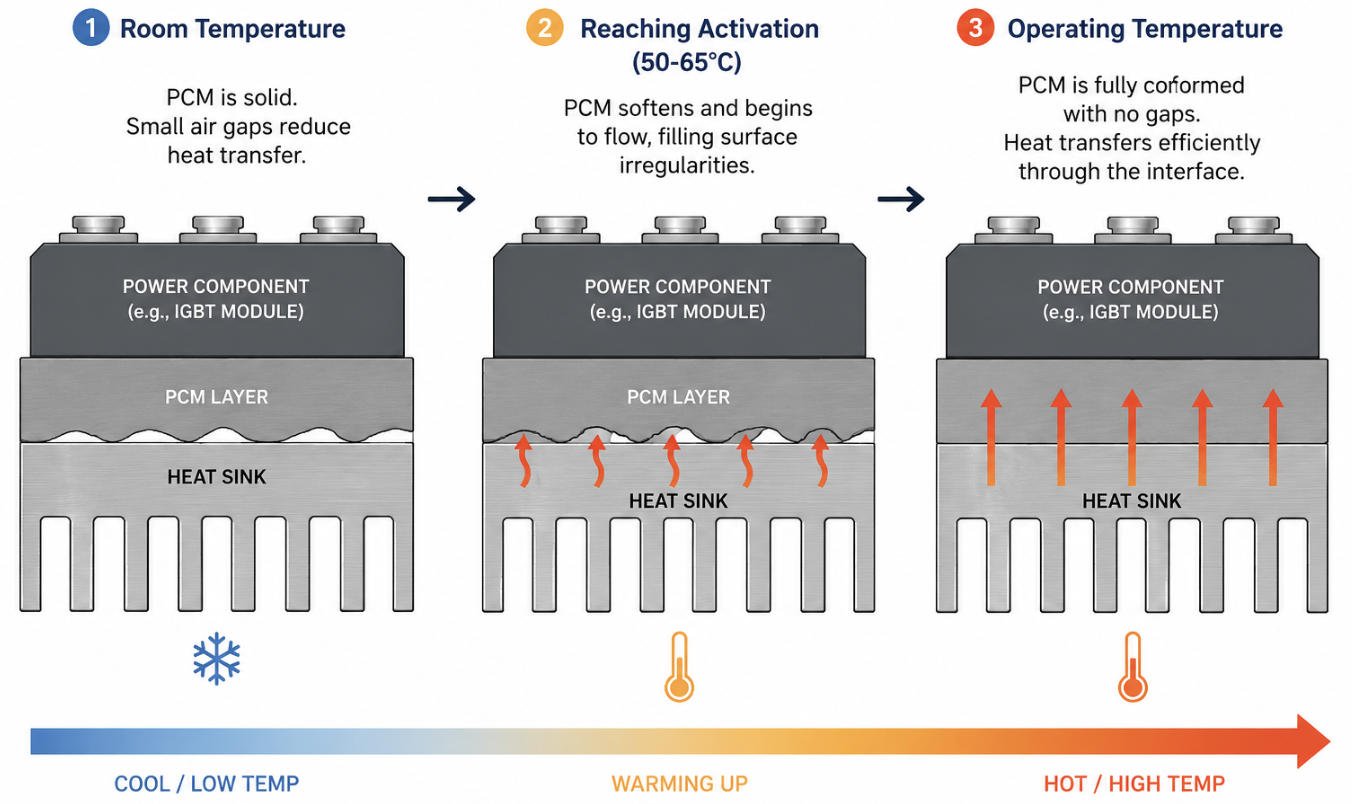
A phase-change material is solid and dry at room temperature, behaving like a thin pad during handling and assembly. Once the assembly reaches its operating temperature — typically in the 45–65°C range depending on formulation — the material softens and flows slightly, conforming to microscopic surface irregularities on both mating surfaces. As the system cools back down, the material re-solidifies, locking the interface in place.
This transition matters because it happens repeatedly. Every power cycle is an opportunity for the PCM to re-wet the interface, which is why PCMs tend to maintain stable thermal resistance over years of operation rather than degrading the way thermal grease does under repeated cycling.
Why the activation temperature matters in practice:
The PCM only delivers its designed thermal performance once it crosses the phase transition point. In a 600W IGBT module that reaches 70–80°C at the case during normal operation, a PCM rated for 50–55°C activation works as intended — it transitions early in the heating cycle and stays softened through the operating range.
In a lower-power application where the component case temperature tops out at 40°C, a PCM with a 55°C activation point never fully transitions. It remains in its solid, pre-application state, and the thermal performance advantage the material is designed to provide simply does not materialize. This is the single most common PCM selection mistake — specifying the material without confirming it will actually reach phase transition temperature in service.
Key Advantages of PCM in Power Electronics
Low thermal resistance after activation. Once transitioned, PCM achieves bond line thickness in the 20–80 µm range, producing thermal resistance comparable to thermal grease — typically within 10–15% of a premium grease formulation at equivalent conductivity.
Stable performance through thermal cycling. Because the material re-wets the interface on each heating cycle rather than relying on a carrier fluid that migrates over time, PCM maintains thermal resistance within roughly 10–15% of initial values after 1,000 thermal cycles in accelerated testing — a level of stability that thermal grease does not typically achieve over the same interval.
No pump-out or contamination risk. PCM stays within its applied footprint. There is no carrier oil to migrate outward under pressure, and no risk of material spreading to adjacent components during assembly or operation — a meaningful advantage in densely packed power modules.
Simplified assembly process. PCM is supplied as cut-to-size sheets or pre-applied to heat sink surfaces, eliminating the need for dispensing equipment, volume control, or operator-dependent application technique. This reduces both assembly variability and the equipment investment required compared to grease or gel dispensing systems.
Head-to-Head Comparison
The table below shows typical performance ranges across the four most common TIM categories used in power electronics. Actual values vary by specific product formulation and application conditions.
| Parameter | PCM | Thermal Grease | Silicone Pad | Gap Filler |
|---|---|---|---|---|
| Thermal conductivity | 3–8 W/m·K | 3–12+ W/m·K | 1–6 W/m·K | 1–4 W/m·K |
| Bond line thickness | 20–80 µm | 20–100 µm | 0.3–3 mm | 0.5–10 mm |
| Activation/transition | 45–65°C | None | None | None |
| Pump-out risk | None | Medium–high | Low | None |
| Assembly method | Peel-and-place | Dispense/manual | Manual placement | Dispense/manual |
| Gap accommodation | Low (tight gaps only) | Low | Medium | High (large gaps) |
| Reworkability | Moderate–easy | Difficult | Easy | Moderate |
| Long-term stability | High | Moderate–low | High | High |
| Relative cost | Higher | Lower | Lower–moderate | Moderate |
Reading the table in context:
PCM and thermal grease occupy similar thermal performance territory in terms of bond line thickness and conductivity — which is exactly why PCM is often selected as a grease replacement. The decision between them typically comes down to reliability requirements and assembly process, not raw thermal numbers.
Silicone pads and gap fillers serve a different purpose entirely: they accommodate larger or uneven gaps that PCM cannot bridge. PCM requires relatively flat, well-controlled surfaces to perform as designed — it is not a substitute for a gap filler in applications with significant tolerance stack-up.
When PCM Is the Right Choice
Power density above 8–10 W/cm² with case temperatures reliably exceeding 50°C. This is the core use case — high enough heat flux that bond line thickness matters, and operating temperatures that reliably trigger phase transition.
Sealed systems with 8+ year service life targets. Industrial inverters, EV charging infrastructure, and telecom power supplies without scheduled maintenance access benefit from PCM's resistance to pump-out and dry-out over extended operation.
Applications currently using thermal grease that show field reliability issues. If thermal resistance degradation or warranty claims trace back to grease pump-out, PCM is frequently the most direct replacement — similar performance profile, without the long-term degradation mechanism.
Flat, well-controlled mating surfaces. PCM performs best when surface flatness and roughness are within the material's design tolerance — typically surface roughness below 10 µm Ra. Well-machined heat sinks and standard power module baseplates meet this requirement reliably.
High-volume automated assembly. Pre-cut PCM sheets or PCM pre-applied to heat sinks integrate cleanly into automated production lines without dispensing equipment or volume calibration.
When PCM Is NOT the Right Choice
Low-power devices that never reach activation temperature. If component case temperature consistently stays below 45°C, the PCM never transitions and provides no performance advantage over a standard thermal pad — at a higher cost. Confirm the actual operating temperature profile before specifying PCM; a thermal pad at 1–3 W/m·K is the more appropriate and economical choice here.
Large or uneven gaps. PCM is designed for thin bond lines on relatively flat surfaces. If component height variation across a board exceeds 0.3 mm, or the design gap is 0.5 mm or more, PCM cannot bridge the distance reliably. A gap filler or thicker silicone pad accommodates these tolerances without the assembly precision PCM requires.
Field-serviceable systems requiring frequent disassembly. PCM is reworkable, but not as easily as a thermal pad. In applications where components are regularly removed for service or testing — lab equipment, modular test fixtures — a pad's clean peel-off removal is more practical than managing a partially re-solidified PCM layer.
Very rough or unmachined surfaces. PCM's thin-film conformability has limits. On surfaces with roughness above roughly 10–15 µm Ra, or with visible machining marks or casting texture, the material cannot fully fill the resulting air gaps. A silicone gap filler, which compresses to a much greater thickness, handles surface irregularity more reliably.
Tight cost targets with moderate thermal requirements. In commodity LED drivers, entry-level power adapters, or other price-sensitive designs where thermal performance requirements are moderate, a standard thermal pad typically delivers adequate performance at a meaningfully lower material cost.
Design Considerations Before Specifying PCM
Before finalizing PCM in a bill of materials, confirm the following:
Operating temperature profile. Pull actual case temperature data — from thermal simulation or prototype testing — across the expected duty cycle. Verify the component reliably exceeds the PCM's activation temperature during normal operation, not just at peak load.
Surface specifications. Check heat sink and component surface flatness and roughness against the PCM manufacturer's recommended tolerances. Request this data from your supplier rather than assuming compatibility.
Clamping method and pressure. PCM performance is pressure-dependent. Confirm your mounting hardware applies consistent, specified pressure across the interface — uneven clamping force is a common cause of inconsistent PCM performance in production.
Production volume and assembly method. If you are running high-volume automated assembly, pre-cut or pre-applied PCM formats reduce process steps. For low-volume or prototype builds, the simpler logistics may not justify the cost premium over grease.
Reliability data, not just datasheet conductivity. Request thermal cycling test data — typically 1,000+ cycles — from your PCM supplier to confirm long-term stability claims rather than relying on initial thermal resistance numbers alone.
TaxoTape® Solutions
TaxoTape® supplies phase-change materials for power electronics applications including industrial inverters, EV charging systems, telecom power supplies, and IGBT/MOSFET modules.
Available in standard sheet formats and custom die-cut dimensions to match component footprints, with multiple activation temperature grades to suit different operating profiles. Full technical documentation — including TDS, RoHS declaration, and thermal cycling test data — is provided with sample and production orders.
If you are evaluating whether PCM is the right fit for your application, or replacing thermal grease due to field reliability concerns, we can recommend a specific grade based on your power density, surface specifications, and operating temperature range.
Request samples or technical consultation →
Conclusion
PCM is not a universal upgrade over other TIMs — it is the right answer for a specific combination of conditions: sufficient power density to reach activation temperature, relatively flat surfaces, and a service life long enough that pump-out resistance matters.
Where those conditions are met, PCM delivers thermal performance close to premium thermal grease with significantly better long-term stability and cleaner assembly. Where they are not — low power, large gaps, frequent disassembly, tight cost targets — a thermal pad, gap filler, or grease remains the more appropriate and economical choice.
The selection decision comes down to confirming your actual operating temperature profile and surface conditions before specifying PCM, rather than assuming it is the premium option by default.
Contact TaxoTape® to confirm whether PCM fits your application →
FAQ
Q: What happens if my application doesn't reach the PCM's activation temperature?
The material remains in its solid, pre-application state and behaves similarly to a low-performance thermal pad — without delivering the bond line reduction PCM is designed to provide. Confirm actual case temperature data before specifying PCM, and select a grade with an activation point reliably below your minimum operating temperature.
Q: How many activation temperature grades are typically available?
Most suppliers offer PCM grades with activation points spanning roughly 45°C to 65°C, allowing selection based on your specific component operating range. Confirm available grades and activation tolerances with your supplier.
Q: Can PCM be used on rough or cast aluminum heat sink surfaces?
Standard PCM grades are designed for surface roughness below approximately 10–15 µm Ra. On rougher cast surfaces, the material may not fully conform, leaving air gaps. Machined or polished heat sink surfaces are recommended for full PCM performance.
Q: Is PCM more expensive than thermal grease per unit?
Generally yes — PCM typically costs more per unit area than standard thermal grease. The cost difference is usually justified by reduced field failure risk and elimination of pump-out related maintenance in long-life, high-cycling applications. For short-life or maintainable systems, grease may remain more cost-effective.