Welcome to Taxo Tape
Thermal Interface Materials in Battery Thermal Management
Introduction
A battery pack that passes thermal qualification testing can still develop hot spots in the field — not because the cooling system design was wrong, but because the interface between cells and that cooling system wasn't given the same level of attention. Cooling plates, liquid channels, and heat sinks only work as well as the thermal path connecting them to the cells they're meant to protect, and that path runs directly through a thermal interface material.
As batteries take on a larger role across EVs, stationary energy storage, and industrial backup power, the engineering conversation around thermal management tends to focus on system-level architecture — liquid cooling loops, cell layout, sensor placement. TIMs are often treated as a downstream detail, specified late in the design cycle almost as an afterthought. In practice, TIM selection has a direct and measurable effect on how evenly heat is drawn away from cells, and getting it wrong can undermine an otherwise well-engineered cooling system. This article looks at where TIMs fit into the broader thermal management picture, what material properties actually matter for battery applications, and how to avoid the selection mistakes that show up most often in the field.
Why Batteries Generate Heat
Batteries generate heat primarily through internal electrochemical reactions and electrical resistance during operation. Current flow during charging and discharging creates resistive heating, and this effect scales up sharply in high-capacity or fast-charging applications where current levels are substantially higher. Chemical side reactions within the cell can also release additional heat, particularly under stress conditions such as overcharging or deep discharging — situations that push the cell outside its normal operating envelope.
As energy density continues to climb to meet demand for smaller, lighter, and more powerful battery systems, the risk of excessive heat generation grows correspondingly. Left unmanaged, this heat drives capacity loss and accelerated degradation, and in extreme cases can trigger thermal runaway — a self-sustaining chain reaction that represents a serious safety hazard. This is the underlying reason thermal management, and by extension TIM selection, isn't a peripheral engineering concern but a core part of battery pack reliability.
How TIMs Fit into the Thermal Management Path
Heat moves through a battery pack via three mechanisms: conduction between adjacent cells and structural components, convection as heat exchanges with air or liquid coolant, and radiation, which plays a minor role at the temperatures batteries typically operate within. Of these three, conduction is where TIMs do their work — specifically at the point where a cell or module surface meets a cooling structure.
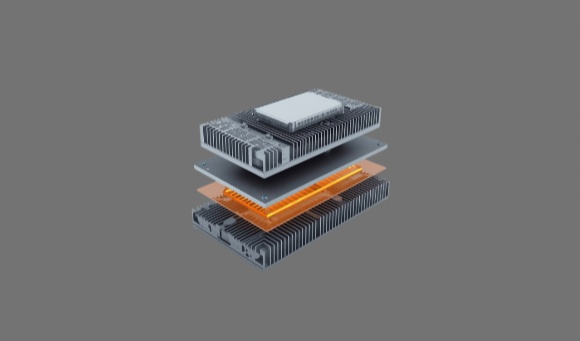
This interface matters more than it might initially seem. Battery modules are assembled from cells and structural components with real manufacturing tolerances, and the resulting surfaces are never perfectly flat or perfectly mated. Left as-is, microscopic air gaps form at every contact point — and air is a poor conductor relative to almost any solid interface material, meaning these gaps become bottlenecks in an otherwise well-designed cooling path. A TIM fills that space, displacing air and creating continuous contact across the interface, which is what allows the rest of the cooling system — the cold plate, the liquid channel, the heat sink — to actually reach the heat it was designed to remove.
Maintaining uniform temperature across the pack depends heavily on this interface being consistent from cell to cell. Even small variations in contact quality between cells lead to uneven heat extraction, which shows up over time as imbalanced charging behavior and uneven aging across the pack — cells running slightly hotter degrade faster than their neighbors, and that imbalance compounds with every cycle.
TIM Types Used in Battery Applications
Several TIM categories see regular use in battery pack design, each suited to different assembly and performance requirements.
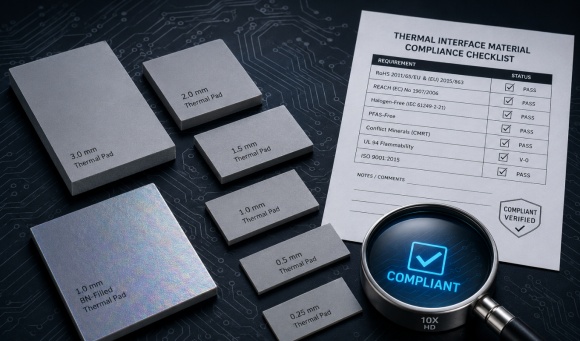
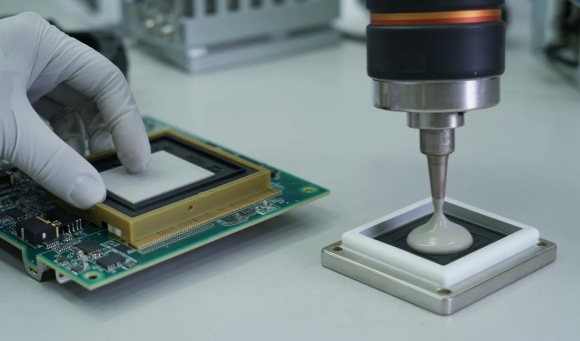
Thermal pads are soft, compressible sheets that provide consistent heat transfer along with electrical insulation — a relevant property in high-voltage packs where creepage and clearance distances matter. Thermal pastes and greases offer very thin bond lines for high-contact areas, though their long-term stability under cycling is a consideration for multi-year applications. Thermal gels are dispensable and conform readily to irregular surfaces, making them a common choice for large-format or dimensionally inconsistent modules. Phase change materials capture and release heat as they shift between solid and softened states, which helps smooth out temperature fluctuations during repeated charge-discharge cycles. Graphite films provide excellent in-plane thermal conductivity, spreading heat laterally across a surface rather than conducting it straight through — useful for reducing localized hot spots before heat reaches the primary cooling path.
Each of these material types comes with a different combination of trade-offs around conductivity, mechanical compliance, and long-term reliability — a full comparison of how they perform against each other for battery applications is covered separately in [Top 5 Thermal Interface Materials for EV & ESS Batteries].
Key Selection Criteria
Choosing a TIM for a battery application involves more than picking the highest thermal conductivity number on a datasheet. A handful of criteria tend to matter more in practice:
Thermal conductivity sets the baseline for how efficiently the material transfers heat, but it needs to be weighed against compressibility — a stiff, high-conductivity material that doesn't conform well to real-world surface tolerances can end up with worse actual contact resistance than a softer material that fills gaps completely. Dielectric strength is a critical consideration in high-voltage packs, where the TIM needs to provide reliable electrical isolation alongside its thermal function.
Beyond these core material properties, cost, ease of assembly, and long-term reliability shape whether a TIM is commercially viable at production volume. A material that performs well in isolated lab testing but is difficult to dispense consistently on an automated line, or that degrades faster than expected under real operating conditions, creates problems that don't show up until a design has already scaled — which is why selection criteria need to account for manufacturability and service-life performance from the start, not just initial thermal numbers.
Industry Applications
TIM selection criteria shift depending on the application environment, since each industry places different demands on the thermal interface.
Electric Vehicles (EVs & Hybrids) push TIMs the hardest — longer driving ranges and faster charging both increase heat load, and effective interface performance is part of what prevents thermal runaway while still allowing the pack to deliver higher performance. Energy Storage Systems (ESS) present a different challenge: large-scale battery arrays supporting solar and wind installations need stable, consistent temperature control across long service lives, often in outdoor environments with wide seasonal temperature swings. Industrial equipment and backup power — UPS systems, data center battery backup, heavy-duty equipment — has less dramatic thermal cycling than EVs but a strong reliability requirement, since unplanned downtime in these applications tends to be costly.
Consumer electronics also rely on TIMs for battery thermal management, though the scale and duty cycle differ substantially from the industrial and automotive applications above — compact devices need thin, space-efficient materials rather than the higher-volume, higher-durability formulations typical of EV and ESS packs.
BTMS System Components
TIMs operate as one part of a larger battery thermal management system, and understanding where they sit within that system helps clarify what performance requirements actually matter.
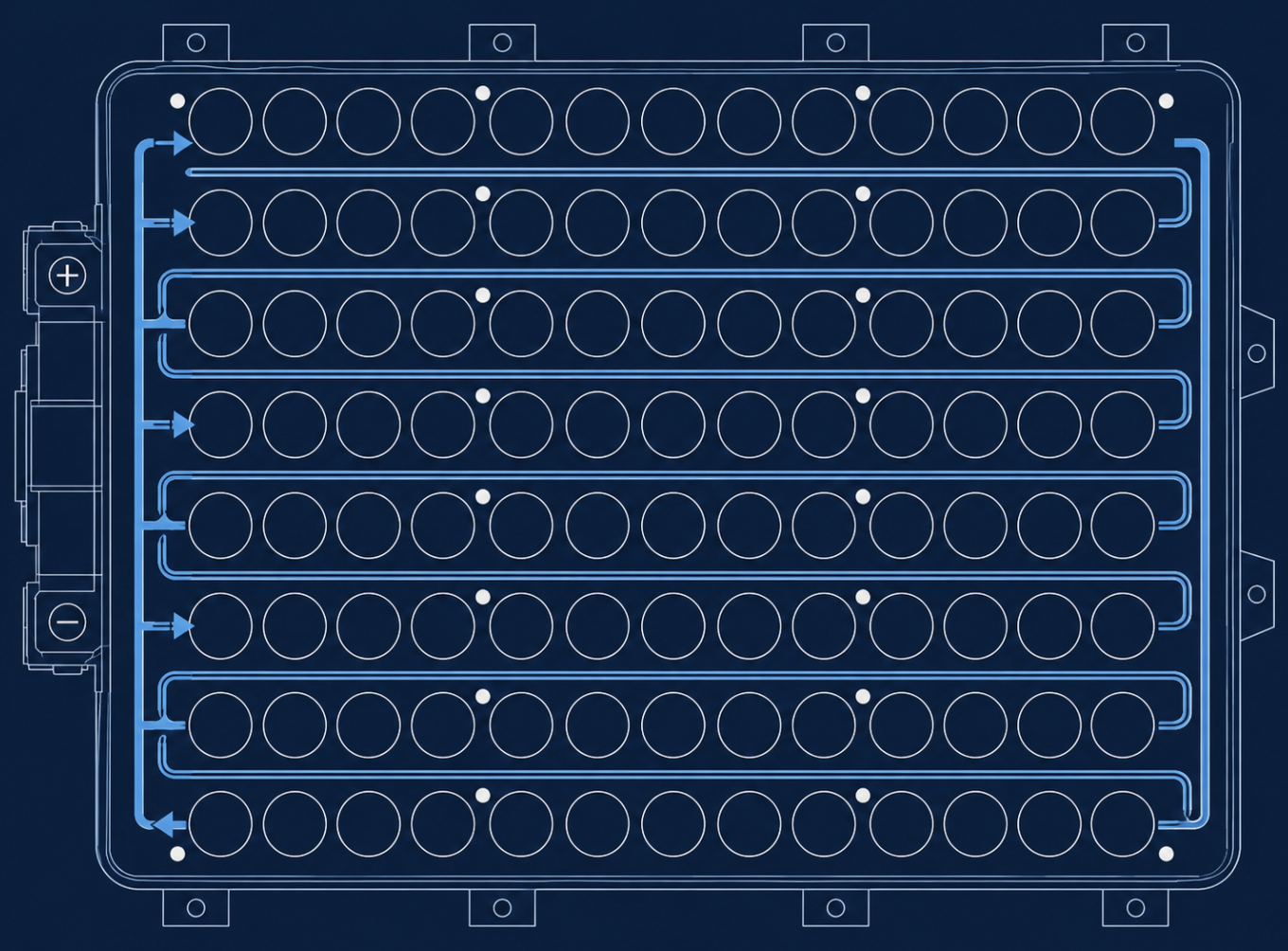
Cooling and heating methods vary by application: liquid cooling offers high efficiency for EVs and other high-power applications by circulating coolant around or through battery modules, while air cooling is simpler and more cost-effective for lower-power or compact systems. Phase change materials can also function at the system level — not just as a TIM at the cell interface — storing and releasing heat to maintain stable temperatures without additional energy input. Many designs combine multiple approaches, pairing liquid cooling with PCM elements for demanding environments.
Beyond the cooling method itself, a complete BTMS typically includes temperature sensors distributed across the pack, feeding data to control algorithms that adjust cooling or heating intensity in real time, along with insulation and safety features — thermal barriers to contain heat spread during fault conditions, pressure relief paths, and fire-retardant materials. These system-level elements work alongside TIM selection rather than in place of it; even a well-designed cooling and sensor architecture can't compensate for a poorly performing interface at the cell level.
Common Selection Mistakes
A few recurring mistakes show up when engineering teams select TIMs for battery applications:
Optimizing for thermal conductivity in isolation. A high conductivity spec looks good on paper, but if the material doesn't compress well against actual surface tolerances, real-world contact resistance can end up worse than a lower-conductivity material that conforms properly to the interface.
Overlooking long-term stability under cycling. A TIM that performs well in initial testing can degrade over a pack's service life — grease-based materials in particular are prone to aging and migration under repeated thermal cycling, which is a meaningful risk for any application with a multi-year service target.
Treating manufacturability as a downstream concern. A material that works in hand-built prototypes can create real bottlenecks once a design moves to automated, high-volume production. Dispensing consistency, cure time, and placement tolerance all need validation against the actual production line, not just a lab bench setup.
Emerging Trends
Battery thermal management continues to evolve alongside battery technology itself. Lightweight, high-conductivity composite and nanomaterial formulations are being developed to improve thermal performance without adding pack weight — a meaningful advantage for both EVs and portable devices. AI-driven thermal modeling and digital twin simulation are increasingly used earlier in the design process to predict hot spots and shorten development cycles before physical prototyping begins.
Fast-charging batteries are pushing TIM formulations toward thinner, more flexible solutions capable of dissipating higher heat loads without adding bulk to the pack. There's also a growing focus on sustainability — recyclable materials, low-VOC adhesives, and environmentally conscious TIM formulations that align with broader green energy initiatives and tightening regulatory requirements across battery-related industries.
Best Practices for Engineers
Effective TIM selection starts earlier in the design process than many teams initially plan for. A few practices consistently reduce risk and rework:
Integrate thermal planning early. Factor in heat flow paths, cooling channel layout, and TIM selection while designing the battery module — not after the mechanical layout is already locked in. Retrofitting thermal solutions into a finished design is where costly rework tends to originate.
Balance cost, performance, and manufacturability together. A TIM that meets every technical requirement on paper but can't scale to production volume, or that carries a cost premium the product can't absorb, isn't a viable solution regardless of its lab performance.
Validate under real-world operating conditions. Testing under varying loads, ambient temperatures, and charging speeds — rather than relying solely on datasheet values from standardized conditions — is the most reliable way to confirm a TIM will perform as expected once the pack is in service.
Conclusion
Battery thermal management is ultimately a system-level engineering problem, but the thermal interface material sitting between cells and cooling structures is where a well-designed cooling system either delivers on its performance targets or falls short of them. Getting the TIM selection right — weighing conductivity against compressibility, validating long-term stability under cycling, and accounting for manufacturability from the start — is what allows the rest of the thermal management system to do its job.
For engineers and procurement teams evaluating TIM options for EV, ESS, or industrial battery applications, matching material selection to the pack's specific thermal budget, mechanical constraints, and service life expectations remains the most reliable path to a reliable, production-ready design.
Contact us to discuss TIM solutions for your battery thermal management application →