Welcome to Taxo Tape
Graphite Films in Power Supply Design: Improving Heat Spreading Efficiency
Introduction
As power supply systems continue to evolve, designers face a constant challenge — higher power density packed into smaller enclosures. Components such as MOSFETs, transformers, and power ICs generate significant heat, while available space for cooling solutions keeps shrinking.
Effective heat spreading has therefore become a critical design factor, not just for efficiency but also for long-term reliability. Traditional metal-based heat spreaders like copper and aluminum offer good performance but add weight and thickness — both undesirable in modern compact systems.
Graphite films have emerged as a new class of thermal management materials, combining exceptional in-plane thermal conductivity with lightweight and flexible form factors. They are now widely adopted in advanced power supply designs to enhance heat uniformity and improve overall system stability.

Understanding Graphite Films
Graphite films are engineered materials composed of either natural graphite or synthetic pyrolytic graphite (PGS). Their layered crystalline structure gives them a unique thermal property:
High in-plane conductivity — efficiently spreads heat along the surface.
Low through-plane conductivity — minimizes heat leakage in undesired directions.
This anisotropic thermal behavior makes graphite films ideal for dissipating heat laterally away from hot components, maintaining uniform temperatures across the module.
Compared with aluminum or copper plates, graphite films offer several advantages:
Up to four times higher in-plane thermal conductivity (up to 1500 W/m·K).
90% lighter than metal alternatives.
Excellent mechanical flexibility and ease of integration in thin designs.
These properties make graphite films a preferred option where traditional metal heat spreaders are impractical due to space or weight constraints.
Thermal Challenges in Power Supply Design
Modern power supply units (PSUs), inverters, and DC-DC converters operate under continuous high loads. As a result, heat buildup in localized regions—especially around MOSFETs, rectifiers, and transformers—can become severe.
Common thermal challenges include:
Hotspot formation: uneven heat dissipation across the board.
Restricted airflow: compact enclosures limit the effectiveness of fans or heatsinks.
Component stress: repeated exposure to high junction temperatures accelerates material fatigue and aging.
Over time, poor heat spreading can lead to efficiency loss, thermal runaway, or premature failure of key components. Thus, designers are increasingly integrating advanced materials like graphite films early in the layout process to maintain temperature balance and extend product lifespan.
Why Graphite Films Are Effective
Graphite films combine high thermal performance with exceptional mechanical and processing advantages, making them particularly effective in power electronics:
Superior thermal conductivity: in-plane values up to 1500 W/m·K, far exceeding most polymeric TIMs.
Ultra-thin and lightweight: typically only 0.025–0.1 mm thick, enabling efficient heat spreading without adding bulk.
Electrical insulation options: coated or composite versions prevent short circuits while maintaining conductivity.
Flexibility: easily conforms to uneven or curved surfaces, allowing close contact between components and heat spreaders.
In compact power modules, these properties help equalize temperature gradients, reduce hotspot intensity, and improve module reliability under thermal cycling.
Integration Strategies in Power Supply Modules
The versatility of graphite films allows for multiple integration methods depending on design goals and assembly processes. Common strategies include:
Between power ICs and chassis: acting as a lateral heat spreader to move heat away from concentrated sources.
Under transformer bases: distributing heat evenly to prevent localized overheating.
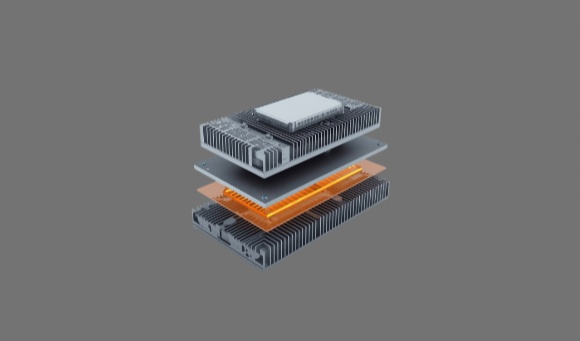
As layered heat spreaders, combined with thermal pads, gels, or phase change materials (PCMs) for hybrid thermal stacks.
For assembly, lamination, or adhesive bonding techniques ensure strong adhesion and minimal contact resistance. Graphite films are also compatible with automated placement and die-cutting, making them suitable for both large-area power boards and compact PSU enclosures.
These integration strategies not only enhance heat dissipation but also simplify the overall thermal design, improving both performance and manufacturability.
Case Example
A leading telecom power supply manufacturer faced recurring issues with thermal imbalance in compact high-power converter modules. The existing aluminum heat spreader provided adequate conduction but failed to equalize temperature distribution across densely packed components.
To address this, the design team replaced the aluminum sheet with a graphite film layer integrated directly under the main power board.
After thermal revalidation, the results were significant:
Temperature uniformity improved across the PCB by over 25%.
Peak local temperature dropped by 8–10°C, mitigating hot spot formation.
Mean Time Between Failures (MTBF) increased notably due to reduced thermal stress.
Additionally, switching to graphite film reduced the total assembly weight by more than 40% and slightly enhanced energy efficiency, thanks to lower operating temperatures and reduced cooling demand.
This case demonstrated how graphite-based solutions not only solve heat management issues but also contribute to lightweight, high-performance product design.
Selection Criteria for Engineers
Choosing the right graphite film depends on balancing thermal performance, mechanical design, and manufacturing needs. Engineers should consider the following parameters:
Thermal Conductivity: Typically ranges from 600 to 1500 W/m·K. Select based on system power density and spreading distance.
Electrical Isolation: Use coated or composite graphite films when insulation is required.
Thickness and Flexibility: Thinner films (25–50 μm) suit compact modules, while thicker layers improve robustness.
Reliability: Ensure resistance to thermal cycling, humidity, and vibration for long-term stability.
Compatibility: Verify bonding compatibility with adhesives, encapsulants, or other TIM layers to prevent delamination.
A well-matched graphite film can significantly improve thermal reliability without compromising structural or electrical performance.
Design and Validation Best Practices
Proper integration of graphite films requires careful design validation to ensure maximum thermal efficiency. Recommended practices include:
Check interface contact quality: minimize surface roughness and contact resistance.
Run thermal simulations: optimize spreading patterns and heat flow paths before physical prototyping.
Perform reliability tests: thermal shock, high-temperature aging, and vibration tests validate long-term durability.
Maintain surface cleanliness: contaminants or oxidation can reduce adhesion and thermal contact effectiveness.
Control pressure during lamination or bonding: excessive pressure may damage the thin graphite layer or alter its conductivity.
These steps help ensure graphite films deliver consistent, reliable heat-spreading performance across production batches.
Conclusion
Graphite films are reshaping how engineers approach thermal design in power supply systems. Their high in-plane conductivity, light weight, and mechanical flexibility enable smaller, cooler, and more efficient devices.
By replacing traditional metal plates or bulky heat sinks, graphite solutions allow designers to manage heat more effectively, reduce component stress, and extend system lifetime.
For optimal results, engineers should evaluate graphite films early in the design stage, in collaboration with thermal interface specialists, to align material properties with the demands of real-world applications.
FAQ
1. What is the thermal conductivity of graphite film?
Graphite films typically range from 600 to 1500 W/m·K in-plane, depending on the formulation and processing method.
2. Can graphite films replace copper or aluminum plates?
Yes, in many cases, graphite provides similar or better heat dissipation with significantly lower weight and thickness, making it ideal for compact power designs.
3. Are graphite films electrically conductive?
Bare graphite is conductive; however, insulated or coated versions are available for applications requiring electrical isolation.
4. How do graphite films perform under high humidity or cycling conditions?
High-quality graphite films maintain thermal stability under temperature cycling and humidity, especially when properly laminated or coated.
5. What applications benefit most from graphite heat spreaders?
Power supplies, inverters, EV chargers, LED drivers, and communication base stations — all benefit from graphite’s superior heat spreading efficiency.