Welcome to Taxo Tape
Graphite Film TIMs – Benefits for Compact Power Supplies
Introduction
The demand for compact and high-efficiency power supplies continues to rise across industries such as LED lighting, consumer adapters, telecom equipment, and electric vehicle (EV) chargers. As devices become smaller and more powerful, designers face a critical challenge: managing heat in increasingly miniaturized systems.
Excessive heat not only reduces efficiency but can also shorten the lifespan of sensitive components like MOSFETs, IGBTs, and capacitors. This makes thermal interface materials (TIMs) an essential element in modern power supply design. TIMs fill microscopic gaps between components and heat sinks, improving heat transfer and preventing thermal bottlenecks.
Among the many TIM options available, graphite film has emerged as an advanced solution. With its unique thermal conductivity, ultra-thin structure, and lightweight profile, graphite film provides significant advantages in compact designs where both space and performance are at a premium.
What is Graphite Film TIM?
Graphite film TIMs are thermal materials engineered from either natural graphite or synthetic (pyrolytic) graphite.
Natural graphite films are made by compressing expanded graphite flakes, offering good thermal performance at a cost-effective level.
Synthetic graphite films are manufactured through high-temperature processes, resulting in extremely high in-plane thermal conductivity, making them suitable for advanced electronics.
The key characteristic of graphite film is its anisotropic thermal conductivity:
In-plane direction: very high conductivity (up to 1700 W/m·K), allowing rapid heat spreading across surfaces.
Through-plane direction: relatively lower conductivity (5–20 W/m·K), which means it is not primarily used for vertical heat transfer but rather for distributing heat laterally.
Compared with traditional TIMs like thermal pads, pastes, or gels, graphite film stands out by offering:
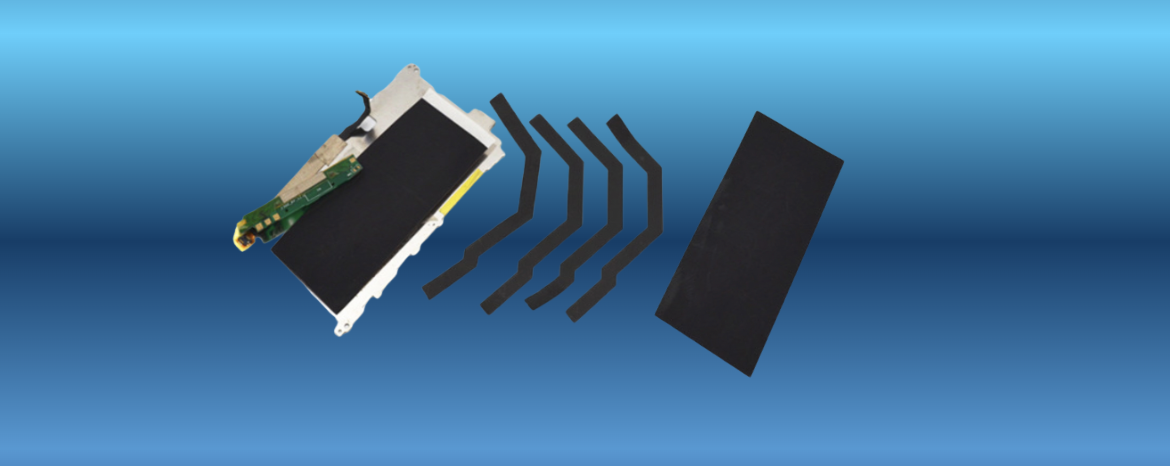
Much thinner profiles, often in the range of 10–100 μm.
Cleaner and more stable performance, with no risk of pump-out or drying.
Superior ability to spread localized heat away from hot spots.
Key Benefits of Graphite Film for Compact Power Supplies
Ultra-thin profile
Graphite films can be as thin as 20–40 μm, making them ideal for power supply units where internal space is extremely limited.
Superior in-plane heat spreading
Unlike pads or greases, graphite film moves heat laterally, effectively reducing hot spots and protecting sensitive components from uneven temperature rise.
Lightweight & flexible
With low density and high flexibility, graphite films add minimal weight, which is especially beneficial in portable adapters, telecom modules, and slim-form-factor electronics.
High thermal stability
Graphite materials maintain performance under repeated thermal cycling, ensuring long-term reliability in demanding applications such as EV chargers or industrial power supplies.
Electromagnetic shielding potential
Beyond thermal performance, graphite film can also contribute to EMI shielding, helping to improve overall system integrity in compact electronic environments.
Application Examples in Compact Power Supplies
Graphite film TIMs are increasingly adopted in compact, high-density power designs:
LED Drivers and Lighting Modules – Graphite film helps spread heat away from LED chips, ensuring stable lumen output and longer lifetime.
Consumer Electronics Adapters – In slim wall chargers and adapters, the ultra-thin profile of graphite films prevents overheating without increasing bulk.
Telecom DC-DC Converters – High-frequency, high-power telecom modules benefit from graphite’s in-plane heat spreading, reducing thermal stress on sensitive components.
Industrial and Medical Power Supplies – For mission-critical equipment, graphite films deliver reliable thermal performance under continuous operation and strict regulatory demands.
Common Challenges & Considerations
While graphite films offer many advantages, engineers must address some challenges in real-world designs:
Electrical Conductivity – Since graphite is inherently conductive, an insulation layer is often required to avoid short circuits.
Handling & Assembly – Pure graphite can be brittle; reinforced or composite versions improve durability for automated assembly.
Cost vs. Performance – Although graphite films bring excellent thermal efficiency, balancing cost at large-scale production is key for consumer and industrial markets.
Graphite Film vs. Other TIMs in Power Supply Design
When compared with conventional TIMs, graphite films stand out in specific areas:
Versus Thermal Pads – Graphite films are thinner and spread heat more effectively, but lack the gap-filling ability of pads.
Versus Pastes and Greases – Graphite provides a cleaner, long-term stable solution without pump-out issues, though it is less conformable for uneven surfaces.
Positioning – Graphite films are not a one-size-fits-all solution. They work best as part of a tailored thermal strategy, complementing other TIMs depending on the design’s geometry and power density.
Conclusion & Recommendation
Graphite film has emerged as a highly effective thermal interface solution for compact, high-power-density power supplies where space and efficiency are critical. Its ultra-thin profile, excellent in-plane heat spreading, and high thermal stability make it especially suitable for LED drivers, telecom converters, and slim adapters.
That said, graphite film is not a universal replacement for all TIMs. In designs with large gaps or where electrical insulation is mandatory, thermal pads, gels, or hybrid solutions may be more appropriate. The most effective strategy is often a combination of TIMs, with graphite film providing targeted heat spreading while other materials handle gap filling or insulation.
For engineers looking to optimize power electronics cooling, we recommend evaluating graphite film TIMs as part of your thermal design toolkit.
Contact us to explore tailored TIM solutions that match your specific application and production requirements.

FAQ
Q1: What makes graphite film different from other TIMs?
Graphite film offers exceptional in-plane thermal conductivity, allowing it to spread heat quickly across a surface, unlike pads or greases that mainly conduct heat vertically.
Q2: Can graphite film replace thermal pads completely?
Not always. Graphite films are ultra-thin and excellent for spreading heat, but they cannot fill large gaps. In many cases, they are used alongside pads or gels rather than replacing them entirely.
Q3: Is graphite film safe for high-voltage power supplies?
Since graphite is electrically conductive, it must be combined with an insulation layer when used in high-voltage or sensitive circuits. Many commercial graphite films are available with protective coatings to ensure safety.
Q4: How to integrate graphite film into mass production?
Reinforced or laminated graphite films are designed for ease of handling in automated assembly. They can be die-cut, laminated with adhesives, or supplied in roll form to fit standard manufacturing processes.