Welcome to Taxo Tape
Designing Efficient Cooling for Server Power Modules Using Graphite Films
Introduction: Rising Thermal Challenges in Server Power Systems
With the rapid growth of high-density data centers and edge computing infrastructure, server power modules are under increasing thermal stress. Components such as PSUs (Power Supply Units) and VRMs (Voltage Regulator Modules) are packing more power into smaller footprints, creating higher heat densities than ever before.
Efficient thermal management is no longer optional—it directly affects conversion efficiency, system uptime, and long-term reliability. Overheating can reduce efficiency, trigger thermal throttling, and even shorten the lifespan of critical components.
To address these challenges, graphite films have emerged as a lightweight, high-performance cooling solution. Their combination of high in-plane thermal conductivity, flexibility, and thin form factor makes them an ideal choice for modern server power systems where space and airflow are limited.

Heat Sources and Thermal Bottlenecks in Server Power Modules
Server power modules generate heat from multiple sources:
MOSFETs and power transistors dissipate energy during switching
Transformers and inductors produce core and winding losses
Power ICs handle voltage regulation and experience conduction losses
Modern server chassis prioritize compactness, leaving minimal airflow and limited surface area for passive cooling. This combination often creates thermal bottlenecks, particularly at interfaces between power components and heat sinks.
The result is localized hotspots, which can reduce conversion efficiency, increase noise, and accelerate material degradation. Without careful thermal design, these hotspots compromise both the performance and lifespan of the module.
Why Graphite Films are Ideal for Power Module Cooling
Graphite films offer several advantages that address these thermal challenges:
Exceptional in-plane thermal conductivity (up to 1500 W/m·K), allowing heat to spread quickly across the module
Ultra-thin, flexible structure, which enables integration in space-constrained designs
Lightweight alternative to traditional metal heat spreaders, reducing system weight without sacrificing performance
Electrical conductivity can be managed with coatings or lamination, providing insulation when required
Environmentally stable and rework-friendly, maintaining performance under temperature cycling, humidity, and mechanical stress
These properties make graphite films particularly suitable for high-density server applications, where lateral heat spreading is critical to avoid hotspots.
Design Considerations When Applying Graphite Films
To maximize performance, engineers must consider several design factors when integrating graphite films:
Thickness and orientation: Proper selection ensures heat spreads efficiently in the desired direction
Interface design: Bonding graphite films to aluminum or copper baseplates improves vertical heat transfer
Uniform pressure: Consistent compression across the interface maintains low thermal resistance and avoids air gaps
Electrical isolation: Laminated or coated films provide insulation for electrically sensitive zones
Compatibility with adhesives, TIMs, and encapsulants: Ensures the film integrates seamlessly without chemical or mechanical degradation
These considerations are critical to achieving reliable and consistent thermal performance across the entire server module.
Case Study 1: Reducing Hotspots in a 2kW Server Power Module
Background:
A 2kW server power module experienced uneven temperature distribution near the VRM area, creating hotspots that threatened efficiency and long-term reliability.
Solution:
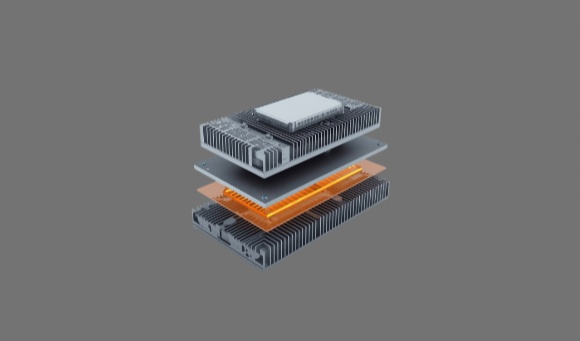
Engineers laminated a graphite film between the heat sink and PCB, providing a lateral heat path to spread energy away from critical hotspots.
Results:
Surface temperature decreased by 12°C
Improved thermal uniformity across the module
Enhanced reliability and reduced risk of thermal throttling
This case demonstrates how a properly applied graphite film can significantly improve heat management in high-density server modules.
Case Study 2: Improving Reliability in Compact Power Supply Units (PSU)
Challenge:
A compact PSU faced space limitations and inefficient forced-air cooling, resulting in elevated temperatures under peak load.
Solution:
A graphite film was integrated beneath the MOSFET array, enabling efficient lateral heat spreading and reducing localized thermal stress.
Test Results:
Conversion efficiency increased by 8%
Component lifespan extended by 20%
Thermal hotspots were mitigated, improving overall PSU reliability
This case highlights the effectiveness of graphite films in compact, high-power applications, where traditional cooling methods may be insufficient.
Integration Tips for Thermal Engineers
Integrating graphite films effectively into server power modules requires careful consideration of both thermal and mechanical factors:
Combine with gap fillers or TIMs for vertical heat transfer: While graphite excels at lateral heat spreading, combining it with thermal interface materials ensures efficient vertical conduction from the component to the heat sink.
Maintain smooth surface finishes: Properly polished and clean surfaces maximize adhesion and minimize thermal resistance at the interface.
Avoid mechanical stress or bending during assembly: Graphite films are thin and flexible but can crack or delaminate under excessive bending or uneven pressure.
Consider hybrid designs with vapor chambers or heat pipes: In high-power modules, integrating graphite films with advanced cooling elements can further reduce hotspots and improve uniform temperature distribution.
By following these guidelines, engineers can achieve maximum heat dissipation while preserving the reliability and longevity of the module.
Validation and Performance Testing
Before full deployment, rigorous testing ensures that graphite films deliver the expected thermal benefits:
Measuring thermal spreading resistance (Rth-spread) and temperature uniformity: Quantitative evaluation verifies lateral heat spreading efficiency.
Thermal imaging comparison: Infrared thermography before and after graphite film integration visually confirms hotspot mitigation and improved temperature distribution.
Reliability testing: Thermal cycling, vibration, and humidity exposure tests simulate real-world server operating conditions to ensure long-term durability.
Data-driven material selection: Comparing graphite grades, lamination methods, and film orientation enables engineers to choose the optimal solution for both performance and manufacturability.
These steps provide confidence that the module will maintain consistent cooling performance under continuous operation.
Conclusion: Optimizing Server Power Efficiency with Graphite Films
Graphite films offer a compact, lightweight, and efficient solution for managing heat in server power modules. They mitigate hotspots, enhance lateral heat spreading, and complement traditional TIMs or heat sinks for improved overall thermal performance.
For high-density servers and edge computing applications, adopting graphite films can increase conversion efficiency, extend component lifespan, and support data center sustainability goals by reducing cooling energy demands.
Looking forward, hybrid cooling designs that combine graphite films with heat pipes, vapor chambers, or phase change materials are poised to address the thermal challenges of next-generation AI and GPU servers, where power density continues to rise.