Welcome to Taxo Tape
Common TIM Application Mistakes and How to Avoid Them
Introduction
In today’s high-performance electronics, managing heat effectively is no longer optional—it is essential. Thermal Interface Materials (TIMs) play a key role in transferring heat away from sensitive components such as CPUs, IGBTs, MOSFETs, and power modules into heat sinks or enclosures. When applied correctly, TIMs significantly reduce thermal resistance and enable stable, efficient operation.
The purpose of this article is to highlight the most common mistakes engineers and technicians make when applying TIMs and provide practical solutions to avoid them. By understanding these pitfalls, companies can improve product reliability, reduce maintenance costs, and ensure long-term system performance.
Why Correct TIM Application Matters
TIMs act as the bridge between heat-generating components and cooling hardware, filling microscopic air gaps that would otherwise trap heat. Without proper application, even the most advanced cooling system cannot perform to its full potential.
Correct use of TIMs leads to:
Lower thermal resistance – ensuring heat moves efficiently from the component to the heat sink.
Improved performance and efficiency – reducing junction temperatures and preventing thermal throttling.
Extended lifespan – keeping components within safe operating limits to avoid premature degradation.
On the other hand, poor TIM application introduces serious risks:
Overheating and hotspots that reduce system efficiency.
Component failure or downtime, leading to costly replacements.
Increased warranty claims and service costs, which directly impact business reputation and profitability.
Common TIM Application Mistakes
Even with the right material, improper application can compromise thermal performance. Below are the most frequent mistakes seen in electronics assembly:
a. Surface Preparation Issues
TIMs rely on intimate contact with component and heat sink surfaces. If those surfaces are dirty, oxidized, or uneven, air gaps remain, blocking efficient heat transfer. Skipping basic cleaning before application is one of the fastest ways to reduce TIM effectiveness.
b. Over-Application or Under-Application
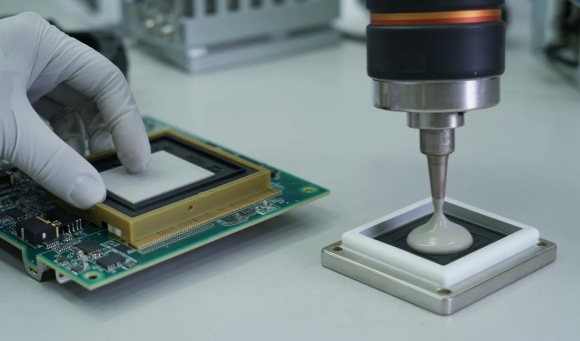
Both extremes create problems. Applying too much TIM can lead to pump-out during operation, contaminating nearby components and reducing long-term stability. Too little TIM leaves uncovered areas, causing hotspots and higher junction temperatures.
c. Wrong Thickness or Material Selection
Not all TIMs are interchangeable. Using a thermal pad that is too thick increases thermal resistance, while a pad that is too thin may not bridge component tolerances. Similarly, selecting the wrong material—for example, grease where a gap pad is needed—can lead to poor heat dissipation in high-power designs.
d. Inconsistent Pressure and Mounting
Even distribution of pressure is crucial. Uneven clamping force can trap voids within the TIM layer, while insufficient contact prevents the material from spreading properly across the surface. Both issues raise thermal resistance and limit cooling effectiveness.
e. Ignoring Long-Term Reliability
A TIM that performs well in initial testing may fail under real-world conditions. Without validation under thermal cycling, humidity, and vibration, materials may dry out, crack, or migrate. Selecting a TIM only by datasheet values, without reliability testing, is a costly oversight.
How to Avoid These Mistakes
Preventing TIM-related failures requires careful attention during design and assembly:
Surface Preparation: Always clean and flatten contact surfaces before applying TIM to ensure maximum contact.
Optimal Application Quantity: Follow manufacturer recommendations for thickness and coverage; avoid “more is better” thinking.
Material Selection Based on Testing: Choose TIMs that have been validated in your application environment, not just on paper specifications.
Proper Mounting Pressure: Use even clamping force or torque specifications to achieve uniform coverage and avoid trapped voids.
Reliability Considerations: Test TIMs under accelerated aging conditions such as temperature cycling, humidity exposure, and vibration to confirm long-term performance.
By applying these practices, engineers can significantly improve thermal performance, reduce system failures, and extend product lifetime.
Case Example: Avoiding TIM Failures in Power Electronics
A power electronics manufacturer faced reliability issues in an industrial inverter system. During high-load operation, the IGBT module consistently overheated, causing efficiency losses and occasional shutdowns.
Upon investigation, engineers found the root cause: TIM was applied unevenly, leaving voids that trapped heat. The team corrected the issue by switching to an optimized thermal gap pad with higher conductivity and by standardizing the assembly process to ensure uniform mounting pressure.
Results:
Junction temperature decreased by more than 10°C.
System reliability improved, with fewer thermal shutdowns.
Product lifetime and customer satisfaction increased significantly.
Conclusion
Avoiding common TIM application mistakes is not just about improving heat transfer—it directly reduces system failures, warranty costs, and long-term maintenance expenses. With proper material selection, precise application methods, and thorough reliability testing, TIMs can ensure stable, efficient operation of high-power electronics.
Call-to-action: Engineers and procurement teams are encouraged to consult with TIM specialists early in the design stage to select the right solution and avoid costly errors down the line.
FAQ
What happens if TIM is applied incorrectly?
Improper application can lead to hotspots, overheating, reduced efficiency, and even permanent component failure.
How much TIM should I use for CPUs or power modules?
Only enough to create a thin, uniform layer that fills microscopic gaps. Too much TIM increases thermal resistance, while too little leaves air pockets.
Can too much TIM damage components?
Yes. Excessive TIM can cause pump-out, contaminate surrounding areas, and increase pressure on delicate parts.
What’s the best way to check if TIM is applied correctly?
Thermal resistance measurements, infrared imaging, and controlled reliability testing are the most effective methods.